
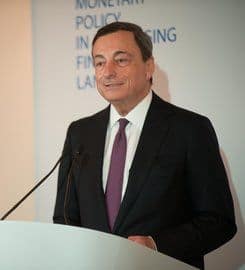
Mario Draghi, President of the European Central Bank (ECB), warned that expectations of extremely low inflation, or even deflation could encourage Eurozone businesses and consumers to postpone purchases.
Economists worldwide expect the ECB to take measures soon to boost economic growth and spending.
Mr. Draghi delivered his comments at the ECB Conference on Central Banking in Sintra, Portugal. He said the ECB is carefully monitoring data and is considering a range of measures, including reducing interest rates, new bank loans, and even a Fed-like asset buying program to prevent ultralow inflation from stifling the Eurozone’s fragile economic rebound.
ECB may act soon
The ECB is likely to respond soon, Mr. Draghi said today, because there is a time lag between any measures taken and their visible effects on the economy.
Mr. Draghi said:
“What we need to be particularly watchful for at the moment is the potential for a negative spiral to take hold between low inflation, falling inflation expectations and credit, in particular in stressed countries.”
He said he is concerned that disinflationary expectations might take hold, causing consumers and businesses to postpone purchases and investments “in a classic deflationary cycle.”
ECB to consider policy change
On Thursday, May 8th, Mr. Draghi hinted that the ECB was about to consider a policy change as the Eurozone faced long-term ultralow inflation.
Although the ECB’s Governing Council voted to keep interest rates where they were, he stressed that the central bank is not resigned to low inflation. Financial markets have since been expecting imminent ECB rate cuts and other stimulus measures.
Draghi had said earlier this month that his ECB team wanted to wait for updated growth and inflation forecasts for the next two years, which they receive every quarter.
If the ECB eventually goes for negative interest rates, it would mean banks would have to pay for keeping surplus funds at the ECB.
Over the last few weeks the euro has weakened against the dollar and other major currencies as expectations grow of new ECB stimulus.
The European Central Bank has a target of 2% annual inflation for the Eurozone. Inflation in April was 0.7%, and has remained below 1% for several months. Draghi said that falling commodity prices have kept inflation down since the last quarter of 2011. Several peripheral Eurozone economies have been reducing labor and other costs, which have also weighed down on the CPI (consumer price index).
Why is ultralow inflation undesirable?
When inflation is high, consumers and businesses spend more money immediately, because they expect prices to rise soon. When inflation is super low, or when there is deflation (falling prices), people postpone their purchase because they expect to get better deals if they wait.
If people and businesses postpone their spending, shops and other businesses earn less and the economy slows down; eventually unemployment rises, wages fall, and a spiral (vicious circle) ensues. This happened in Japan and affected the country for more than two decades.
Regarding the Eurozone’s current persistent, ultralow inflation rate, Mr. Draghi said “This is fertile ground for a pernicious negative spiral, which then also affects expectations.”
The ECB’s latest forecast sees inflation rising to 1.6% in 2016. However, many economists think otherwise. Peter Praet, the ECB’s chief economist, recently said that since the beginning of 2014 inflation has been lower than forecast. The 2016 inflation predictions are based on higher rates for the first few months of this year.
Several European countries – Croatia, Slovakia, Bulgaria, Greece, Cyprus, Portugal, Spain and Sweden – have reported declining prices. Even Switzerland, a non-EU nation, is experiencing deflation.
Anti-EU parties surge in European elections
Anti-EU (European Union) and nationalist parties across Europe did extremely well in the European parliament elections on Sunday. One of their arguments is that the ECB is distant, bureaucratic and bent on tight monetary policy.
They also say that the euro will eventually fail because there are too many different types of economies in the Eurozone.
Peripheral countries cannot devalue their currency like they could in the past and end up accumulating massive deficits and unemployment, while Germany builds up a huge trade surplus because it cannot revalue its currency, i.e. they say the euro is too expensive for the peripheral nations and too cheap for Germany.
