
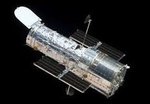
The Hubble Space Telescope has discovered that a gigantic eruption occurred at the heart of our Milky Way galaxy about 2 million years ago, that drove gases and other material outward at a speed of about 2 million miles per hour (3.21 million kph).
Astronomers today are witnessing the outcome of that explosion: fanning clouds of gas towering approximately 30,000 light-years below and above the plane of the Milky Way.
The massive structure was discovered five years ago as a gamma-ray glow on the sky in the direction of the center of the galaxy. The balloon-like features have been observed in radio waves and X-rays since then.
However, in order to measure the speed and composition of the mystery lobes, the scientists needed NASA’s Hubble Space Telescope. They are now trying to calculate the mass of the material that is being blown out of our galaxy, which would help them determine what caused the outburst.
Astronomers believe the two lobes were either caused by a firestorm star birth at the center of the Milky Way or the eruption of its ultra-massive black hole.
Thanks to the Hubble Space Telescope, scientists now can get a unique, close-up view of the Milky Way’s own fireworks.

This image shows how the Hubble Space Telescope probed light from a distant quasar to analyze the Fermi Bubbles, two lobes of material that are being blown out of the Milky Way’s core. Credit: NASA, ESA, and A. Feild (STScI).
Lead researcher, Dr Andrew J. Fox, of the Space Telescope Science Institute in Baltimore, Maryland, said:
“When you look at the centers of other galaxies, the outflows appear much smaller because the galaxies are farther away. But the outflowing clouds we’re seeing are only 25,000 light-years away in our galaxy. We have a front-row seat.”
“We can study the details of these structures. We can look at how big the bubbles are and can measure how much of the sky they are covering.”
The team’s results were presented at the American Astronomical Society meeting in Seattle, and will be published in The Astrophysical Journal Letters.
The Fermi Bubbles (the giant lobes) were first detected using NASA’s Fermi Gamma-ray Space Telescope. The presence of high-energy gamma rays suggested that a violent event in the Milky Way’s core aggressively launched energized gas into space.
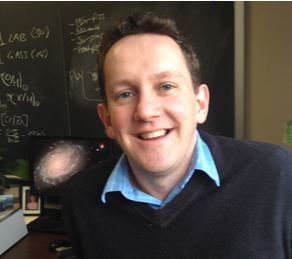
Dr. Fox is an astronomer at the Space Telescope Science Institute in Baltimore, the scientific home of the Hubble Space Telescope and the James Webb Space Telescope. (Photo: Space Telescope Science Institute)
Dr. Fox used Hubble’s COS (Cosmic Origins Spectrograph) to probe the ultraviolet light from a distant quasar (a very remote and extremely bright mass of energy and light) that lies behind the base of the northern bubble. With the help of COS, the scientists can gather data from the light as it travels through the lobe regarding the composition, speed and temperature of the expanding gas within the bubble.
Dr. Fox and colleagues were able to measure that the gas on the far side of the bubble is moving away from Earth while the gas on the near side is moving toward us. COS spectra show that the gas is speeding through the galactic center at about 2 million mph (3.21 million kph).
Co-author Rongmon Bordoloi, of the Space Telescope Science Institute, said:
“This is exactly the signature we knew we would get if this was a bipolar outflow. This is the closest sightline we have to the galaxy’s center where we can see the bubble being blown outward and energized.”
For the first time, the COS observations also measured the composition of the material being swept up in the gaseous cloud. Aluminum, carbon and silicon were detected, suggesting that the gas is enriched with heavy elements produced within stars, and represents the fossil remnants from when stars were being formed.
The gas is estimated to have a temperature of about 17,500 °F, which is considerably cooler than most of the super-hot gas in the outflow, which is believed to be around 18,000,000 °F.
Dr. Fox explained:
“We are seeing cooler gas, perhaps interstellar gas in our galaxy’s disk, being swept up into that hot outflow.”
Regarding the outflows, Dr. Fox said:
“It looks like the outflows are a hiccup. There may have been repeated ejections of material that have blown up, and we’re catching the latest one. By studying the light from the other quasars in our program, we may be able to detect the fossils of previous outflows.”
“It looks like there’s a link between the amount of star formation and whether or not these outflows happen,” Dr. Fox said. “Although the Milky Way overall currently produces a moderate one to two stars a year, there is a high concentration of star formation close to the core of the galaxy.”
