

Changes in the Arctic caused by human-induced global warming will lead to countries in the Northern hemisphere’s mid-latitudes having longer periods of extreme heat and droughts during the summer months, researchers from the Potsdam Institute for Climate Impact Research found in a new study.
Northern Hemisphere mid-latitude nations (northern countries with a temperate climate) include most of Europe (excl. northern Scandinavia), most of the US (excl some southern sates and northern Alaska), most of Canada (excl. the far north), northern China, Mongolia, most of Russia (excl. the far north), and most of Japan (excl. its most southerly island).
Lead author Dim Coumou and colleagues published their findings in the academic journal Science (citation below).
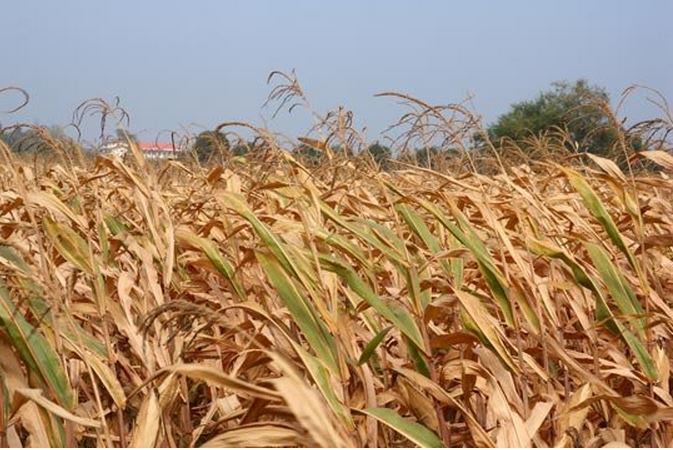
Periods of extreme heat and drought in the summer months will become more common the Northern Hemisphere.
Mr. Coumou said:
“When the great air streams in the sky above us get disturbed by climate change, this can have severe effects on the ground. While you might expect reduced storm activity to be something good, it turns out that this reduction leads to a greater persistence of weather systems in the Northern hemisphere mid-latitudes.”
“In summer, storms transport moist and cool air from the oceans to the continents bringing relief after periods of oppressive heat. Slack periods, in contrast, make warm weather conditions endure, resulting in the buildup of heat and drought.”
Climate change may undermine warm season circulation further
Other studies have concentrated mainly on winter storms, because they tend to cause the most damage. While regionally the incidence or intensity of winter storms may vary, on average storm activity during the colder months remains largely steady.
In the warmer months (summer), however, there has been a clear decline in overall storm activity, according to observational data coming from weather stations and satellites. This means summer storms are either becoming less frequent, less intense, or both.
The research team studied specific types of turbulences called synoptic eddies, and worked out the total energy in their wind speeds.
This energy, which is a measure of the interaction between intensity and frequency of low and high pressure systems in the atmosphere, declined by approximately one-tenth since 1979.
Co-author Jascha Lehmann said:
“Unabated climate change will probably further weaken summer circulation patterns which could thus aggravate the risk of heat waves.”
“Remarkably, climate simulations for the next decades, the CMIP5, show the same link that we found in observations. So the warm temperature extremes we’ve experienced in recent years might be just a beginning.”
Warming arctic may be driving circulation changes
The researchers believe that rapid warming in the Arctic could be driving the observed changes in circulation. While greenhouse-gas emissions from burning fossil fuels pushes up temperatures globally, in the far north this warming is faster.
Far northern parts of the planet that were covered in ice but now are ice free are darker in colour (than white ice), and consequently reflect less sunlight back into space.
This leads to warmer water which raises the temperature of the air. This is turn reduces the atmospheric temperature difference between the cold polar region and the rest of the Northern Hemisphere.
For air motion to occur you need a temperature difference – the greater the difference the more the air moves. If this difference gets smaller, the jet-stream weakens, the researchers explained. They believe this weakening is linked to the observed decline in summer storm activity.
Mr. Coumou said:
“From whichever angle we look at the heat extremes, the evidence we find points in the same direction. The heat extremes do not just increase because we’re warming the planet, but because climate change disturbs airstreams that are important for shaping our weather.”
“The reduced day-to-day variability that we observed makes weather more persistent, resulting in heat extremes on monthly timescales. So the risk of high-impact heat waves is likely to increase.”
Citation: “The weakening summer circulation in the Northern Hemisphere mid-latitudes,” Dim Coumou, Jascha Lehmann, and Johanna Beckmann. Science. Published online 12 March, 2015. DOI:10.1126/science.1261768.
