
The UK’s Office of Rail Regulation (ORR) has criticized Network Rail for a string of shortcomings, and expressed concern at the reliability of some of the company’s data, which it relies on to make decisions regarding punctuality and financial performance.
The ORR described Network Rail’s quality of data as “unreliable”, especially those related to bridges, structures and earthworks. These poor quality data could be undermining its efforts when trying to meet its funded targets, the economic and safety regulator added.
National train punctuality, which is currently at 89.1%, is 0.7 of a percentage point below what was expected at this point. While progress has been noted on Network Rail’s two-year performance recovery plan, it has not had the desired impact on punctuality, the ORR points out.
With over one in every ten trains running late, the report showed that passengers had to endure thousands of extra delays and cancellations during the Apr-Oct period because of Network Rail’s weak performance.
The ORR has told the railway company to address this “underperformance”.
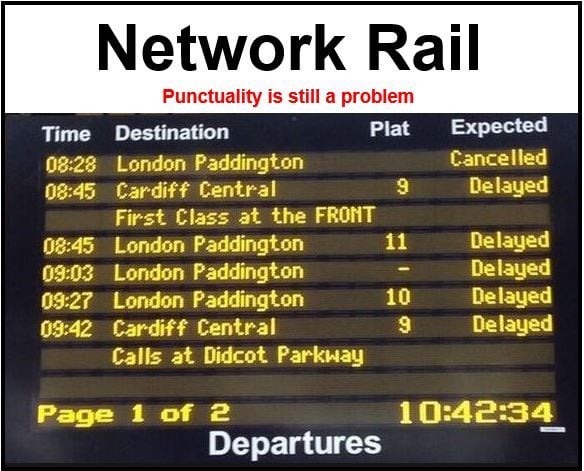
Millions of rail passengers face frustrating delays and have to pay Europe’s highest prices to travel.
According to the ORR, train service overall is “below expectations”. It did praise Network Rail, however, for making good progress in reducing safety risk as level crossings, which was achieved mainly through a program of closures as well as the implementation of new technology, better systems, and more effective risk assessment.
ORR wonders about Network Rail’s ability
Network Rail is criticized for failing to make the expected progress in the early stages of some improvement projects, including the strategic freight network at Ipswich Yard, and the second phase of the Barry to Cardiff Street corridor.
The ORR even wonders whether the owner and operator of most of the rail infrastructure in the UK has the ability to deliver the ambitious enhancements program.
Network Rail has been instructed to produce an improvement plan laying out how it will make up for the delays.
ORR chief executive Richard Price said:
“At ORR we have changed our approach to regulating train punctuality and the performance of the network – focusing on the indicators that will tell us more about Network Rail’s likely performance trajectory. This enables us to predict whether Network Rail’s work in the coming months will put matters right for passengers. This is vital as too many people are facing too many delays. It is the biggest source of dissatisfaction with the railways, and the industry needs to tackle the problem.”
“ORR is also concerned about the reliability of some of the information Network Rail depends upon to take decisions about how to achieve and sustain the high levels of punctuality and financial performance. Network Rail has made progress in some of these areas, but not in all of them. Without up-to-date knowledge, Network Rail will not have sufficient understanding of how and why its assets fail and its maintenance approach will remain reactive – leading to inefficiencies and hindering its efforts to improve punctuality. The new management at the company has made it clear that it shares our concerns and has committed to address these issues.”
Unions also criticize Network Rail
Head of the TSSA rail union, Manuel Cortes, said Network Rail is failing millions of passengers with over 10% of services running late, despite the massive £38 billion investment by the taxpayer over the next five years. “They need to up their game, especially when you take into account that those long-suffering passengers are paying the highest fares in Europe,” he added.
CEO of Network Rail, Mark Carne admitted that there are too many passengers who are not receiving the level of reliability they have a right to expect.
Mr. Carnes said:
“Increasing capacity on a complex network, at the same time as keeping it running every day, is the challenge we face. We have clear strategies to deliver the improvements required. We will publish a transparent, detailed business review every quarter, measuring its performance against key targets.”
