
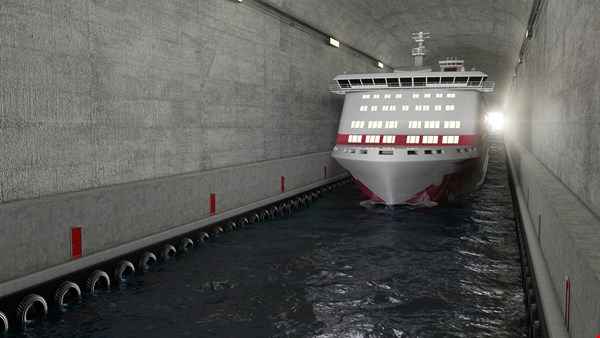
An ambitious project to build the world’s first ship tunnel is now officially part of Norway’s national transport plan, and funding for the first phase is now in place.
The Stad Ship Tunnel project plans to build a tunnel of length 1.7 km (1.1 miles), height 37 metres (121 feet), and width 26.5 metres (87 feet) through the narrowest point of the Stadlandet peninsula in the west of Norway.
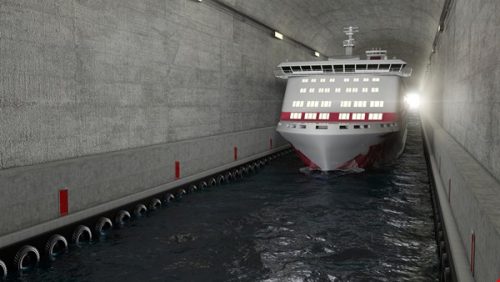 The ship tunnel will be large enough to accommodate the passenger steamers that travel along Norway’s coastline. Image: Norwegian Coastal Administration
The purpose of the project is to allow cargo, passenger, and recreational vessels to navigate more safely through the Stadhavet Sea, the most exposed and perilous stretch of sea along Norway’s coast.
The planned size of the ship tunnel will allow passage of vessels as large as the Hurtigruten coastal steamers that are popular with tourists.
The Norwegian Coastal Administration (NCA or Kystverket) recently announced that the project now forms part of the 2018-2029 Norwegian National Transport Plan (NTP).
Funding for first phase in place
The total cost of the project is likely to be at least 2.7bn krone (£252m, $310m). A sum of 1.5bn krone (£140m, $170m) for the first phase (2018-2023) is now in place.
Terje Andreassen, NCA’s project manager for the ship tunnel, says: “There are still many pieces of the puzzle that needs to be put into place before construction can start, but we have previously stated that the actual construction could be at the earliest in 2019.”
 The plan is for the ship tunnel to cut through the narrowest point of the Stadlandet peninsula.
Image: Norwegian Coastal Administration
Construction is likely to take 3-4 years, and will remove about 3 million square metres of solid rock, equivalent to around 8 million tons.
Passenger ships will have priority
The plan is to control traffic through the tunnel using white and red lights to indicate when it is safe/unsafe to enter. Ships will likely be allocated a time slot – similar to the system for controlling commercial aircraft at an airport.
Commercial vessels – especially passenger ships – will have priority. Leisure boats will most likely be given specific slot times.
 Fended pathways inside the ship tunnel will protect vessels from scraping the sides and provide emergency exits for people. Image: Norwegian Coastal Administration
There will be no charge for use of the ship tunnel, although vessels over 70m will have to comply with the law and hire a pilot – unless they have an exemption certificate.
The likely speed limit through the ship tunnel will be 8 knots for speed boats – giving a voyage time of 10 minutes. The speed limit for other vessels is likely to be set at 5 knots.
Fended pathways on each side
To prevent the sides of vessels from scraping on the tunnel walls, there will be a 3.5m fended pathway on each side of the tunnel. This will also provide an evacuation route for emergency use. The NCA say this will not be available for people who just want to walk through the tunnel.
Since NCA announced the ship tunnel project, there has been a lot of interest from other parts of Norway and other countries.
Andreassen says: “We expect the interest to become even greater when the actual construction begins.”
Video – Stad Ship Tunnel
The following video from NCA outlines the plan for the Stad Ship Tunnel.
