

An Oracle MICROS Systems deal worth more than $5 billion is getting closer, as Oracle CEO, Larry Ellison, moves to add software for restaurants and hotels in his quest to reverse ten quarters of slowing growth. According to Bloomberg, Oracle and MICROS are in “exclusive talks”.
Oracle was a latecomer to the Internet-based cloud software market and is now paying the price as its customers move to Web-based computing. Ellison’s strategy is to hasten the catch-up through acquisitions.
Update: June 21, 2014: Oracle’s 4th quarter net income declined by four percent to $3.6 billion compared the previous Q4.
Oracle’s biggest purchase
Over the last ten years, Oracle has spent about $50 billion buying up about 100 companies, twenty of which were specialized in specific industries. If the purchase goes through, it will be Oracle’s biggest takeover since buying out Sun Microsystems in 2009 for $5.7 billion.
MICROS Systems Inc., based in Columbia, Maryland, manufactures and sells computer software, hardware, and services for the hospitality, hotel, restaurant and other specialty retail markets. The company started in 1977 as Picos Manufacturing, and changed to MICROS Systems Inc. in 1978. “MICROS” is an acronym for Modular Integrated Cash Register Operating Systems.
In 2013, MICROS achieved $1.3 billion in sales and a profit of $171 million. Its revenue rose by 10.7% over a 12-month period, higher than the industry’s average of 7.5%.
MICROS stocks up
MICROS Systems share price soared by about $9, more than 16%, on Tuesday after news of a possible Oracle takeover came out, helping the final price tag to move well above Oracle’s planned $5 billion.
According to several media sources, Oracle nearly acquired MICROS six years ago. The then MICROS chairman and CEO, Tom Giannopoulos, flew to Oracle’s headquarters in Redwood City, California, to finalize the deal, which eventually fell through.
The number of mergers and acquisitions in the technology space is speeding up as traditional software firms try to respond to customers’ shift to cloud computing. Last week, SanDisk Corp. and Fusion-io Inc. came to a deal worth approximately $1.1 billion. Fusion-io provides storage to Apple and Facebook.
Oracle publishes earnings for the last quarter this coming Thursday. In the previous quarter, revenues for license and cloud-subscription were lower than analysts had forecast.
Oracle needs more fuel in the tank
In an interview with Bloomberg, Daniel Ives, an analyst at FBR Capital Markets & Co., said:
“This would really be an acquisition for their retail arm and it would add another leg to their growth stool as they are more focused on their e-commerce and cloud strategy. They haven’t really made a big acquisition in the last few years and they need more fuel in the tank.”
Mr. Ives rates Oracle the equivalent of a buy.
According to industry analysts, MICROS’ business has grown evenly in its two main divisions:
- management software for hotels, and
- point of sales for restaurants and retail outlets.
By joining Oracle’s $190-billion business, MICROS could expand into new markets and other countries.
MICROS is already a reseller of Oracle database. The acquisition would allow Oracle to work directly with MICROS customers including Ben & Jerry’s, Burger King, IHOP, Hyatt, Marriot and Hilton.
Mr. Ellison says his company plans to compete aggressively against those currently offering cloud-based technology infrastructures, such as Rackspace Hostings and Amazon.com.
About Oracle Corporation
Oracle Corporation is one of the world’s biggest software giants. It develops and markets database development tools, hardware systems and software products.
The company was founded by Larry Ellison, Ed Oates and Bob Miner in 1977, and was called Software Development Laboratories. In 1979 the name was changed to Relational Software Inc., and the first Oracle database software ran on PDP-11 hardware.
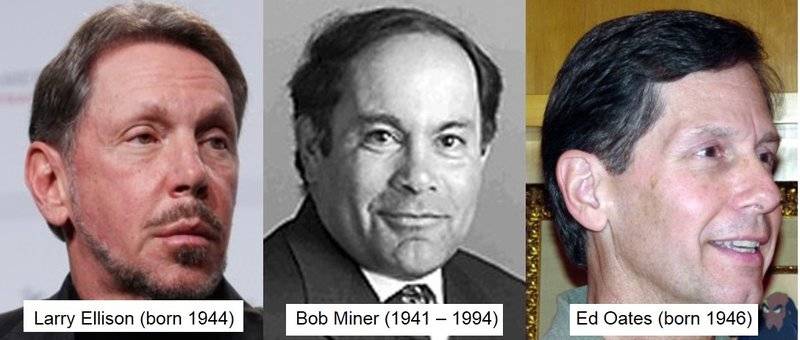
Oracle founders.
As the software was a great success, the founders wanted to change the company name to something more closely linked to its primary products. They changed the name to Oracle Systems Corporation in 1982.
Oracle was floated in 1986.
In 1989, Oracle predicted an Internet boom and started to prepare for it. The company developed database support of online transaction processing. In that year the head office was moved to Redwood Shores, California.
The company name was changed to Oracle Corporation in 1995.
In 1998, Larry Ellison said:
“If the internet turns out not to be the future of computing, we’re toast. But if it is, we’re golden.”
