

featured-image-standard-abstract-lines-dots-nodes-connecting

An overview of the US economy in 2014

Written by Joseph Nordqvist

Published: 14:39, August 28, 2014

The United States is showing signs of recovery after the Great Recession. A recession that not only had a hugely devastating economic impact in the US, but also the entire world.

However, despite improvements in many aspects of the economy, there are still lingering effects of the financial crisis that millions of American continue to face.

This article analyzes the economic position of the country in 2014, highlights the areas it has improved in since late 2009, and attempts to provide a general picture of the economy.

Unemployment

In 2009 the unemployment rate in the US reached a high of approximately 10%. This has improved vastly, with a June 2014 statistic released by the Bureau of Labor Statistics revealing that unemployment is at 6.2 percent, which is comparable to the unemployment rate in mid-to-late 2008.

Below is a chart from the Labor Force Statistics from the Current Population Survey, which reveals the unemployment rate for Americans aged 16 years and over since 2004:
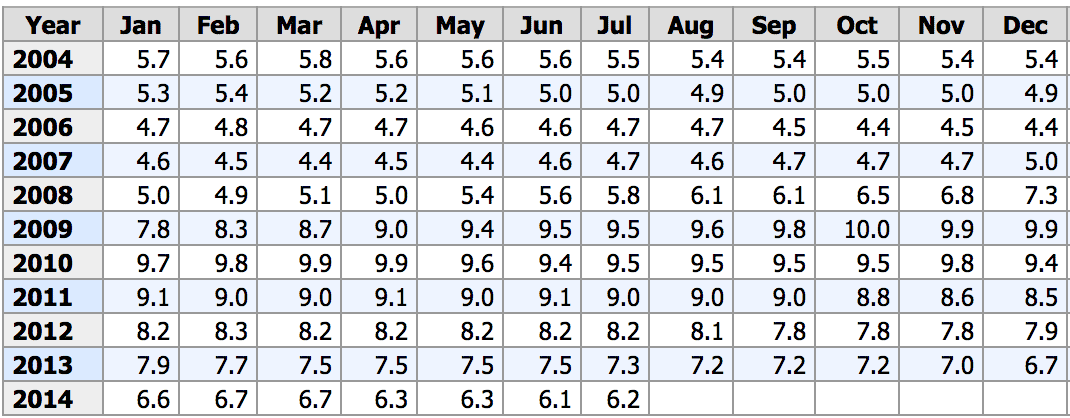
Unemployment in the US

Gross Domestic Product

In the first quarter of 2014 real GDP decreased by 2.1%. In the second quarter real GDP increased by 4.0%. Therefore, there has been no ‘consistent growth’ in the country’s economic output this year so far. The second quarter growth was mainly fueled by an increase in exports, good performance in residential fixed investments, and government spending.

The chart below shows how much the US GDP has changed (on a quarterly basis) since 2010.

It is important to note that since late 2010 the average rate of real GDP growth (on a quarterly basis) is approximately 2%.

US GDP Growth

Personal Income

Personal income has been steadily increasing and for the first time in three years there have been two consecutive quarters of income above $14,400.

Personal income for the first quarter of 2014 was $14,488.3 and for the second quarter it was $14,696.3.

This is promising as personal income is also a major driver of consumer spending, household borrowing and property prices.

Personal Income in the US


Joseph Nordqvist Avatar

Other News

Digital tools could reshape women’s entrepreneurship, suggest researchers

Aug 5, 2026

Success can make people learn less from their own mistakes, study suggests

Aug 5, 2026

Shopify data suggests AI search is giving niche products a new route to customers

Aug 5, 2026

Customer data is moving deeper into pricing decisions

Aug 5, 2026

Texas pauses data-center grid connection approvals as power queue reaches 474 gigawatts

Aug 4, 2026

Japan tests whether carbon pulled from seawater can fuel planes

Aug 4, 2026

Expressive robots engage people more, but their mistakes carry a higher social cost

Aug 4, 2026

Employees reported a better work experience after hybrid work was introduced

Aug 4, 2026

Tomato gene helps plants recover after drought in controlled tests

Aug 4, 2026

New process could reduce the need to purify factory carbon dioxide before reuse

Aug 4, 2026

More novel drugs gained revenue faster in the U.S. after 2013

Aug 3, 2026

Why the right decade matters: new research could help advertisers use nostalgia more effectively

Aug 3, 2026

Could flexible working unlock a new generation of women leaders in family businesses?

Aug 3, 2026

Can waste become the world’s next fire-resistant building material?

Aug 3, 2026

Public R&D spending can boost the economy before the money is even spent, study finds

Aug 2, 2026

Boehringer Ingelheim’s Mexico City expansion targets 5 billion tablets a year

Aug 2, 2026

Why more accurate AI forecasts don’t always make better investment decisions

Aug 1, 2026

The AI boom is inheriting the geography of America’s old energy economy

Jul 31, 2026

Brands scale AI investment as consumers place greater value on reliability, survey finds

Jul 30, 2026

Customers may praise products they helped create even when they fail

Jul 30, 2026