
Post-Brexit pessimism affects nearly half of UK employees, according to a new survey of how they felt about the future following the 23rd June UK referendum vote to leave the European Union.
Overall, while 44 percent of respondents to the survey of 1,045 UK workers expressed post-Brexit pessimism, the feeling was much higher among younger workers aged 25-34 (63 percent), public sector workers (61 percent), and voluntary sector workers (58 percent).
The survey from CIPD, the professional body for HR and people development, also found that 22 percent of employees feel their jobs are less secure, compared with only 3 percent who said they feel more secure about their jobs following the Brexit vote.
Again, feelings about job insecurity were higher among public sector employees – 33 percent of whom said they feel less secure following the referendum.
Perhaps feelings of insecurity are triggering concerns about employability, as around one in five (21 percent) of respondents also said they felt they needed to update their skills following the Brexit vote.
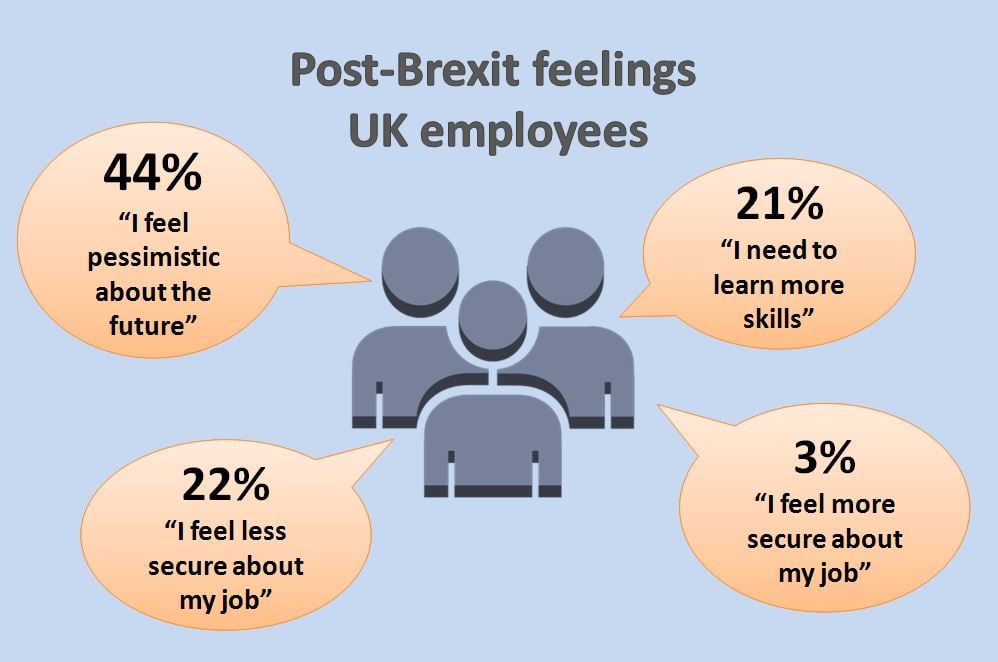
The survey asked just over 1,000 working adults in the UK how they felt about the future as a result of the Brexit referendum vote to leave the European Union. (Data from CIPD survey)
Ben Willmott, CIPD’s Head of Public Policy says he hopes that as the political and economic situation becomes clearer, these high levels of post-Brexit pessimism – particularly among public and voluntary sector workers – will subside.
‘Clear signs of worry in the UK workforce’
However, Willmott urges that “in the short term there is a clear need for UK employers to do more to engage with their workforce about the likely effects of Brexit on their organisation.”
“The survey exposes clear signs of worry among the UK workforce and, if left unchecked, could lead to associated issues such as stress and anxiety,” he adds.
Willmott sees the fact employees feel they should update their skills following the referendum as a positive sign, revealing that they are “engaged with their learning and development needs.”
However, countering this is the risk that employers may cut back on training and development due to uncertainty about Brexit. But for the benefit of staff and organizational resilience, Willmott urges against it.
Harassment and bullying
The CIPD survey also asked employees about workplace incidents of harassment and bullying related to the Brexit decision and found:
– 13 percent said they had either experienced, witnessed or heard about incidents of harassment or bullying of a political nature.
– 7 percent referred to incidents of a racist nature related to the Brexit decision.
Willmott says the racial and political divisions arising in the workplace post-Brexit are a cause for concern.
Employers need to nip this in the bud, he urges. They need to take a “zero-tolerance” approach to any workplace conflicts that are racially or politically motivated and ensure their workers have an open environment where they feel welcome.
Willmott says line managers have an important role to play in a climate of post-Brexit pessimism, in ensuring “that the wellbeing of their staff is front and centre in their minds, and that their organization has the correct culture and structure in place where people can easily raise their concerns and be heard.”
Priority HR areas for employers
There appears to be a mix of post-Brexit pessimism and optimism in the UK labour market.
Last week, Lloyds Banking Group announced they will be axing 3,000 jobs and closing an additional 200 branches by the end of 2017, despite returning better than expected first-half-year pretax profits.
At the same time, McDonald’s said they were creating 5,000 jobs over the next 18 months, despite what the burger giant describes as challenging economic conditions.
Meanwhile, the CIPD say the key HR areas employers need to tackle in the wake of the Brexit vote are: talk to employees, calm immediate tensions, reassure EU nationals, understand the legal implications, and look to the long term.
Alan Price, CEO of the HR consultancy Peninsula Group, says, “Employees should be given as much unbiased information as possible, and signposted to support areas should they need them. Acknowledge the uncertainty, but don’t let the situation control your day-to-day agenda.”
Some employers have gone out of their way to show their appreciation of their EU staff. The NHS, for example, launched a social media campaign #LoveOurEUStaff.
Ross McEwan, CEO of The Royal Bank of Scotland Group, in a recent memo to staff comments on how the fallout of the Brexit vote has affected not only markets but the “everyday exchanges between colleagues, friends and family,” and adds:
“The diversity of those who make up this bank at every level is key to our success. In uncertain times I want to ensure that everyone understands that.”
While words can only do so much, it is important nevertheless, to ensure that the ones doing the talking are not just the ones infected with post-Brexit pessimism.
Video – CEO of CIPD reaction to Brexit vote
In this video, Peter Cheese, Chief Executive of CIPD, explains their understanding of the Brexit vote result and the effect it will most likely have on the world of work. He spoke in this video one month ago.
