
A significant rare earth element and poly-metallic claim discovery was announced by Compañia Minera Rio Sol SAC and RioSol SAC LLC in Peru on Wednesday. The report suggests the 10-kilometer claim is the largest rare earth discovery ever made in Peru, containing LREEs (light rare earth elements) and HREEs (heavy rare earth elements and metals).
According to third-party geology and geochemical analysis, the claim, which is located about 95 kilometers (59 miles) northwest of Cusco, is the largest in Peru’s history.
Rildo Oscar Rodriguez, geology consultant leader, said:
“The claim is one of the newest rare earth finds in all of Latin America that contains both light and heavy rare earth elements and metals, as well as copper, zinc, aluminum and other base metals.”
“It proves that the potential for rare earth elements exists outside of China with significant opportunity for development of new production in a mining-friendly country.”
More than 90% of rare earth elements today are located in China. Having another supply coming from the American continent for commodities used today and in the future will be important for commercial competition and geographic diversity.
RioSol, which is based in Portland, Oregon, has been testing the claim over the last two years. It initially concentrated on base metals. In recent field explorations and assay results it discovered rare earths, and consequently carried out further testing.
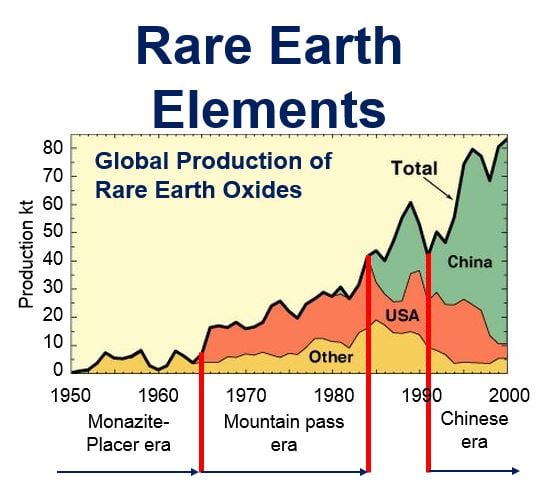
China started to dominate rare earth element production in the 1990s. (Source: US Department of the Interior)
Both Mr. Rodriguez and RioSol general manager Max Cruz said they will present the results of the discovery at the PROEXPLO 2015, the 9th International Congress of Prospectors and Explorers in May, 2015.
Rare earth elements
Rare earth elements consist of 17 chemical elements that occur together in the periodic table. They include yttrium and the 15-lanthanide elements: lutetium, europium, gadolinium, terbium, neodymium, samarium, lanthanum, cerium, praseodymium, ytterbium, erbium, thulium, dysprosium, holmium and promethium. Scandium is found in the majority of rare earth element deposits and is often classified as a rare earth element.
As they are all metals, rare earth elements are commonly known as “rare earth metals”. They have many similar properties and are typically found together in geologic deposits. They are often called “rare earth oxides” because many of them are traded as oxide compounds.
Rare earth metals and alloys with rare earth metals in them are used in a wide range of devices that people use every day, such as mobile phones, rechargeable batteries, specialty magnets, DVDs, computer memory, catalytic converters, fluorescent lighting, mercury-vapor lamps, aerospace components, radioactive tracing agents in oil refineries, microwave filters, polishing powder, portable x-ray machines, and much more.
From a business standpoint, rare earth metals claims are among the most prized in the world due to the scarcity of the commercial deposits.
RioSol and Compañia Minera Rio Sol
RioSol is based in Portland, Oregon in the US. Its operating arm Compañia Minera has its headquarters in Cusco, Peru. The business has legal offices in Peru and the United States.
RioSol has operated in Peru since 2000, building a diverse portfolio of claims, ranging from base metals to rare earths.
