
One day, renewable energy will supply all our energy needs. In today’s world, we are still very dependent on fossil fuels. An economist has modelled the transition from our current energy situation to tomorrow’s.
Raul Barreto has examined the consequences of the relative productivity differential between fossil fuel and renewable energy in the short- and long-term.
Dr. Barreto is a Senior Lecturer at Adelaide University’s School of Economics.
Dr. Barreto said:
“The transition from fossil fuels to alternative energy is dependent on their relative productivity. Sustainable energy will increasingly replace fossil fuels as the former becomes a less productive, more expensive source and the latter becomes more productive and less expensive.”
Dr. Barreto wrote about his study and findings in the journal Economic Modelling (citation below). The research shows that fuel productivity determines the viability of renewable energy.
His study also shows how economies will transition from their current fuel situation to a future one. Today, sustainable energy complements fossil fuels. In the future, renewable energy will supply all our energy needs. In this context, sustainable energy and renewable energy have the same meaning.
What is renewable energy?
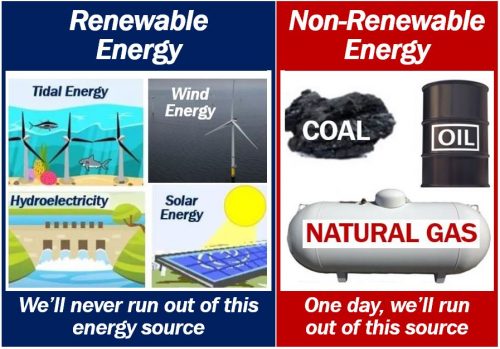
Renewable energy is energy that comes from a source that lasts forever. In other words, it never runs out (in a human timescale).
For example, wind energy is there every day, as is solar energy. We can never use up sunlight and wind so that there is none left. Global oil and gas supplies, on the other hand, will eventually end.
Therefore, oil and gas are non-renewable energy sources while wind and sunlight are renewable.
“Fossil fuels have the advantage of being a relatively inexpensive and stable source of energy, but stocks are finite,” Dr. Barreto explained.
“Sustainable energy sources such as solar and wind power are potentially limitless, but supply is inconsistent, and they require large amounts of capital investment to make them a viable source,” he added.
When will fossil fuels run out?
Even though the world has passed ‘peak oil,’ it is still hard to predict when fossil fuels will run out. Estimates for when depleting reserves will become a problem range from fifty to one-hundred years’ time. Therefore, we cannot be sure exactly when renewable energy will become our main source of energy.
Dr. Baretto said:
“Hypothetical scenarios predict that finite stocks of fossil fuels will be depleted and economies that are solely dependent on those sources of energy will collapse causing severe welfare problems.”
“These predictions assume that the supply of fossil fuel cannot be influenced by productivity increases, economies of scale or substitution.”
“However, alternative energy substitution can alleviate the negative implications on growth and welfare of an ever-depleting fuel source on an energy-dependent dynamic economy.”
In a press release, the University of Adelaide stated:
“The further that alternative energy must improve to catch up to oil, the larger the relative decrease in consumption will be.”
If alternative energy continues being less productive than fossil fuels, we will suffer declining growth. That decline could continue for a long time, as we are forced to switch to the less efficient alternative.
Citation
“Fossil fuels, alternative energy and economic growth,” Raul A.Barreto. Economic Modelling, Volume 75, November 2018, Pages 196-220. DOI: https://doi.org/10.1016/j.econmod.2018.06.019.
