

The market for robotic exoskeletons – enhanced mechanical suits that bring to mind the one donned by Ellen Ripley in Aliens – is set to grow to $2.1bn by 2021 according to a new analysis of pricing, shares, forecasts, and profiles of key industry players.
The new analysis by Market Research Reports – and titled Wearable Robots, Industrial Exoskeletons: Market Shares, Market Strategies, and Market Forecasts, 2016 to 2021 – says the technology for wearable robotic exoskeletons is rapidly increasing the range of things they can do.
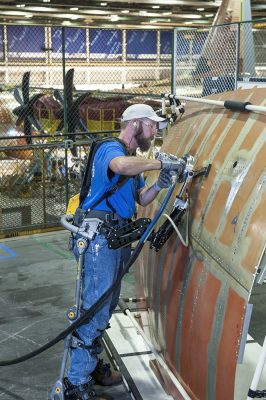 The Fortis robotic exoskeleton from Lockheed Martin is designed to help industry workers use heavy tools. Image: Lockheed Martin
China, Europe, Korea, Japan, and the United States are developing robotic exoskeletons for a wide range of markets, from medical through manufacturing, warehousing and construction to warfare.
The technology is already well established in the field of health and rehabilitation. An example of this is the Ekso GT, a robotic exoskeleton designed to help rehabilitate patients with spinal cord injury or who have suffered a stroke.
The new report notes that all the measurable revenue for 2015 – when the market size was estimated to be $36.5 million – is from medical applications.
Technology in its infancy
In able-bodied applications such as for military and industrial use, the technology is still very new and only just starting to enter the market.
Companies to watch in these markets include BAE Systems, Cyberdyne, Daewoo, Ekso Bionics, Honda, Lockheed Martin, Noonee, Panasonic, Raytheon/Sarcos, and Revision Military.
Last year, Panasonic announced a range of robotic exoskeletons – called “power assist robots” – for supporting industry workers and the elderly.
One such product – the Panasonic Power Loader – is a powerful robotic exoskeleton for use in the construction industry and disaster relief. The suit controls 20 motors via four sensors in the hands and feet.
Another example is the Fortis from Lockheed Martin, which is designed to enhance the physical abilities of operators, such as helping them use heavy tools as if they were weightless.
Many applications in pipeline
The idea is that powered human augmentation will increase safety while enhancing productivity and performance.
Applications will include not only enhancing ability of able-bodied workers but also of workers with reduced mobility so they can carry out a wider range of tasks.
The new report suggests that once the devices are fully tested and proven to work for particular industrial tasks, then they will quickly become more common.
Market Research Reports say various applications that are in the pipeline will soon be in the field, and suggest that over the next few years the market will expand to reach $2.1bn by 2021.
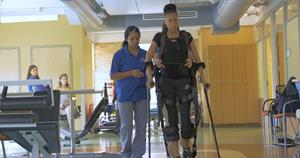 The Ekso GT is designed to help stroke and spinal cord injury patients. Image: Ekso Bionics
Battery life limits range
Currently, the range of robotic exoskeletons is limited by their short battery life – they can work on their own for several hours but then need to be recharged.
Some manufacturers in China are researching ways to extend battery performance. Once this problem is solved, then the military market opens up.
The report suggests that with longer battery life, robotic exoskeletons can be worn by soldiers on the front line who have to carry heavy equipment for long periods and operate in mountainous terrains and other challenging environments.
