
Is the Russian shrinking economy heading for a meltdown? According to the Economy Ministry on Friday, the country’s economy has shrunk in annual terms for two months running.
In July, GDP (gross domestic product) contracted by 0.2%, after shrinking by 0.1% in June.
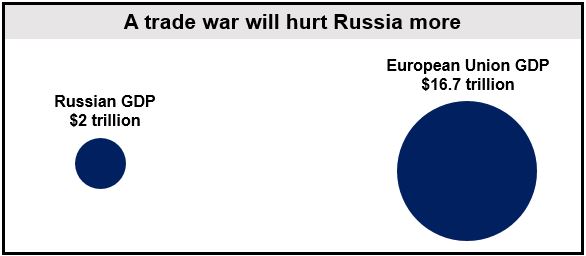
If the Eurozone, whose GDP is several times greater than Russia’s, has felt the impact of the recent tightening of sanctions, imagine the effect on Russia, economists say.
Russia was struggling before the sanctions
In April, 2014, Anton Siluanov, Russia’s Finance Minister, predicted there would be zero growth in 2014. Even before the sanctions were imposed, the Russian economy was already in trouble.
The State Statistics Service published figures showing that investment declined by 2% in July.
Growth forecasts coming out of Russia vary, depending on which department published them. Economy Ministry officials recently predicted 1% GDP growth for 2014, while central government forecast 0.5%.
Most economists around the world today say they would be surprised if the economy grew at all this year.
Latest Economy Ministry data showed that the economy grew by 0.7% (year-on-year) during the first seven months of this year.
When will Russian consumers start complaining?
Geopolitical tensions making problems worse
Reuters quoted Dmitry Polevoy, chief Russia economist at ING, who said:
“The risk of negative annual growth in GDP (in 2014) is still high, and these risks are probably rising on the back of geopolitical tensions.”
Russia faces a combination of economic problems:
- Inflation is high and rising. According to the Wall Street Journal, Raiffeisen Bank expects the recent food import bans imposed by Russia on the US, EU and its allies will increase its 2014 estimate for inflation from 6% to 9%.
- GDP is shrinking.
- There is a serious capital flight problem (investors moving their money out of the country).
- Investment has slumped.
- The world’s richest nations are tightening economic sanctions.
- Oil prices are falling. The Moscow Times reported earlier this week that Russian Urals crude weakened for the eighth day running on Monday, falling well below $100 per barrel for the first time in a year. Russia has balanced its 2014 budget at $114 per barrel.
