
The SLS RS-25 engine, formerly the space shuttle main engine, the one that will drive NASA’s next great rocket to deep space, underwent its first successful test on January 9th at the agency’s Stennis Space Center near Bay St. Louis, Mississippi.
The RS-25 fired up for 500 seconds on the A-1 test stand, providing NASA scientists vital data on the engine controller unit and inlet pressure conditions.
This is the first hot fire of an RS-25 engine since 2009. Four RS-25 engines will propel the Space Launch System (SLS) in future missions, including to an asteroid and Mars, NASA informed.
Manager of the SLS Liquid Engines Office at NASA’s Marshall Space Flight Center in Huntsville, Steve Wofford, said:
“We’ve made modifications to the RS-25 to meet SLS specifications and will analyze and test a variety of conditions during the hot fire series.”
“The engines for SLS will encounter colder liquid oxygen temperatures than shuttle; greater inlet pressure due to the taller core stage liquid oxygen tank and higher vehicle acceleration; and more nozzle heating due to the four-engine configuration and their position in-plane with the SLS booster exhaust nozzles.”
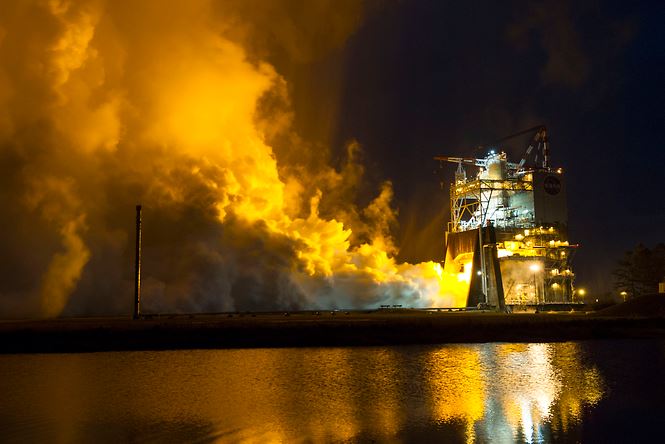
The RS-25 engine firing up during its 500-second test. (Image: NASA)
The “brain” of the engine, the controller unit, allows the vehicle to communicate with the engine, relaying commands to the engine and sending back data to the vehicle. The controller unit also provides closed-loop engine management by regulating the thrust and fuel mixture ratio while monitoring the engine’s status and health.
The new controller will use state-of-the-art hardware and software configured to operate with the new rocket’s avionics architecture.
RS-25 project manager at Stennis, Ronald Rigney, said:
“This first hot-fire test of the RS-25 engine represents a significant effort on behalf of Stennis Space Center’s A-1 test team. Our technicians and engineers have been working diligently to design, modify and activate an extremely complex and capable facility in support of RS-25 engine testing.”
Testing will re-commence in April 2015, after the upgrades on high pressure industrial water system are completed. The engineers plan to carry out eight tests totaling 3,500 seconds for the current development engine.
Another development engine will undergo ten tests, totaling 4,500 seconds. NASA wrote “The second test series includes the first test of new flight controllers, known as green running.”
NASA added:
“The first flight test of the SLS will feature a configuration for a 70-metric-ton (77-ton) lift capacity and carry an uncrewed Orion spacecraft beyond low-Earth orbit to test the performance of the integrated system. As the SLS is upgraded, it will provide an unprecedented lift capability of 130 metric tons (143 tons) to enable missions even farther into our solar system.”
