

FlyCroTug is a small flying robot, i.e., a drone, that can haul surprisingly heavy loads. A closed door, for example, poses no barrier for the small flying robot.
Engineers have fitted the FLyCroTug with advanced gripping technologies. It also has the ability to move and pull on objects in its vicinity. Two FlyCroTugs, for example, can jointly turn the handle and heave a door open. They do this by first lassoing the door handle and then turning it.
The small flying robot was developed in the laboratories of Mark Cutkosky and Dario Floreano. Cutkosky is the Fletcher Jones Chair at Stanford University’s School of Engineering. Floreano is a Professor at the École Polytechnique Fédérale de Lausanne’s Laboratory of Intelligent Systems in Switzerland.
The researchers have modified the FlyCroTug so that it can anchor itself to various surfaces. It does this using adhesives that the Cutkosky’s lab developed. The engineers got their inspiration when observing the feet of insects and geckos.
Professors Cutkosky and Floreano, and colleagues wrote about their work and achievements in the journal Science Robotics (citation below).
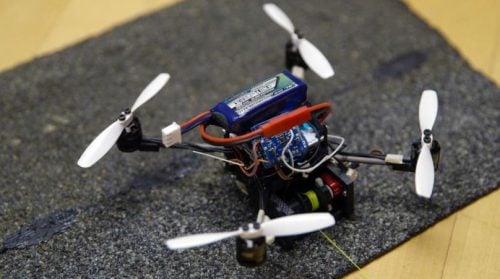
FlyCroTug is a mighty carrier
FlyCroTugs, with these attachment mechanisms, can pull objects weighing up to forty times their own weight. They could, for example, carry water bottles and cameras in rescue situations.
In the world of small flying robots, FlyCroTugs are super strong machines. Similar vehicles can only lift objects weighing approximately twice their own weights using aerodynamic forces.
Lead author, Matthew Estrada, a graduate student at Stanford, said:
“When you’re a small robot, the world is full of large obstacles. Combining the aerodynamic forces of our aerial vehicle along with interaction forces that we generate with the attachment mechanisms resulted in something that was very mobile, very forceful and micro as well.”
The FlyCroTug is small, which gives it certain advantages. It can, for example, navigate through cramped spaces. It can also come up fairly close to people. These features, among many others, make it useful for search and rescue missions.
As the FlyCroTugs tug, they hold tightly to surfaces. They could, therefore, position a camera to evaluate a hazardous area or move pieces of debris.
Inspiration from nature
As with the majority of projects in Cutkosky’s lab, these small flying robots were inspired by the natural world.
The researchers wanted to create a small vehicle that could fly. It also had to be fast, highly maneuverable, and able to move large loads. The researchers looked at wasps for inspiration.
Prof Cutkosky said:
“Wasps can fly rapidly to a piece of food, and then if the thing’s too heavy to take off with, they drag it along the ground. So this was sort of the beginning inspiration for the approach we took.”
The authors read wasp studies. Specifically, studies on wasp prey capture and transport. They wanted to identify the ratio of flight-related muscles to total mass that determines whether the wasp drags its prey or flies with it.
They also followed the wasp’s lead in having different attachment options depending or where their small flying robot landed.
Attachments for smooth and rough surfaces
The FlyCroTug has gecko grippers for smooth surfaces. These are non-sticky adhesives that mimic the intricate toe structures of the gecko. Gecko’s feet hold on by creating intermolecular forces between the surface and the adhesive.
The robot has 32 microspines for rough surfaces. They consist of a series of fishhook-lie metal spines. Each one can individually latch onto small pits in a surface.
In a press release, Stanford University explained:
“Each FlyCroTug has a winch with a cable and either microspines or gecko adhesive in order to tug. Beyond those fixed features they are otherwise highly modifiable.”
“The location of the grippers can vary depending on the surface where they will be landing, and the researchers can also add parts for ground-based movement, such as wheels. Getting all of these features onto a small air vehicle with twice the weight of a golf ball was no small feat, according to the researchers.”
FlyCroTug does more than just fly
Prof. Floreano said:
“People tend to think of drones as machines that fly and observe the world, but flying insects do many other things – such as walking, climbing, grasping, building – and social insects can even cooperate to multiply forces.”
“With this work, we show that small drones capable of anchoring to the environment and collaborating with fellow drones can perform tasks typically assigned to humanoid robots or much larger machines.”
Small flying robots may seem all the rage at the moment. However, the FlyCroTug, with its ability to fly to remote locations, pull, and anchor, falls into a more specific niche.
Prof. Cutkosky explained:
“There are many laboratories around the world that are starting to work with small drones or air vehicles, but if you look at the ones that are also thinking about how these little vehicles can interact physically with the world, it’s a much smaller set.”
With two FlyCroTugs, the researchers can successfully open a door. They also had one of them fly atop a crumbling structure. It managed to haul up a camera and see inside.
The researchers hope to work on autonomous control next, as well as the logistics of flying many vehicles simultaneously.
Citation
“Forceful manipulation with micro air vehicles,” Matthew A. Estrada, Stefano Mintchev, David L. Christensen, Mark R. Cutkosky, and Dario Floreano. Science Robotics, 24 Oct 2018:
Vol. 3, Issue 23, eaau6903. DOI: 10.1126/scirobotics.aau6903.
