

Smartphone addiction is a growing problem among European children, with fifty percent reporting experiences linked to overdependence, says a report by Net Children Go Mobile (PDF).
Increasingly, children across Europe say they feel compelled to always be available and do not like it when they cannot check their smartphone.
More than 3,500 kids aged 9-16 years and their parents across seven European nations were questioned for the report. (The nations were Denmark, Italy, Romania the UK, Ireland, Belgium and Portugal.)
Below are some of the findings regarding smartphone and internet use:
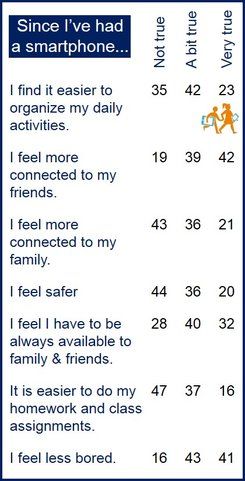
- 72% of children felt that since getting a smartphone they feel more pressure to be available at all times to family and friends.
- 50% felt a strong need to check their mobile phone to determine whether there was anything new ‘very or fairly often’.
- 8% said they had missed meals and gone without sleep because of the internet.
(Source: Net Children Go Mobile)
- 20% have caught themselves surfing when not really interested.
- 18% blamed the internet/smartphones for not spending enough time with family, friends or doing schoolwork.
- 16% tried unsuccessfully to spend less time online.
Forty-eight percent of respondents said they experienced at least two of the six factors listed above that are linked to excessive smartphone use.
There was little gender difference in smartphone usage. However, age appears to be a key factor. While 20% of 9 to 10 year-olds reported two or more of the six experiences linked to smartphone addiction, the figure was 61% for 15 to 16 year-olds.
Smartphones – the good news
The majority of children said they felt more connected to their friends and family thanks to their mobile phone.
Two-thirds of the respondents said their smartphones help them organize their daily lives, while more than half believe their devices make them feel safer and help them do homework.
Co-ordinator of Net Children Go Mobile Leslie Haddon, said:
“Although we tend to worry about children more because of the demands made on them at this stage of their life, some of these experiences could be found among many adults. A decade ago quite a few children were saying similar things about mobile phones in general, that they could not be without them, reflecting how embedded these technologies had become in their lives.”
“Smartphones seem to have taken this a stage further, both in terms of their usefulness and attractiveness, but also in terms of children’s dependence upon them.”
With more than one billion smartphones shipped globally in 2013, and sales set to continue growing, problems related to smartphone usage among children are forecast to increase.
More UK kids addicted to smartphones
Below is the percentage of children who experienced at least two forms of excessive internet and smartphone use ‘fairly or very often’, by country:
- Belgium: Smartphone 34% – Internet 16%
- Denmark: Smartphone 43% – Internet 25%
- Ireland: Smartphone 41% – Internet 23%
- Italy: Smartphone 50% – Internet 11%
- Portugal: Smartphone 57% – Internet 16%
- Romania: Smartphone 38% – Internet 24%
- UK: Smartphone 65% – Internet 29%
- Average all countries: Smartphone 48% – Internet 21%
