

For Spiderman to be able to climb walls, he would need mega giant freak hands, and adhesive pads which would cover 40% of his body surface. He would look nothing like the superhero we see in the movies or comic books, but rather like a scary mutant.
A study carried out by scientists at the University of Cambridge and colleagues from Australia and the United States found that geckos, the lizards that can climb smooth vertical walls, are the largest animals on Earth with that ability.
Dr. David Labonte, who works at Cambridge University’s Department of Zoology, and colleagues published details of their research in the academic journal PNAS. They say their findings have implications for the feasibility of large-scale, gecko-like adhesives.
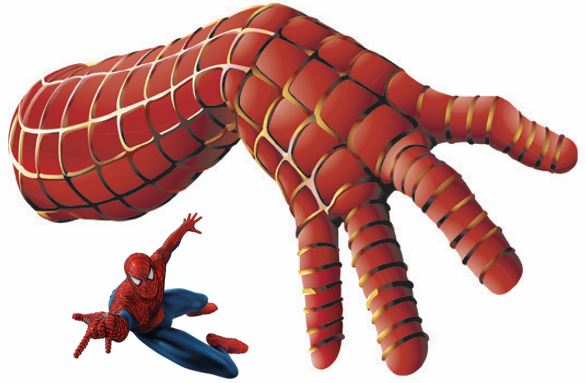 For Spiderman to be able to climb walls like a gecko, he would need to have incredibly large hands and feet.
Climbers come in many sizes
Climbing animals vary in size, from tiny mites to geckos. As body size increases, so does the percentage of body surface that needs to be covered in adhesive footpads. The gecko is the limit in body size for smooth, vertical wall-climbing. Large creatures would need disproportionately large hands and feet.
The scientists found that tiny mites use about 200 times less of their body surface area for adhesive pads compared to geckos, nature’s biggest adhesion-based climbers.
Humans would need to have about 40% of their body surface, or approximately 80% of their front, covered in sticky footpads if they wanted to copy Spiderman.
Dr. Labonte explained that evolution would never go in that direction for a large animal, i.e. covering most of the front of its body in sticky footpads.
Imagine humans with size 145 feet (US: 114)
Senior author, Walter Federle, also from Cambridge University’s Department of Zoology, said:
“If a human, for example, wanted to climb up a wall the way a gecko does, we’d need impractically large sticky feet – and shoes in European size 145 or US size 114.”
As animals increase in size, there is a decrease in the amount of body surface area per volume. For example, an ant has very little volume but lots of surface area, while an elephant is mostly volume with not much surface area, the authors explained.
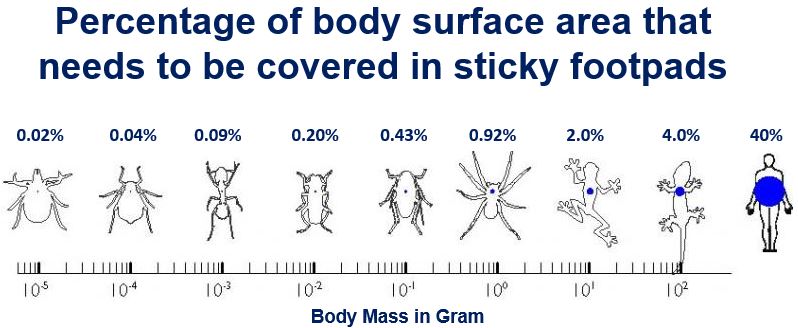 Larger animals need a much greater percentage of their body surface area than small ones. (Image: cam.ac.uk)
Dr. Labonte said:
“This poses a problem for larger climbing animals because, when they are bigger and heavier, they need more sticking power, but they have comparatively less body surface available for sticky footpads.”
“This implies that there is a maximum size for animals climbing with sticky footpads – and that turns out to be about the size of a gecko.”
The scientists compared the weight and footpad size of 225 different climbing animal species, including a lizards, spiders, frogs, insects and also one mammal.
They covered a range of over seven orders of magnitude in body weight, like the equivalent difference between Big Ben and a cockroach.
Animals’ sticky feet are remarkably similar
Although they were studying vastly different animals – a gecko and a spider are about as different as an ant is to a human – their sticky feet are amazingly similar, the researchers found.
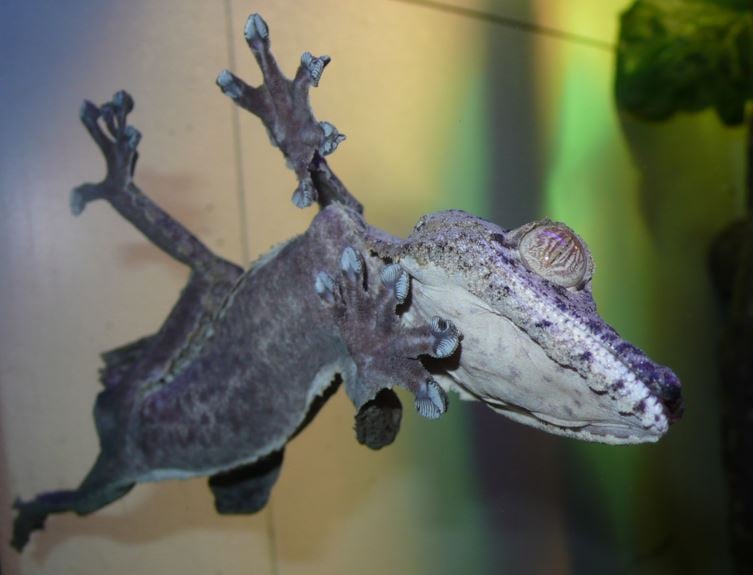 A gecko climbing a vertical glass pane. It is the largest animal that can do this. (Image: Wikipedia)
Dr. Labonte said:
“Adhesive pads of climbing animals are a prime example of convergent evolution – where multiple species have independently, through very different evolutionary histories, arrived at the same solution to a problem. When this happens, it’s a clear sign that it must be a very good solution.”
There is one way of overcoming how to stick when you are a large animal, and that is to make the sticky footpads significantly stickier.
Co-author, Christofer Clemente, from the University of the Sunshine Coast, Australia, said:
“We noticed that within some groups of closely related species, pad size was not increasing fast enough to match body size yet these animals could still stick to walls.”
“We found that tree frogs have switched to this second option of making pads stickier rather than bigger. It’s remarkable that we see two different evolutionary solutions to the problem of getting big and sticking to walls.”
“Across all species the problem is solved by evolving relatively bigger pads, but this does not seem possible within closely related species, probably since the required morphological changes would be too large. Instead within these closely related groups, the pads get stickier in larger animals, but the underlying mechanisms are still unclear. This is a great example of evolutionary constraint and innovation.”
Development of large-scale bio-inspired adhesives
The authors believe these insights into the sticky footpad size limits may have profound implications for developing large-scale bio-inspired adhesives, which are currently effective only on very small areas.
Dr. Labonte said:
“Our study emphasises the importance of scaling for animal adhesion, and scaling is also essential for improving the performance of adhesives over much larger areas.”
Further research is needed to determine what strategies animals use to make their footpads more adhesive. The authors think these would probably have very useful applications in the development of large-scale, powerful yet controllable adhesives.
The research was supported by grants from the Human Frontier Science Programme, the Denman Baynes Senior Research Fellowship, the UK Biotechnology and Biological Sciences Research Council, and a Discovery Early Career Research Fellowship.
Citation: “Extreme positive allometry of animal adhesive pads and the size limits of adhesion-based climbing,” David Labonte, Christofer J Clemente, Alex Dittrich, Chi-Yun Kuo, Alfred J Crosby, Duncan J Irschick & Walter Federle. bioRxiv (Preprint server for biology). 18 January, 2016. DOI: http://dx.doi.org/10.1101/033845.
Video – Man climibng glass wall with gecko-inspired dry adhesive pads
Stanford engineers created ‘gecko gloves’ that allow humans to climb glass walls like a gecko.
