
Researchers have successfully developed an artificial synaptic device that simulates human brain function. Specifically, the function of neurons and synapses in the human brain. We also refer to neurons as nerve cells.
Team leader, Myoung-Jae Lee, and colleagues, wrote about their study in ACS Applied Materials and Interfaces (citation below).
Lee is Director of the Intelligent Devices and Systems Research Group at Daegu Gyeongbuk Institute of Science and Technology (DGIST).
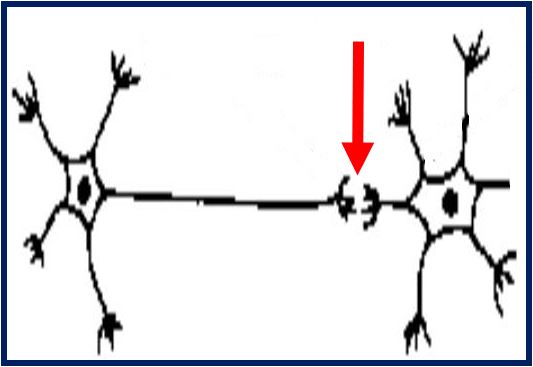
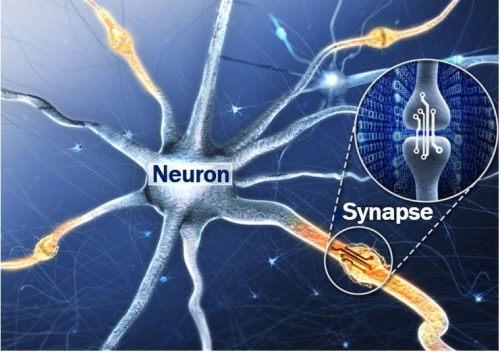
A synapse is a junction between two nerve cells, consisting of a tiny gap. Impulses pass by the diffusion of a neurotransmitter across the minute gap. The neurotransmitter is, in other words, like a ‘message sender.’
In the human brain, synapses are the junctions between axons and dendrites. In other words, where axons and dendrites meet. Synapses allow the human brain to send signals. They also allow the brain to receive signals.
The human brain has hundreds of trillions of synapses.
Race to create a synaptic device
The human brain’s chemical synapse information system can handle high-level parallel arithmetic with very little energy. Researchers are currently competing globally to create a synaptic device which mimics the biological function of a synapse. In other words, there is a race to create an artificial synapse device that mimics the human brain.
Dr. Lee, together with Prof. Hyunsang Hwang from POSTEC, Professor Sung Kyu Park from Chung-ang University, and Professor Gyeong-Su Park from Seoul National University developed a high-reliability artificial synaptic device with several values.
The researchers built it by structuring tantalum oxide into two layers of Ta2O5-x and TaO2-x and controlling its surface. We get tantalum oxide, a trans-metallic material, by igniting tantalum in oxygen or air.
Electrical synaptic device
The research team developed an electrical synaptic device that mimics the function of brain synapses. The resistance of the tantalum oxide layer gradually declines or increases depending on the electric signal’s strength.
Current devices have serious durability limitations. The researchers, however, managed to overcome this by allowing current control just in Ta2O5. In other words, current control occurs on just one layer.
The scientists also successfully implemented an experiment that realized synapse plasticity. Synapse plasticity is the process of creating memories, as well as storing and deleting them. One can subsequently strengthen or suppress long-term memory by adjusting the synapse connection strength between neurons.
In a press release, DGIST wrote:
“The non-volatile multiple-value data storage method applied by the research team has the technological advantage of having a small area of an artificial synaptic device system, reducing circuit connection complexity, and reducing power consumption by more than one-thousandth compared to data storage methods based on digital signals using 0 and 1 such as volatile CMOS (Complementary Metal Oxide Semiconductor).”
Ideal for ultra-low power devices
The authors believe we could use their high-reliability artificial synaptic device in ultra-low power devices or circuits. It can process huge amounts of big data thanks to its capability of low-power parallel arithmetic.
The researchers expect it to be applied to next-generation intelligent semiconductor device technologies.
We could use the synaptic device in the development of, for example, AI, including machine learning and deep learning. We could also use it for brain-mimicking semiconductors.
AI stands for artificial intelligence – software technologies that make robots and computers think like humans. They also make them behave like humans. Features of human intelligence include, for example, decision-making and speech recognition. Translation between languages and visual perception are also features of human intelligence.
Dr. Lee explained:
“This research secured the reliability of existing artificial synaptic devices and improved the areas pointed out as disadvantages.”
“We expect to contribute to the development of AI based on the neuromorphic system that mimics the human brain by creating a circuit that imitates the function of neurons.”
Citation
“Reliable Multivalued Conductance States in TaOx Memristors through Oxygen Plasma-Assisted Electrode Deposition with in Situ-Biased Conductance State Transmission Electron Microscopy Analysis,” Myoung-Jae Lee, Gyeong-Su Park, David H. Seo, Sung Min Kwon, Hyeon-Jun Lee, June-Seo Kim, MinKyung Jung, Chun-Yeol You, Hyangsook Lee, Hee-Goo Kim, Su-Been Pang, Sunae Seo, Hyunsang Hwang, and Sung Kyu Park. ACS Appl. Mater. Interfaces, 2018, 10 (35), pp 29757–29765. DOI: 10.1021/acsami.8b09046.
