
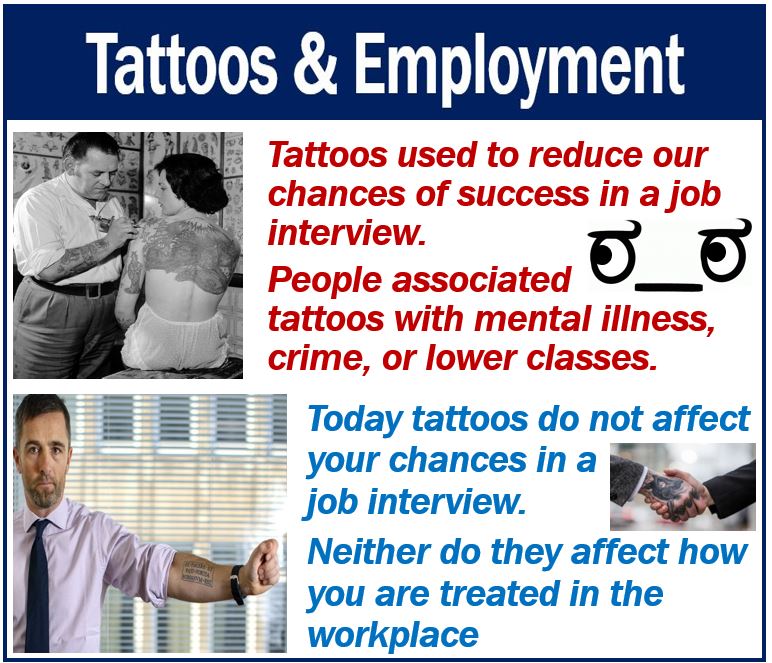
If you thought that tattoos would make it harder to get a job, you were wrong. Researchers found that a person with a tattoo is not at a disadvantage when looking for employment. In fact, in some cases, the opposite appears to be true.
Andrew R. Timming and colleagues gathered and analyzed data from over 2,000 people across the USA. They wanted to determine whether the perception of tattoos affected a person’s employability negatively. Timming is an Associate Professor of *Human Resource Management at the University of Western Australia’s (UWA’s) Business School.
* Human Resources is a science that perceives human beings as valuable assets in the workplace. Human Resource Development (HRD), for example, is a part of Human Resource Management. HRD specifically deals with the development and training of employees.
Tattoos in the job market
The researchers wanted to determine whether a tattoo affected a person’s treatment in a job interview. They also wanted to see how colleagues and bosses treated them in the workplace.
In other words, does a tattoo affect a job seeker, and also, might it even affect people who are working?
Prof. Timming, Karoline Mortensen, and Michael French wrote about their study in the journal Human Relations (citation below). Prof. Mortensen and Prof. French work at the University of Miami, USA.
The authors wrote that having a tattoo did not appear to be related to different treatment in the workplace. The results challenge what most people believe.
The study results also challenge some previous studies’ findings.
Tattoos may even help
Prof. Timming said:
“What’s interesting about this is it flies in the face of common perceptions that tattoos, particularly visible ones, lead to a negative judgment being made about how an employee is perceived.”
“What is also interesting is that the study found that people with tattoos are not only on an even footing in finding employment and in the workplace, but in some cases having a tattoo actually worked in their favor.”
Prof. Timming said that their findings suggest that society is becoming more accepting.
Tattoo a form of self-expression
In the past, people would associate a tattoo with lower classes, mental illness, and drug abuse. Over the last few decades, however, tattooing has become a form of self-expression. People are less likely to associate a tattoo with those stereotypes, the authors explained.
Prof. Timming said:
“Historically, tattoos have been associated with lower classes, crime, drug abuse and mental illness, however in the past few decades tattooing has broken away from those stereotypes as a form of self-expression.”
“Previous research has found that employers held largely negative views toward body art, but this new study suggests that times are changing quickly, along with public attitudes.”
“We used multiple measures of tattoos, including whether the respondent had one, how many tattoos the respondent had, and whether the tattoos were visible. In each case, there was no evidence that body art reduces wages or employment opportunities.”
Citation
‘Are tattoos associated with employment and wage discrimination? Analyzing the relationships between body art and labor market outcomes,’ Michael T French, Karoline Mortensen, Andrew R Timming. Human Relations. First Published August 7, 2018. First Published August 7, 2018. https://doi.org/10.1177/001872671878259.
Interesting related article: “Business etiquette rules your employees should follow.”
