
Just 15% of Australian workers and owner managers of incorporated enterprises were trade union members in August 2014, compared to 17% one year earlier, figures from the Australian Bureau of Statistics (ABS) revealed on Monday.
In August 2014, there were 1.6 million people who were trade union members in their main job.
Stephen Collett from the ABS, said:
“The Characteristics of Employment survey collects information on the distribution of weekly earnings, working arrangements, independent contractors, labour hire workers and trade union membership.”
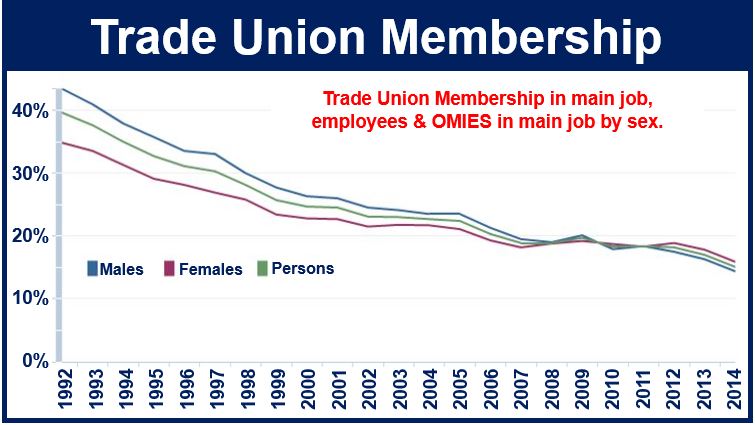 Since 1992, there has been a steady decline in trade union membership for employees and OMIEs in Australia. (Image: abs.gov.au)
Thirty-nine percent of public servants were trade union members in August, compared to 11% in the private sector, and 17% of full-time employees and OMIES (owner managers of incorporated enterprises). A smaller percentage of part-time workers and OMIES (12%) belonged to a trade union.
Earnings up on last year
According to the survey, the median weekly earnings of workers and OMIES in all jobs was $1,000, which was less than the mean weekly earnings of $1,189 – this reflects the impact of a relatively small number with high earnings.
The mean weekly earnings in all jobs has risen by 3%, or $33, since August 2013.
Mr. Collett added:
“24 per cent of employees did not have paid leave entitlements in their main job in August 2014. This proportion has been reasonably stable for 10 years.”
ACTU Secretary Dave Oliver said in a statement that the trade union movement was not in crisis. He said that union membership currently stands at 1.8 million, based on ACTU data gathered from 46 affiliated unions.
He did admit that in order to stay relevant, the movement needs to modernize.
Mr. Oliver said:
“Every day unions are looking for ways to represent Australian workers and it has become very clear that as workplaces modernise, so must unions. Progress and change in the workplace can be a great thing but it can’t be at the cost of worker’s rights, wages, safety and other conditions.”
