
Yellowstone National Park is one of America’s most popular national parks, with over 3 million visitors per year.
However, this high level of tourism appears to be having a negative impact on the conservation of the park, particularly its hot springs.
The park is located primarily in the U.S. state of Wyoming, but extends into Montana and Idaho. It was established by the U.S. Congress and signed into law by President Ulysses S. Grant on March 1, 1872.
Researchers at Montana State University and the Brandenburg University of Applied Sciences in Germany have made an interesting discovery, revealing how the color of the hot springs at the park have transformed over time because of pollution from visitors.
Their research shows that tourists have contaminated and changed the chemistry of the hot springs over the years with “make-a-wish coin throws”, as well depositing other debris into the pools.
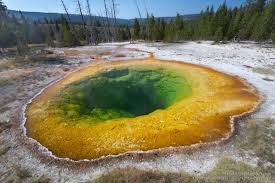
Joseph Shaw, co-author of the study at the Electrical and Computer Engineering Department of Montana State University, and his colleagues, simulated what Morning Glory Pool (which is now a mix of yellow, green, and blue) looked like between the 1880s and 1940s when its temperatures were much higher than those of today and before tourists starting flocking to the site.
They found that the pool’s waters were a uniform deep blue in the past.
Trash and coins have collected at the bottom of the pool, which is blocking the vent that heats it, reducing the temperature of the pool to a level where small microbes can survive and thrive.
There are significant communities of microbes that collect in “mats” in certain parts of the pool, which have changed the color of the hot waters.
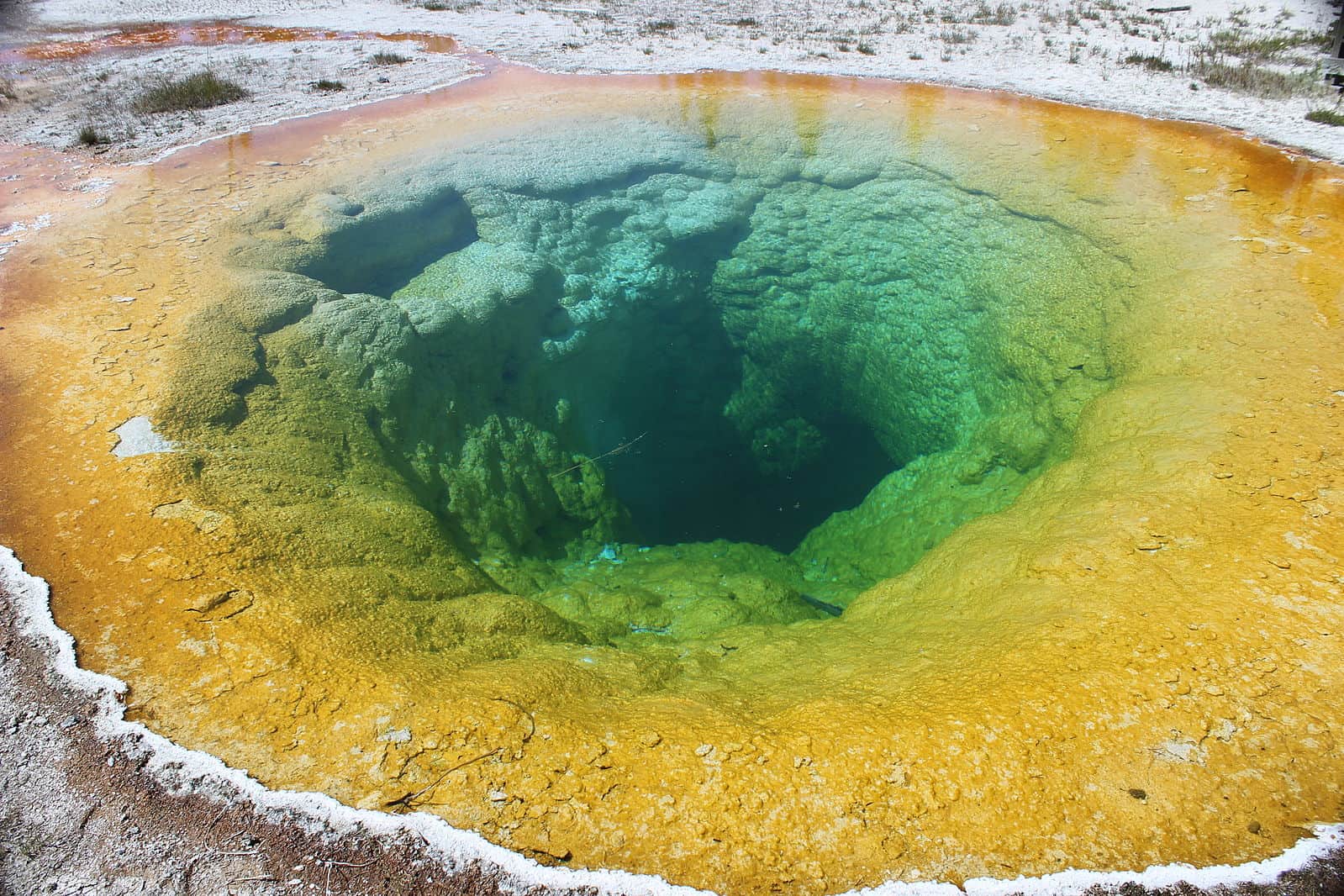
The Morning Glory Pool at Yellowstone National Park didn’t always look like this.
“It is now understood that these mats are comprised of complex communities of microbes, primarily thermophilic cyanobacteria (often called blue-green algae) and other thermophilic bacteria and archaea,” according to the study’s lead author Paul Nugent, a computer engineering researcher at Montana State University.
According to the study, thermophilic cyanobacteria, or blue-green algae, is the most common type of algae in these pools, giving the pools a green to yellow color.
“The measurements and simulations confirm that colors observed from shallow-water features arise primarily from the spectral properties of the microbial mat, which is related to the water temperature, while colors observed from deeper water arise primarily from the wavelength-dependent absorption and scattering in the water,” the researchers wrote in their study published in the journal Applied Optics.
