

Scientists have created a super-thin film that changes color chameleon-style when twisted or pulled. UC Berkeley engineers say they got their inspiration from nature.
Study leader, Connie Chang-Hasnain, professor of electrical engineering and computer sciences, and colleagues believe their thin-skinned material could be developed into active camouflage on vehicle exteriors, or a new type of display technology.
It could also be used on bridges, wings of aircraft, or buildings as an early warning system for structural fatigue, they add.
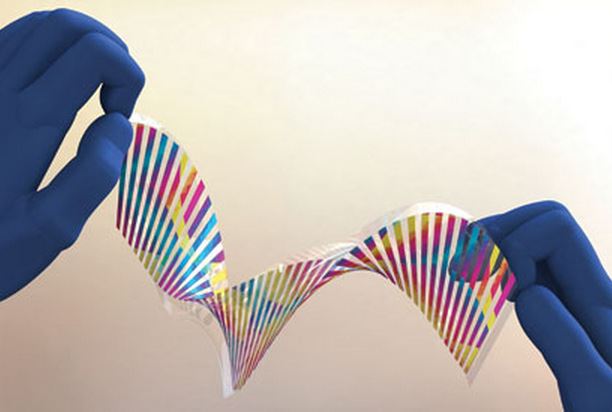
New chameleon-like ‘skin’ changes color when pulled or twisted. (Image courtesy of Connie Chang-Hasnain, UC Berkeley)
A thousand times thinner than human hair
Rather than using pigments or chemical dyes to reflect or absorb light, the scientists manipulated the structure of the material, which in this case is an ultra-thin film of silicon, about one thousand times thinner than a human hair, to achieve the color changes.
The film has rows of tiny ridges that reflect light at different wavelengths. Each ridge is smaller than a wavelength of light. Which wavelengths of light are reflected depend on the spacing between the ridges.
By tuning the ridge spacing, the scientists were able to select which specific colors reflected back.
As the spacing between the ridges alters when you stretch or twist the material, different wavelengths of light are reflected. In other words, by stretching or twisting it, the material changes color.
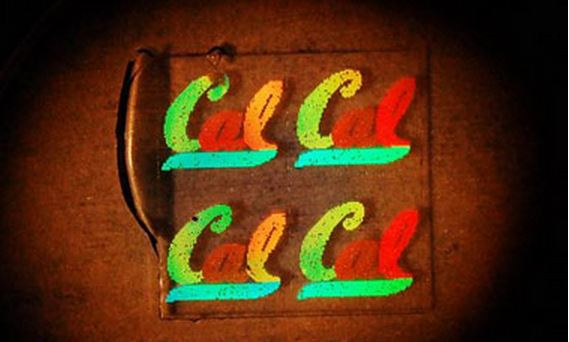
The scientists display their Cal pride with this example of their new super-thin, color-shifting film. (Image courtesy of Connie Chang-Hasnain)
Chameleons rearrange nanocrystals in skin cells
Earlier this week, Swiss researchers reported on a study showing that chameleons rearrange crystals within specific skin cells to accomplish their complex and rapid color changes during camouflage and social interaction strategies.
Professors Michel Milinkovitch and Dirk van der Marel explained that the vivid colors are the result of the active tuning of a lattice of nanocrystals present in the reptile’s iridophores (type of pigment cells).
Professor Chang-Hasnain said:
“We were fascinated by the chameleon’s ability to change colors, and the process of mimicking their skin has been exciting. The coolest thing is that you can hold the sample film and stretch it to see the colorful effect.”
Citation: “Flexible photonic metastructures for tunable coloration,” Li Zhu, Jonas Kapraun, James Ferrara, and Connie J. Chang-Hasnain. Optica, Vol. 2, Issue 3, pp. 255-258 (2015). http://dx.doi.org/10.1364/OPTICA.2.000255.
