
House on pile of money

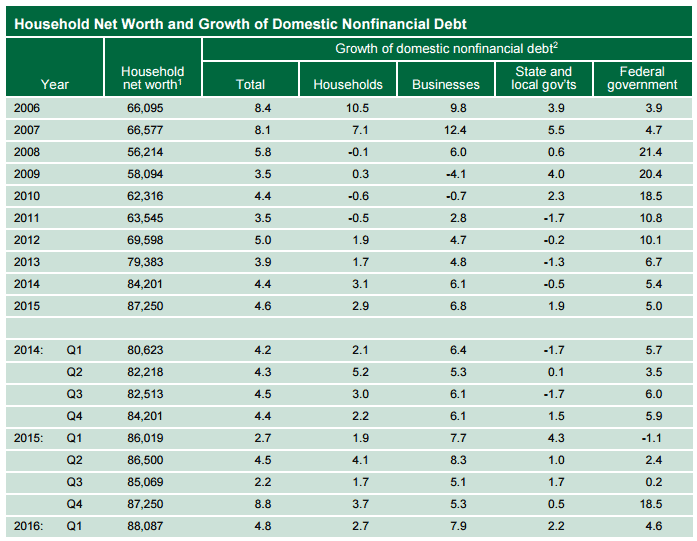
US household wealth rose to a record $88.1 trillion in Q1 2016

Written by Joseph Nordqvist

Published: 00:25, June 11, 2016

US household wealth rose by one percent in the first quarter of 2016 to a record $88.1 trillion, according to data released by the Federal Reserve on Thursday.

The increase in wealth was boosted by a $477.5 billion increase in the value of household real-estate assets, with owner’s equity as a share of total real-estate holdings up from 56.9 percent to 57.8 percent.

The value of financial assets, which includes stocks and pension funds, rose by $299.5 billion.
US_Household_Wealth_Federal_Reserve
Source: US Federal Reserve – ‘Financial Accounts of the United States’

Household debt increased at an annual rate of 2.7 percent in the first quarter of 2016, while consumer credit, including student and auto loans, grew 6.1 percent, and mortgage debt (excluding charge-offs) grew 1.6 percent at an annual rate – a fourth consecutive gain.

Federal government debt increased 4.6 percent at a seasonally adjusted annual rate in the first quarter, while State and local government debt rose at an annual rate of 2.2 percent.

Total non-financial debt rose at a 4.8 percent annual pace.

The results highlight the economic recovery since the financial crisis. In 2009 US household wealth plunged to as low as $55 trillion – it has since recovered by over $33 trillion.

House on pile of money
Household wealth was boosted by an increase in the value of real-estate assets.

In addition, the wealth increase in the first quarter is believed to have been more widely shared than in previous periods as home ownership is one of the middle-class’s primary sources of wealth – the wealthiest Americans rely more on financial assets. The U.S. homeownership rate is currently at 63.7 percent.

“Real estate wealth tends to be a bit more evenly spread across households than equities,” Paul Ashworth, chief U.S. economist for Capital Economics, told the Wall Street Journal.

He added: “People are freer to go out and spend now, based on those wealth gains.”

Joseph Nordqvist Avatar

Other News

Workforce health becomes a business issue as productivity costs mount

Aug 10, 2026

Why some companies pay much less tax than others

Aug 10, 2026

Cybersecurity study finds convenience can outweigh compliance

Aug 10, 2026

AI system helps robots perform learned tasks up to 3.2 times faster

Aug 8, 2026

Meaningful work may come from accepting career uncertainty

Aug 8, 2026

Nvidia reportedly plans up to $3 billion investment in Lancium

Aug 8, 2026

Why businesses are being urged to prepare for tighter microplastics rules

Aug 7, 2026

Retiring a working gasoline car for an EV can cut lifetime emissions, study finds

Aug 7, 2026

U.S. businesses produced more per hour, but labor’s share of output hit a record low

Aug 6, 2026

Researchers test continuous method for making leather-like fabric from fungal mycelium

Aug 6, 2026

U.S. renters expect to move less as homeownership feels further out of reach

Aug 6, 2026

CEO confidence turns positive as pessimism recedes, but investment remains cautious

Aug 6, 2026

Digital tools could reshape women’s entrepreneurship, suggest researchers

Aug 5, 2026

Success can make people learn less from their own mistakes, study suggests

Aug 5, 2026

Shopify data suggests AI search is giving niche products a new route to customers

Aug 5, 2026

Customer data is moving deeper into pricing decisions

Aug 5, 2026

Texas pauses data-center grid connection approvals as power queue reaches 474 gigawatts

Aug 4, 2026

Japan tests whether carbon pulled from seawater can fuel planes

Aug 4, 2026

Expressive robots engage people more, but their mistakes carry a higher social cost

Aug 4, 2026

Employees reported a better work experience after hybrid work was introduced

Aug 4, 2026