

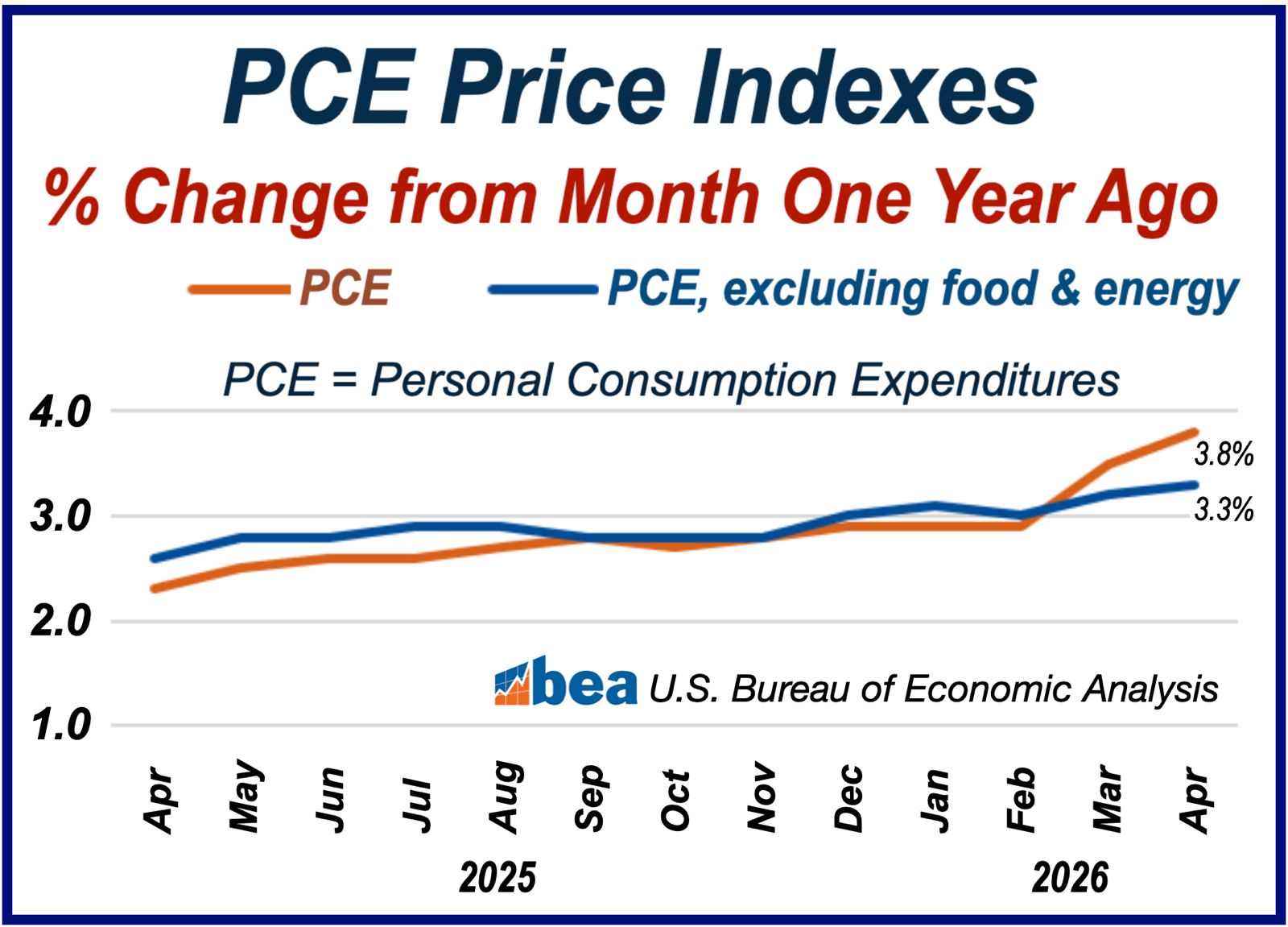
Inflation in the United States has reached its highest point since March 2023—in other words, the highest in three years, according to the U.S. Bureau of Economic Analysis (BEA).
The BEA’s PCE price index excluding food and energy, also known as core inflation, is the US Federal Reserve’s preferred inflation gauge. The Federal Reserve (Fed) is America’s central bank.
Core inflation
In April, Core Inflation year-on-year stood at 3.3%. This is much higher than the Fed’s 2% goal. Most other central banks, especially those of the advanced economies, such as the Bank of England, the European Central Bank, the Bank of Japan, the Bank of Canada, and the Reserve Bank of Australia also have an annual inflation target of 2%.
Headline inflation
Headline inflation year-on-year was 3.8% in April. This number is higher because it includes energy and food prices. The Iran war and the blocking of the Strait of Hormuz, through which about 20% of the world’s crude oil passes, has pushed up energy prices significantly. Even though the Fed’s preferred gauge is the other type (core inflation), headline inflation is also important because it is the one that everyday people feel. The price of food and energy, including gasoline, diesel, and cooking gas, matters a lot to consumers.
Purchasing power
In the US, consumers are spending more money to fuel their cars, stock their larders, cook their food, and keep their homes warm or cool. People are paying more for daily services.
Prices are rising faster than people’s monthly paychecks. Real take-home pay has declined for the third consecutive month.
Americans’ savings accounts are at a four-year low, which tells us that people are dipping into their savings to make ends meet. Consumers are running out of extra money. Households are paying more to maintain the same standard of living they had in previous months. According to the BEA, people are running out of extra money.
The outlook
Most economists believe that fuel and food prices will remain high for some time to come. The Fed is unlikely to lower interest rates anytime soon. To cool down prices, interest rates will have to stay high.
Optimism among CEOs (chief executive officers) in the US has fallen significantly, according to The Conference Board’s Measure of CEO Confidence™. Confidence stood at 59 in the first quarter, compared with 47 today (Q2). Any reading below 50 means there are more negative than positive responses. The latest survey included 141 CEO participants from the country’s largest companies. They responded to questions from May 4 to 18.
The surge in optimism seen in the first quarter has reversed sharply, pushing confidence back into negative territory. Most CEOs say that the American economy is significantly worse today than it was six months ago. They also believe that conditions are going to get worse.
There could be a knock-on effect from this pessimism. Business leaders tend to invest less when the economic outlook is poor.
Things do not look promising for the Republican Party in November’s midterm elections. Inflation is rising, people’s purchasing power is declining, the Iran war is extremely unpopular, and consumer and business confidence have both fallen sharply.
