
US October Manufacturing PMI

US manufacturing growth slows in October

Published: 12:39, November 3, 2014

The Markit US Manufacturing Purchasing Managers’ Index (PMI) came in at 55.9 in October, down from September’s 57.5. This does not mean there was a contraction – any reading above 50 signifies growth.

October’s business conditions for manufacturers grew at their slowest pace in three months.

The survey found that October’s more moderate performance was mainly due to weaker export sales. Job creation, however, remained ‘resilient’.

Input cost inflation in October was the weakest in seven months, while factory gate charges increased at a slower rate.

Output growth in October slowed down to a seven-month low, “but was still stronger than the post-crisis trend,” the authors wrote.

Sluggish new business gains also contributed to the weakest rise in backlogs of work since January.
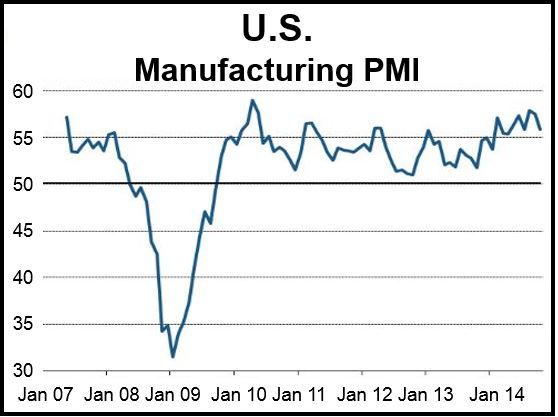
US Manufacturing PMI

(Source: Markit US Manufacturing PMI)

The fast pace of job creation continued in October at nearly the same rate as in September.

Manufacturers of consumer goods registered the best upturn in business conditions in October, while investment goods producers saw the slowest gains in new business and volumes of output.

Markit’s Senior Economist, Tim Moore, said:

“October’s survey highlights the revival in US manufacturing conditions remains on track. Production levels expanded at an impressive rate by international standards and overall momentum is still stronger than the post-recession trend.”

“However, the latest figures indicate that the recovery has lost some intensity at the start of the fourth quarter, reflecting subdued export demand from the euro area and key emerging markets. Meanwhile, a solid rate of manufacturing job creation was sustained in October, which provides an early indication that domestic labor market conditions have continued to strengthen through the final quarter of the year.”

Christian Nordqvist Avatar

Other News

Public R&D spending can boost the economy before the money is even spent, study finds

Aug 2, 2026

Boehringer Ingelheim’s Mexico City expansion targets 5 billion tablets a year

Aug 2, 2026

Why more accurate AI forecasts don’t always make better investment decisions

Aug 1, 2026

The AI boom is inheriting the geography of America’s old energy economy

Jul 31, 2026

Brands scale AI investment as consumers place greater value on reliability, survey finds

Jul 30, 2026

Customers may praise products they helped create even when they fail

Jul 30, 2026

Study links Uber and Lyft to higher local GDP, but overall job effects remain unclear

Jul 30, 2026

Why some industrial parks create thousands of jobs while others create almost none

Jul 29, 2026

Solar farms meet farming as AI robots work beneath the panels

Jul 28, 2026

Simple chemical treatment could make recycled car plastic almost as strong as new

Jul 28, 2026

Leaf spray could give farmers another tool against salty soil

Jul 28, 2026

Product recalls were linked to lower reported tax rates near year-end

Jul 27, 2026

Land degradation is linked to billions in lost farm output

Jul 26, 2026

Chile’s mining disruption exposes a hidden risk in the AI supply chain

Jul 26, 2026

Bad customer matching can make a profitable ad campaign look like a failure

Jul 26, 2026

1% of resumes contain hidden prompts to trick AI hiring tools

Jul 25, 2026

One fund transaction may have sent the wrong signal about bond investors

Jul 25, 2026

How Kuwait is raising $7.85 billion without selling its pipelines

Jul 25, 2026

Why Gruyère makers would rather make less cheese than cut prices

Jul 25, 2026

Consumer distrust grows twice as fast as trust, study finds

Jul 25, 2026