
Venezuelan inflation hit 63.4% (annualized) in August, the fastest pace since 1998, after posting a 62% rise in July and 62.2% in June, according long-delayed figures published by the Banco Central de Venezuela (Central Bank of Venezuela), its first price report since June.
The central bank said August posted the lowest figure since the month of March.
Data on Venezuela’s GDP and balance of payments have not been published so far this year, suggesting that they are so bad the authorities are keeping the lid on.
A Bloomberg survey estimates GDP has shrunk by about 2% so far in 2014.
Access to quality economic data in Venezuela has deteriorated, analysts say, resulting in diminishing confidence regarding the country’s ability to service its debt. The appearance of government-style propaganda phrases appearing in the central bank’s reports adds to suspicion regarding its impartiality.
In its latest report, the Banco Central de Venezuela used the term “economic war“, and made no mention of money supply or access to dollar, etc. The central bank wrote:
“The Index results began to be affected by the political unrest in the economic war which undermined the normal course of production activities and distribution of essential goods…” (“los resultados del indicador comenzaron a verse afectados por la conflictividad política inducida por la guerra económica que obstaculizó el normal desempeño de las actividades productivas y la distribución de los bienes esenciales que demanda la población venezolana.”)
Prices in August were 3.9% higher than in July, which posted a 4.1% rise over June, driven by a sharp increase in the cost of food and drink.
Below is a list of August price increases (July in brackets):
- Health care: 2.2% (2.3%),
- Property rentals: 1.4% (1.5%),
- Recreation & culture: 3.5% (4.5%),
- Restaurants & hotels: 4.9% (5.4%),
- Educational services: 1% (1.6%),
- Alcoholic drinks & tobacco: 3.9% (7.8%),
- Communications: 1.5% (8.6%),
- Household goods: 1% (0.9%),
- Clothes & footwear: 2.5% (2.3%),
- Misc. goods & services: 3.8% (3.3%),
- Transport: 3% (2.2%),
- Household services: 8.1% (-0.9%),
- Food & non-alcoholic drinks: 5.9% (5.9%).
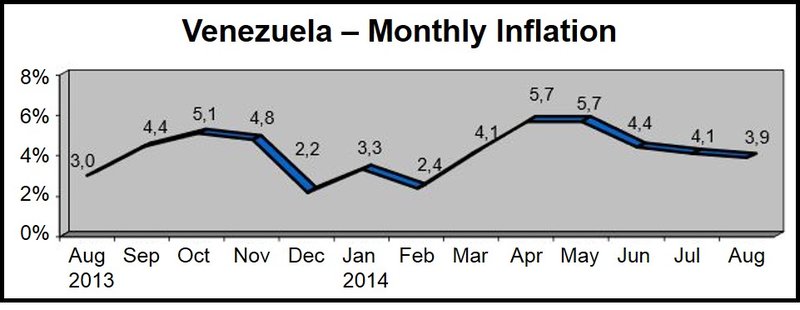
(Source: Banco Central de Venezuela)
Stricter dollar rationing drove imports down by 33% during the first six months of 2014, compared to H1 2012, the largest decline in three decades.
No urgently-needed reforms
Despite hopes that much-needed reforms would be considered, President Nicolás Maduro has done nothing to stabilize an economy that is plunging deeper into the abyss.
Rafael Ramirez, the only hope for introducing measures to re-establish price balance, was replaced on September 2 as Vice President for the Economy and Oil Minister; he is now Foreign Minister.
Mr. Maduro blames spiraling inflation on the months of street protests that occurred earlier this year. He said roads were blocked, stores had to close early, supplies could not get through properly, and prices rose. He also claims there is an American-led conspiracy to destabilize Venezuela and topple his administration.
Economists worldwide disagree with Maduro’s assessment. They say the problems are due to an explosive expansion of the money supply that is not linked at all to economic growth, rampant corruption, plus a scarcity of dollars that has made it extremely difficult for companies to import goods.
The Venezuelan government resorts to Soviet Union-styled measures when trying to resolve inflation. Price caps are imposed, which nearly always lead to serious shortages because manufacturers, wholesalers and retailers cannot earn a living and pull out.
Unfortunately for Venezuelan citizens, the only thing the government’s socialist experiment discovered after nearly a decade-and-a-half, is that all communist-style regimes – including Venezuela – end up having to implement rationing because the system does not produce enough goods and services for the population.
