
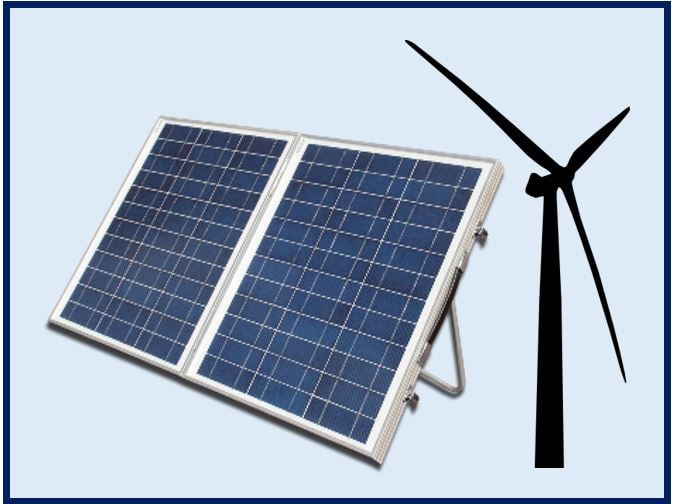
If the Sahara Desert had giant wind and solar farms, the area would be wetter, greener, and warmer researchers report. We know that solar and wind farms have local effects on humidity, heat, and other factors. Sometimes the effects are beneficial for the area. Other times, on the other hand, they can be detrimental.
In the case of the Sahara Desert, building massive wind and solar farms would benefit the area. Researchers from China, the United States, and Italy carried out a study.
They focused on what the effects of building wind and solar farms on a large scale in the Sahara might be. They also tried to determine what the effects on neighboring Sahel might be.
Lead author, Yan Li, and colleagues wrote about their study and findings in the journal Science (citation below). Dr. Li is a postdoctoral researcher in natural resources and environmental sciences at the University of Illinois.
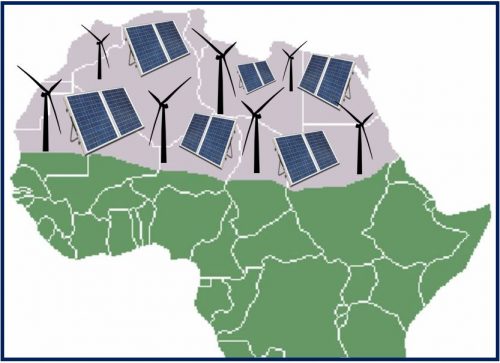
A greener, wetter, and warmer Sahara Desert
The researchers’ climate-modeling study found that the Sahara and Sahel would experience higher temperatures. There would also be more precipitation (rain) and vegetation.
They modeled the climate effects of solar and wind installations while taking into account how vegetation might respond to changes in rainfall and heat. Dr. Li said that it was the first time anybody had done this.
Dr. Li said:
“Previous modeling studies have shown that large-scale wind and solar farms can produce significant climate change at continental scales.”
“But the lack of vegetation feedbacks could make the modeled climate impacts very different from their actual behavior.”
Why the Sahara Desert?
Safa Motesharrei and Eugenia Kalnay, both from the University of Maryland, co-led the study. Regarding why they focused on the Sahara, Dr. Li explained:
“We chose it because it is the largest desert in the world; it is sparsely inhabited; it is highly sensitive to land changes; and it is in Africa and close to Europe and the Middle East, all of which have large and growing energy demands.”
More energy than the world needs
In the study simulations, the solar and wind farms covered over nine million square kilometers (3,474,919 square miles). They generated approximately 79 terawatts and 3 terawatts of electrical power respectively.
Dr. Li compared this production with the global requirement for electricity:
“In 2017, the global energy demand was only 18 terawatts, so this is obviously much more energy than is currently needed worldwide.”
Sahara desert – wind farms
According to their model, wind farms caused near-surface air temperatures to rise. The model also revealed that minimum temperatures rose more than maximum temperatures.
Regarding nighttime warming, the researchers wrote:
“The greater nighttime warming takes place because wind turbines can enhance the vertical mixing and bring down warmer air from above.”
Wind farms also increased rainfall by as much as (average) 0.25 millimeters per day. This was twice as much rainfall compared to what the control experiments had shown, Dr. Li said.
Wind farms increased rainfall in the Sahel by an average of 1.12 millimeters per day.
This increase in rainfall subsequently leads to greater vegetation cover, which leads to more rainfall, etc. In other words, there is a positive feedback loop.
Sahara Desert – solar farms
The solar farms also had a similar positive effect on rainfall and temperature. Their effect on wind speed, on the other hand, was minimal.
Prof. Kalnay said:
“We found that the large-scale installation of solar and wind farms can bring more rainfall and promote vegetation growth in these regions.”
“The rainfall increase is a consequence of complex land-atmosphere interactions that occur because solar panels and wind turbines create rougher and darker land surfaces.
Dr. Motesharrei said:
“The increase in rainfall and vegetation, combined with clean electricity as a result of solar and wind energy, could help agriculture, economic development and social well-being in the Sahara, Sahel, Middle East and other nearby regions.”
Wind and solar energy
Solar
Solar energy involves capturing the energy from the Sun and converting it into electricity. We also call it solar power.
The world’s largest generator of solar energy is China.
Wind
Wind energy involves capturing the energy from moving air, i.e., wind, and then converting it into electricity.
Renewable energy
Solar energy is renewable energy. So is wind energy. Renewable energy is energy whose source never runs out. In other words, we cannot use it up completely so that there is none left – that is, in a human timescale.
Other types of renewable energy include geothermal energy and biomass energy. Geothermal energy uses the Earth’s internal heat, while biomass energy uses the energy from plants and other organic matter.
Citation
“Climate model shows large-scale wind and solar farms in the Sahara increase rain and vegetation,” Yan Li, Eugenia Kalney, Safa Motesharrei, Jorge Rivas, Fred Kucharski, Daniel Kirk-Davidoff, Eviatar Bach, and Ning Zeng. Science 07 Sep 2018: Vol. 361, Issue 6406, pp. 1019-1022. DOI: 10.1126/science.aar5629.
