

Barclays H1 profit fell 7% to £3,349 million compared to £3,591 million in H1 last year, due mainly to currency movements and a decline in investment banking profitability. Adjusted income declined by 12% to £12,332 million while operating income dropped 9% to £12,246 million, the company announced today.
H1 operating expenses plunged 20% to £9.7 billion, while its return on equity was 6.5% down versus 7.8% last year.
Q2 profit up
Second quarter profit, however, increased to £161 million ($272.7 million) compared to a £168 million loss in Q2 2013.
On a negative note, the bank was hit by a £900 million provision for PPI (Payment Protection Insurance) mis-selling claims.
In another regulatory setback, the London-based bank said that the US Department of Justice has until June 27th next year to decide whether its foreign-exchange trading activities might have violated an existing agreement not to commit any crimes in the United States.
The bank had entered a non-prosecution agreement two years ago with the Justice Department after admitting that some of its traders had tried to rig interest rates. The two-year agreement, which started on June 26th, 2012, stipulates that Barclays has to hand over non-privileged data until June 2015 at the request of the Department of Justice.
Barclays undergoing a major transformation
Barclays, Britain’s second largest bank by assets, is undergoing a major overhaul, the aim being to transform it from an investment-banking dependent institution into a leaner high-street bank.
Earlier this year, Barclays said it planned to lay off 7,000 workers at its investment bank within the next two years, as part of its drive to cut 19,000 jobs across the whole company by 2017.
At the beginning of July, Barclays announced that it was abolishing bank cashiers. Its 6,500 traditional cashiers in the UK would be promoted to ‘community bankers’ with a 2.8% wage increase.
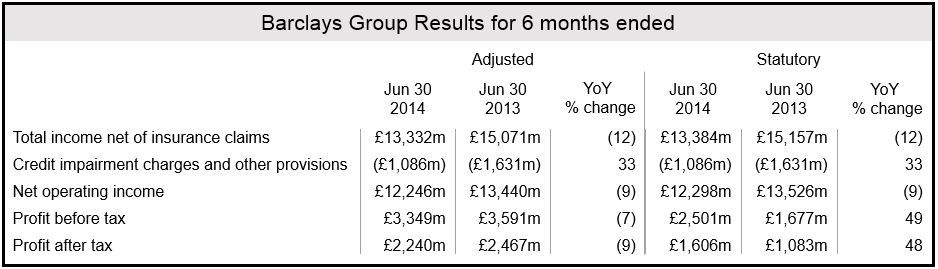
(Data source: Barclays Group)
Fixed income unit down, personal & corporate division up
The British lender’s profit before tax at its fixed income, currencies and commodities unit, traditionally its largest earner, fell by almost half year-over-year to £567 million. Restructuring costs pushed up expenses considerably at the division.
At the bank’s Barclaycard credit card unit plus its personal and corporate banking division, profit before tax partially offset lackluster investment banking performance.
Antony Jenkins, Barclays CEO, who is two years into his tenure, said:
“We are making encouraging progress in executing this plan (restructuring). Profits before tax in Personal & Corporate Banking and Barclaycard were up 23% and 24% respectively. Africa Banking also delivered a good performance with profits increasing 12% on a constant currency basis.”
“Performance in the Investment Bank was impacted by the repositioning underway as well as difficult trading conditions in the quarter, but it is where we expected it to be at this point. The strong performance of our Banking division is demonstrating the attractiveness of our new origination-led strategy to our clients.”
Barclays shares down
Compared to Europe’s forty-seven major banks, Barclays bank’s shares are struggling. Its shares have dropped 20% in value since the beginning of 2014, compared to a 1% increase among the top 47 banks.
According to Reuters data, Barclays’ shares trade at 0.6 times book value, while its European competitors trade at 1 times.
Dark pool trade accusation
In June, 2014, New York Attorney General Eric Schneiderman filed a lawsuit alleging that Barclays was involved in dark pool fraud. The complaint charges the bank of not telling investors how many predatory traders were active in the dark pool, and that it falsified documents and set up the system biased in favor of high-frequency traders.
The lawsuit accuses Barclays of misrepresenting the types of investors who were using the dark pool, i.e. that it lied about who was in the dark pool.
Attorney General Schneiderman said:
“The facts alleged in our complaint show that Barclays demonstrated a disturbing disregard for its investors in a systematic pattern of fraud and deceit. Barclays grew its dark pool by telling investors they were diving into safe waters. According to the lawsuit, Barclays’ dark pool was full of predators – there at Barclays’ invitation.”
