
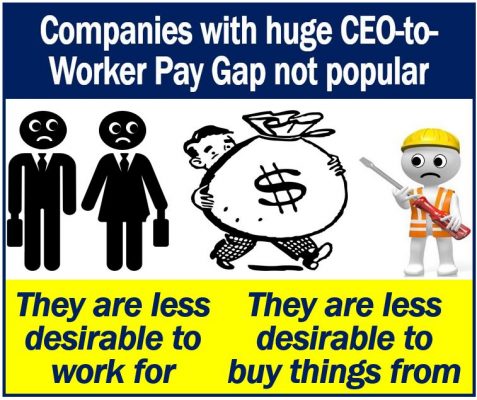
Employers with giant pay gaps are not popular. Companies whose CEO incomes are hundreds of times that of their average employees have a bad name. Specifically, they are less desirable places to buy things from. They are also less desirable places to work for, a new study has found.
Arianna H. Benedetti and Serena Chen set out to determine how people viewed companies. They wanted to see how people would feel about a company when they knew what its CEO’s pay was compared to its workers. They wrote about their study and findings in the Journal of Experimental Social Psychology (citation below).
Lead author, Arianna Benedetti, is a Ph.D. student in psychology at the University of California (UC), Berkeley. Serena Chen is a Psychology Professor at UC Berkeley.
The authors found that the people had a more negative perception of companies with the widest pay gaps. Both employees and consumers viewed them negatively.
Consumers and workers don’t like large pay gaps
Benedetti said:
“Our results indicate that consumers are less interested in purchasing from and getting a job at companies with high CEO-to-worker compensation ratios.”
Their study on pay gaps is timely in the face of the SEC’s new requirement. The SEC now requires that public companies disclose their CEO-to-worker pay ratios. SEC stands for the Security and Exchange Commission. The SEC enforces federal securities laws, proposes securities rules, and regulates the US securities industry. A public company is a company whose shares we, members of the public, can buy and sell on a stock exchange.
According to the most recent SEC filings, the average CEO-to-worker ratio is 361:1. In other words, the average public company in the US has a CEO who earns 361 as much as its average worker.
These pay gaps can be ten times wider in some Fortune 500 companies.
Study participants were less bothered by how much CEOs made than the size of the CEO-to-worker pay gaps. There appears to be a visceral disapproval of companies whose profits don’t trickle all the way down the corporate ladder.
Psychological aversion toward inequity
Regarding our attitude toward giant pay gaps, Prof. Chen said:
“This likely reflects a psychological aversion toward inequity, which develops early in life.”
“For example, if a CEO makes a great deal of money, but the average worker also makes a good wage, people feel that the wealth is being distributed more fairly and in turn will have a more positive impression of the company.”
Public distaste for huge CEO-to-worker pay gaps could translate into difficulties attracting investors and recruiting talent. It could also result in lukewarm reviews in Yelp and other crowdsourcing forums.
The disparity, however, did not influence participants’ perception of a company’s overall success. Neither did it influence their view of a company’s ability to innovate.
Moreover, when the participants learned more details about a top executive’s responsibilities, their negative feelings toward giant pay gaps lessened.
The study
The authors recruited over 1,000 participants across the USA via Amazon’s Mechanical Turk crowdsourcing platform. They also used Bay Area networks.
The participants had to read a detailed description of a fictitious company. However, the researchers had modeled the mock company after a real one.
Different participants saw different CEO-to-worker pay gaps. Ratios ranged from 25:1 to 350:1. The researchers could subsequently see how the participants’ evaluations were influenced by the size of the pay gaps.
The participants then rated the companies based on employee well-being, collaboration, innovation, and trustworthiness. They also rated the employers based on employee morale, ratio fairness, global impression, and work-life balance.
They then had to describe their likelihood of buying the company’s products and becoming one of its employees.
The results demonstrated consistently that companies’ external reputation and internal morale could be influenced by CEO-to-worker pay gaps. In other words, a huge pay gap had a negative influence while a small one had a positive influence.
Study findings reflect real-world data
The study results reflect real-world data that the researchers had gathered from Glassdoor.com, a job search website. Glassdoor.com data showed a connection between reviews of companies and CEO-to-worker pay ratios.
Benedetti said:
“Our study shows that CEO-to-worker ratios really matter to employees and consumers alike. These results demonstrate that, now that publicly traded companies have started to disclose their CEO-to-worker ratios, they need to be cognizant of and prepared for the effects such disclosure may have.”
Citation
“High CEO-to-worker pay ratios negatively impact consumer and employee perceptions of companies,” Arianna H.Benedetti and Serena Chen. Journal of Experimental Social Psychology, Volume 79, November 2018, Pages 378-393. https://doi.org/10.1016/j.jesp.2018.09.003.
