

If the Ebola epidemic continues in Guinea, Sierra Leone and Liberia and infects people in neighboring countries, the economic toll could reach $32.6 billion by the end of 2015, the World Bank warned on Wednesday.
So far, 3,439 have died in the three-most infected countries.
In a new World Bank report, the authors wrote:
“As it is far from certain that the epidemic will be fully contained by December 2014 and in light of the considerable uncertainty about its future trajectory, two alternative scenarios are used to estimate the medium-term (2015) impact of the epidemic, extending to the end of calendar year 2015.”
The report defines a ‘Low Ebola’ scenario as one in which the epidemic is contained in the three most severely affected nations, while a ‘high Ebola’ scenario corresponds to much slower containment in the three nations, plus infections spreading into regional countries.
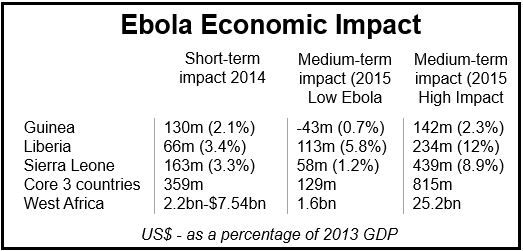
The report is titled ‘The Economic Impact of the 2014 Ebola Epidemic’.
Catastrophic economic impact potential
The Ebola epidemic’s economic impact in Liberia and Sierra Leona is already “very serious”, the report points out, and is highly likely to become “catastrophic” under a slow-containment scenario.
With comprehensive national and international action to halt the epidemic and alleviate the “aversion behavior” (fear factor) it is causing neighboring nations, the economic impact could be limited, the World Bank says.
Ebola so far contained
So far, the Ebola epidemic has been successfully contained in Senegal and Nigeria, thus demonstrating that under the right circumstances, its spread can be halted.
President of the World Bank Groups, Jim Yong Kim, said:
“With Ebola’s potential to inflict massive economic costs on Guinea, Liberia, and Sierra Leone and the rest of their neighbors in West Africa, the international community must find ways to get past logistical roadblocks and bring in more doctors and trained medical staff, more hospital beds, and more health and development support to help stop Ebola in its tracks.”
“The international community now must act on the knowledge that weak public health infrastructure, institutions, and systems in many fragile countries are a threat not only to their own citizens but also to their trading partners and the world at large. The enormous economic cost of the current outbreak to the affected countries and the world could have been avoided by prudent ongoing investment in health systems-strengthening.’’
What is Ebola?
Ebola virus disease (EVD), Ebola hemorrhagic fever (EHF) or simply Ebola is a disease that affects primates including humans when infected with the ebolavirus.
Infected patients develop symptoms within two days to three weeks, which include muscle pain, headaches and fever. The infected individual typically develops diarrhea and vomiting, after which a skin rash develops. Kidney and liver functions are also affected.
The body eventually bleeds both externally and internally. Up to 75% of patients die from the infection.
Exxon says the Ebola epidemic is disrupting its West African operations.
