
A Facebook LiveRail acquisition has been agreed between the start-up company that allows for more relevant banner ads to be targeted at online videos (web and mobile) and the world’s largest online social media network. Facebook describes the package as the complete advertising solution for video publishers.
Analysts say that online video advertising will expand considerably over the next few years. Facebook’s purchase of the 170-person company could help it gain a larger chunk of video advertising – the fastest growing medium on the internet today.
The digital-video market
Researcher EMarketer Inc. predicts that in the United States this year, the digital-video market will increase by 42% to $5.96 billion.
Facebook started offering short 15-second video ads from a selected number of companies in March this year. It is discreetly introducing them on its social network in the hope that users will accept them.
Marketers pay more money for video ads compared to other forms of online promotion, such as banner ads. As the Internet giants, such as Google, Yahoo, Twitter and Facebook strive to sustain strong growth, they are racing to grab a slice of TV-marketing budgets.
So far, Facebook, unlike Google, has not got into the business of helping other media firms better monetize their online ads.
Rival Twitter announced earlier this week that it acquired TapCommerce, a mobile advertising firm. According to Twitter, via TapCommerce’s service mobile app marketers will have “more robust capabilities for app re-engagement, tools and managed service solutions for real-time programmatic buying, and better measurement capabilities.”
Experts believe social networks will grab a large share of this expanding market. The BBC quotes Sanjana Chappalli, Asia-Pac head of LEWIS Pulse, a company that specializes in digital marketing, who said “It is no longer about saying, ‘My ad was was seen by so many people.’ But it is now about knowing who those people are and how they have responded to the information fed to them. And on that front, social networks enjoy a tremendous advantage over everyone else.”
Deal likely worth $500 million
The two companies did not disclose how much money changed hands, but US media believe Facebook probably paid up to $500 million to buy LiveRail.
Facebook’s Vice President of Ads Product Marketing and Atlas, Brian Boland, wrote in the company’s newsroom:
“We believe that LiveRail, Facebook and the premium publishers it serves have an opportunity to make video ads better and more relevant for the hundreds of millions of people who watch digital video every month.”
“More relevant ads will be more interesting and engaging to people watching online video, and more effective for marketers too. Publishers will benefit as well because more relevant ads will help them make the most out of every opportunity they have to show an ad.”
LiveRail, a rapidly-growing start-up
LiveRail, which claims to deliver 7 billion video ads each month, is the world’s biggest programmatic platform for video publishers. Its customers include Daily Motion, Major League Baseball, A&E Networks, ABC Family, Gannett, and hundreds of others.
Headquartered in San Francisco, LiveRail also has offices in New York, London, and Romania. The company was launched in 2007.
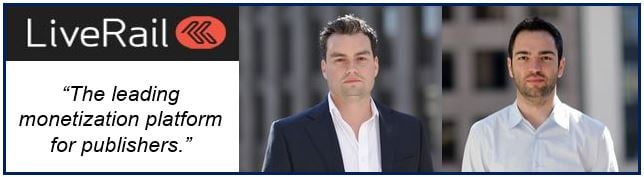
LiveRail was founded in 2007 by Mark Trefgarne (left) and Andrei Dunca (right).
LiveRail’s CEO, Mark Trefgarne, said:
“This announcement marks the beginning of a new chapter for the team at LiveRail, and I’m incredibly grateful to all the amazing people who have helped build this company to where it stands today. I’m confident that as part of the Facebook family, our team has the opportunity to redefine the ad tech landscape and set a new standard in technology for publishers.”
According to TechCrunch, in 2013 LiveRail had forecast revenues of $100 million. It had been considering an initial public offering this year.
