
A method to increase how much electric charge graphene can store has been discovered by a team of engineers at the University of California, San Diego. They found that charged defects may be useful for energy storage.
Graphene, the strongest material known to science, 200 times stronger than steel, is also the thinnest and lightest material we know of. It consists of a single layer of pure carbons – making it two-dimensional – arranged in a hexagonal lattice pattern.
Prabhakar Bandaru, who works at the University’s Jacobs School of Engineering, and colleagues wrote in the academic journal Nano Letters that their research may provide a better understanding of how to improve the energy storage ability of capacitors for potential applications in solar power, wind turbines and cars.
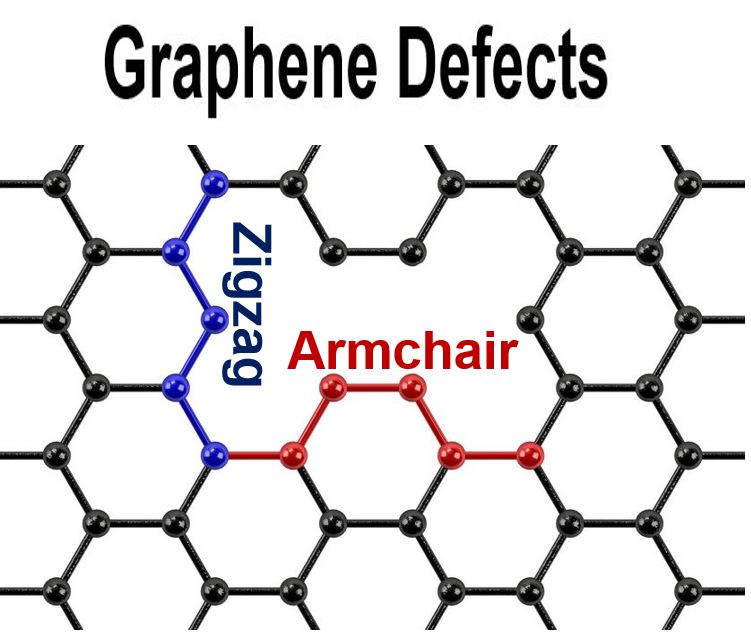 Zigzag and armchair defects in graphene. (Image: jacobsschool.ucsd.edu)
Capacitors charge and discharge rapidly, and are more useful for fast, large bursts of energy, such as in power plants and camera flashes.
Improving the energy storage of capacitors
Their ability to charge and discharge rapidly is an advantage over the long charge time of batteries. However, capacitors have one major problem – they store much less energy than batteries.
How can a capacitor’s energy storage be improved? One approach Bandaru and colleagues used was to introduce more charge into a capacitor electrode using graphene as the model material for their experiments.
The principle is that a greater charge leads to increased capacitance, which translates into more energy storage.
How it is made
Creating a perfect carbon nanotube structure – one with no defects, which are holes corresponding to missing carbon atoms – is virtually impossible.
Instead of avoiding defects, the scientists figured out a practical way to use them.
Bandaru said:
“I was motivated from the point of view that charged defects may be useful for energy storage.”
The scientists at Bandaru’s lab used a method called argon-ion based plasma processing, in which positively-charged argon ions are bombarded onto graphene.
During the bombardment, carbon atoms are knocked out of the graphene layers and leave holes behind containing positive charges – these are the charged defects.
By exposing the graphene sample to argon plasma, the capacitance of the materials improved by a factor of three.
First author, Rajaram Narayanan, a graduate student in professor Bandaru’s research group, said:
“It was exciting to show that we can introduce extra capacitance by introducing charged defects, and that we could control what kind of charged defect we could introduce into a material.”
Using electrochemical measurements and Raman spectroscopy, the researchers were able to characterize the kinds of defects that argon plasma processing introduced into the graphene lattices.
Zigzag and armchair defects
The results showed the formation of extended defects, known as ‘zigzag’ and ‘armchair’ defects, which are named based on the configurations of the missing carbon atoms.
Electrochemical studies helped the researchers discover a new length scale that meausres the distance between each charge.
Bandaru said:
“This new length scale will be important for electrical applications, since it can provide a basis for how small we can make electrical devices.”
Earlier this month, a team of scientists from the The Institute of Photonic Sciences, Barcelona, Spain, reported that graphene can convert light to electricity at incredibly fast speeds, which could have a major impact on a number of technologies, ranging from cameras to solar cells. They believe their discovery could take data communications applications to their next level.
An Italian team of scientists sprayed some spiders with a solution of water and graphene. They produced incredibly strong webs, strong enough to catch a falling airplane.
Citation: “Bandaru. Modulation of the Electrostatic and Quantum Capacitances of Few Layered Graphenes through Plasma Processing,” R. Narayanan, H. Yamada, M. Karakaya, R. Podila, A. M. Rao, and P. R. Nano Letters. Published online 31 March, 2015. DOI: 10.1021/acs.nanolett.5b00055.
