
A graphene based microphone was found to be almost 32 times more sensitive than the standard nickel-based ones, researchers from Serbia and France reported. They said graphene’s extremely high mechanical strength and super-light weight makes it an ideal material for sound devices.
The scientists, from the University of Belgrade, created a vibrating membrane from graphene. The vibrating membrane is part of a condenser microphone that converts sound to a current. They were able to show up to 15 dB greater sensitivity compared to a standard, commercial microphone, at frequencies up to 11 kHz.
Marko Spasenovic, Assistant Professor at the Institute of Physics, Belgrade University, and colleagues in Serbia and the Laboratoire de Photonique et de Nanostructures (Laboratory for Photonics and Nanostructures) in France, wrote about their study results in the academic journal 2D Materials.
 Acoustics is just one of many fields where graphene’s potential shows enormous promise. (Image: generic microphone – ioppublishing.org)
Graphene – great potential for real world applications
Prof. Spasenovic said:
“We wanted to show that graphene, although a relatively new material, has potential for real world applications. Given its light weight, high mechanical strength and flexibility, graphene just begs to be used as an acoustic membrane material.”
The graphene membrane, about 60 layers thick, was formed on a nickel foil using chemical vapour deposition, to make sure quality was consistent across all the samples.
While the membrane was being produced, the nickel foil was etched away and the graphene membrane placed in the same housing as a commercial microphone in order to make a direct comparison. This showed a 15dB greater sensitivity than a standard, commercial microphone.
Prof. Spasenovic and team also simulated a 300-layer thick graphene membrane, which showed potential for performance far into the ultrasonic part of the spectrum. Ultrasonic refers to sound waves with a frequency above the upper limit of human hearing.
Prof. Spasenovic added:
“The microphone performed as well as we hoped it would. A thicker graphene membrane theoretically could be stretched further, enabling ultrasonic performance, but sadly we’re just not quite there yet experimentally.”
“At this stage there are several obstacles to making cheap graphene, so our microphone should be considered more a proof of concept. The industry is working hard to improve graphene production – eventually this should mean we have better microphones at lower cost.”
What is graphene?
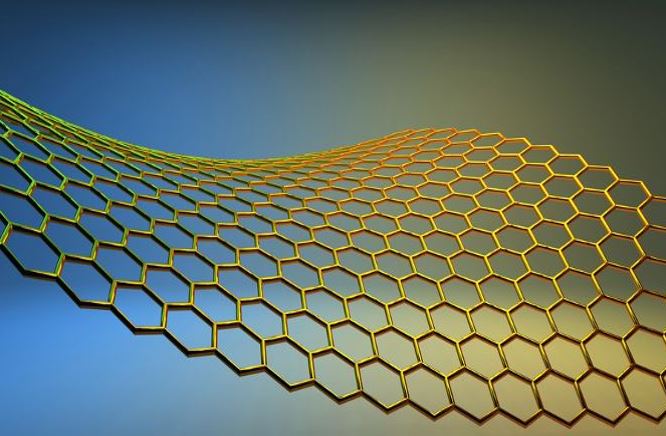
Graphene is a single layer of pure carbon atoms arrange in a hexagonal (six-sided) lattice pattern. It is the strongest material we know of – 207 times stronger than steel. It is also the world’s thinnest and lightest material.
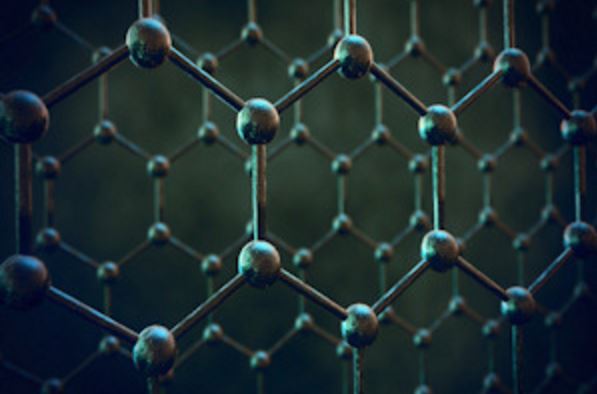 Graphene is the thinnest, lightest and strongest material we know of.
Graphene is so thin it is considered to be a 2-D object. First measurably produced and isolated in 2004, scientists say it has enormous potential for industry, hi-tech, medical devices and several other sectors.
Graphene also has amazing thermal and electrical conductivity properties. It is unusual in that apart from being super-strong and ultra-thin, it is also flexible.
Its potential applications include electric circuits, solar cells, several chemical, industrial and medical processes, super-thin and flexible display screens and other optoelectronic devices, biomicrorobotics, nanotechnology, lithium batteries, storing hydrogen for fuel cell powered cars, and scores of other possibilities.
Citation: “Multilayer graphene condenser microphone,” Dejan Todorović, Aleksandar Matković, Marijana Milićević, Djordje Jovanović, Radoš Gajić, Iva Salom and Marko Spasenović. 2D Materials. 26 November, 2015. DOI: 10.1088/2053-1583/2/4/045013.
