

Researchers are now moving from hybrid cars to hybrid airplanes. A team from the University of Cambridge has successfully tested a hybrid aircraft that can recharge its batteries in flight, thus taking the first step towards low-carbon air travel.
The prototype plane, which was created thanks to funding from The Boeing Company, is based on a commercially-available single seat aircraft. Engineers at Cambridge designed and built the hybrid engine.
The aircraft uses a combination of an electric motor/generator and a 4-stroke piston engine, coupled through the same drive pulley to turn the propeller.
The engine and motor work together when the plane is taking off and climbing. However, as soon as it reaches cruising height, the electric motor is then switched to generator mode to recharge the battery. It can also be used in motor-assist mode to minimize fuel consumption.
The team say it uses the same principle as that used in a hybrid car.
Team leader, Dr Paul Robertson of Cambridge’s Department of Engineering, said:
“Although hybrid cars have been available for more than a decade, what’s been holding back the development of hybrid or fully-electric aircraft until now is battery technology. Until recently, they have been too heavy and didn’t have enough energy capacity.”
“But with the advent of improved lithium-polymer batteries, similar to what you’d find in a laptop computer, hybrid aircraft – albeit at a small scale – are now starting to become viable.”
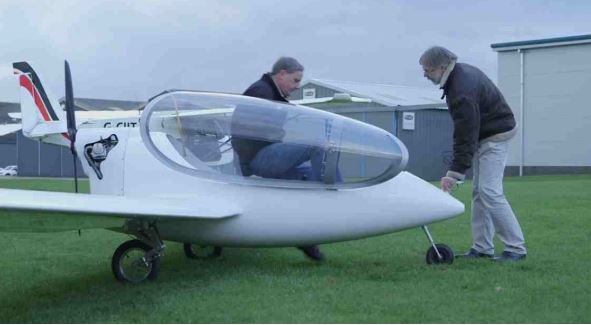
The world’s first hybrid-electric aircraft that can recharge itself while flying.
The Cambridge prototype’s hybrid power system is based on a Honda engine in parallel with a custom-made lightweight motor.
The aircraft has a set of 16 large lithium-polymer cells (batteries) located within its wings. The Engineering Department designed and build a power electronics module that controls the electrical current to and from the batteries.
The gasoline engine has been optimally-sized to provide cruise power at its “most efficient operating point,” resulting in overall improved fuel efficiency.
Marty Bradley, Boeing’s principal investigator for the program, said:
“Our mission is to keep our sights on finding innovative solutions and technologies that solve our industry’s toughest challenges and continually improve environmental performance. Hybrid electric is one of several important elements of our research efforts, and we are learning more every day about the feasibility of these technologies and how they could be used in the future.”
A commercially-viable hybrid aircraft one day?
While their prototype is a major step towards the development of a hybrid or fully-electric airplane, much more research is required before commercial airplanes powered by electric motors may come onto the market.
With current technology, a modern jetliner could only fly for ten minutes if it were entirely powered by batteries.
The team tested their prototype at the Sywell Aerodrome near Northampton in the East Midlands in England. The tests consisted of a series of hops along the runway, followed by longer flights reaching an altitude of 1,500 feet.
Robertson’s team includes MEng student Tim Corker, and PhD students Andre Thunot and Christian Friedrich.
