
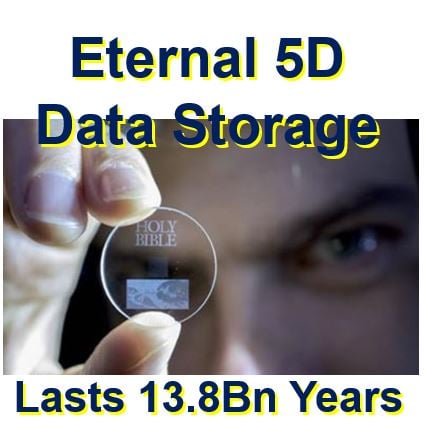
An incredible 5D digital data storage in nanostructured glass that lasts billions of years has been created by a team of scientists at the University of Southampton in England. This ultra-advanced recording and retrieval process using femtosecond laser writing takes this technology to a completely new level.
The researchers, who work at the University’s Optoelectronics Research Centre (ORC), said their storage system allows unprecedented properties including 360 TB/disc data capacity, virtually unlimited lifetime at room temperature (at least 13.8 billion years at 160 centigrade), and thermal stability at 1,000 °C.
The Big Bang – the birth of our Universe – occurred 13.7 billion years ago. If this data storage can be kept intact for 13.8 billion years, it means it could outlive the current age of our Universe.
 Tons of data can be stored in that small glass disk virtually forever. (Image: southampton.ac.uk)
A new era of everlasting data archiving
This technology opens an entirely new era of eternal data archiving, say scientists across the world.
As an extremely stable and safe from of portable memory, this 5D data storage could be highly useful for organisations with lots of large archives, such as libraries, museums and national archives, to preserve their data and records.
In 2013, scientists first experimentally demonstrated the technology, when a 300 kg digital copy of a text file was recorded in 5D successfully.
Since then, the scientists have managed to save major documents from human history including the Kings James Bible, the Magna Carta, Newton’s Opticks, and the Universal Declaration of Human Rights (UDHR).
Recently, a copy of the Universal Declaration of Human Rights was presented to UNESCO by the Optoelectronics Research Centre at the International Year of the Light closing ceremony in Mérida, Yucatan, Mexico.
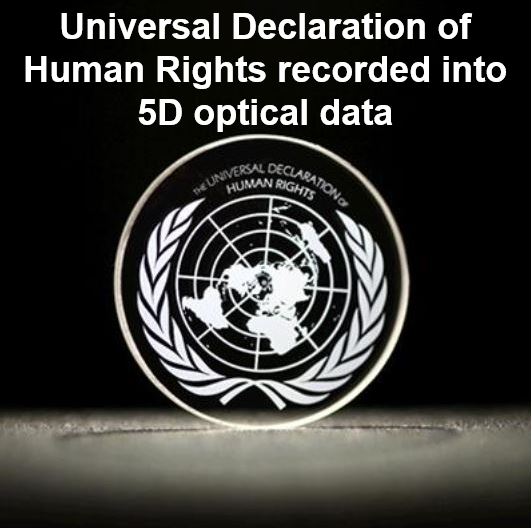 The next time we send a spacecraft into deep space with the intention of telling intelligent aliens about us, we could store all the data about human civilisation in small glass disks. If an extraterrestrial recovers it billions of years in the future, the data will still be intact. (Image: southampton.ac.uk)
Data storage using nanostructures
The data in the documents was recorded using ultra-fast laser, producing very short and intense pulses of light. The file is written in three layers of nanostructured dots separated by five micrometres. One micrometer is one millionth of a metre.
The nanostructures, which are self-assembled, alter the way light travels through glass, changing the polarization of light that can then read by combination of a polarizer and an optical microscope, similar to that found in Polaroid sunglasses.
Nicknamed the Superman memory crystals, like the ‘memory crystals’ used in the Superman movies, the data is recorded via self-assembled nanostructures created in fused quartz.
Data encoding in 5 dimensions
The data encoding is realized in five dimensions – the orientation and size, plus the three dimensional position of these nanostructures.
Peter G. Kazansky, a Professor at the ORC, leading a group in physical optoelectronics, said regarding this data storage breakthrough:
“It is thrilling to think that we have created the technology to preserve documents and information and store it in space for future generations.”
“This technology can secure the last evidence of our civilisation: all we’ve learnt will not be forgotten.”
The scientists will present their research and achievements at the photonics industry’s SPIE – The International Society for Optical Engineering Conference in San Francisco, California, this week.
The invited paper 5D Data Storage by Ultrafast Laser Writing in Glass (citation below) will be presented today – Wednesday 17 February, 2016.
In an Abstract of their presentation, the authors wrote:
“The storage allows unprecedented parameters including hundreds of terabytes per disc data capacity and thermal stability up to 1000°C. Even at elevated temperatures of 160°C, the extrapolated decay time of nanogratings is comparable with the age of the Universe – 13.8 billion years.”
“The demonstrated recording of the digital documents, which will survive the human race, including the eternal copies of Kings James Bible and Magna Carta, is a vital step towards an eternal archive.”
The scientific team is currently actively seeking industry partners interested in developing this ground-breaking new technology further and commercializing it.
Citation: “Eternal 5D data storage by ultrafast laser writing in glass (Invited Paper),” Paper 9736-29, Time: 4:20 PM – 4:50 PM. Author(s): Jingyu Zhang, Univ. of Southampton (United Kingdom); Aušra Cerkauskaite, Rokas Drevinskas, Aabid Patel, University of Southampton (United Kingdom); Martynas Beresna, Peter G. Kazansky, Univ. of Southampton (United Kingdom). SPIE — The International Society for Optical Engineering Conference. 17 February, 2016.
Video – Fabrication process for 5D optical storage

Comments are closed.