
Italian banking is going to damage the EU significantly more than Brexit, say economists, who fear that Italy’s teetering banks will shake the trading block to its core, making Brexit seem like a minor irritation in comparison. For the past three weeks, the 23rd June referendum and its shocking result – Britons voted to leave the European Union (EU) – has taken the limelight as far as crisis and panic news is concerned, allowing Italy’s banking system to hide in the shadows.
However, mega-bad news can never stay hidden for very long, like the energy that accumulates in a pressure cooker, it eventually finds a way out. That is why headlines have started to appear in several financial publications, including the Financial Times – ‘Italy’s Banking Crisis‘ – and The Economist – ‘Italy’s Teetering Banks will be Europe’s Next Crisis‘.
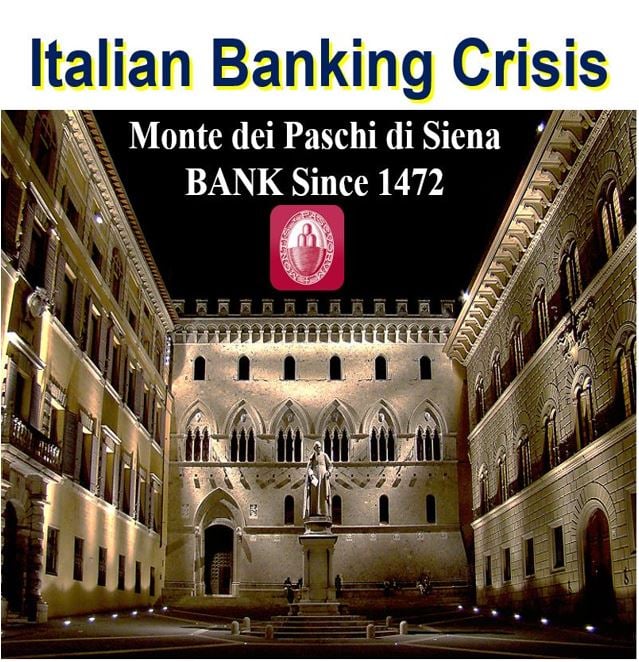 Monte dei Paschi di Siena is the world’s oldest bank and Italy’s third largest. It is in serious trouble. (Image: adapted from Wikipedia)
How does Italy get away with it?
Italy is an enigma for economists, EU citizens, and their counterparts across the globe. How can this country, one of the EU’s founding members, manage to pay lip-service to all the rules and follow so few of them?
It more or less hides its deficit – not that difficult to determine – and refuses to do anything about its €2.3 billion indebtedness, which represents 132% of the country’s whole GDP while the European regulation insists on a maximum of 60%.
Italian banks have literally driven themselves into the abyss – one that would have London or New York bankers running for the hills. How on Earth did they manage to go from bad debts representing 6% of all their loans during the financial crisis to a whopping 17% today?
Georges Ugeux, Chairman and CEO, Galileo Global Advisors and Adjunct professor at Columbia Law School, writing in the Huffington Post points out a fact regarding the heads of the European Central Bank and the European Banking Authority, plus the Director-General Economic and Financial Affairs of the European Commission – THEY ARE ALL ITALIAN!!
Prof. Ugeux also points to the weakness of governance of the EU. He wrote: “The perfect example is the process to fine Spain and Portugal for breaching some ratios a few years ago and the lack of sanction when it comes to Italy, and probably for that matter Germany and France.”
 If you thought Brexit triggered a crisis in the European Union, wait until the Italian Banking Crisis explodes – and it definitely will with a big bang!
Unless the smaller EU nations get together to create a counter-power to the big boys to derail their complacency, these smaller countries risk being the first casualties of the European Commission’s or ECB’s policies that are well tilted in favour of the larger economies.
Italy’s third largest bank – Monte dei Paschi di Siena – is in dire straits and will need a major rescue effort. It managed to lose ninety percent of its market capitalization, and that was after a significant capital injection. It failed the stress test miserably, with an equity shortfall that reached €8 billion, while the ECB stress test limited it to €2 billion.
Banca Popolare di Vicenza, despite passing the stress test needs to be recapitalized to the tune of €1 billion. Unicredit, Italy’s biggest bank and its major shareholder, says it does not have the money needed without violating its own capital rules.
Italian banking crisis has a long reach
Other banks within the Eurozone but outside Italy are also shareholders in Italian banks. The country’s fourth largest bank, Banca Nazionale del Lavoro, is owned by BNP Paribas, for example.
Any major banking crisis in Italy would have a nasty ripple effect well beyond its borders – some say an Italian banking collapse would trigger unpleasant financial tremors globally across the whole world of banking.
Last week The Economist wrote:
“Italy’s banks are in deep trouble, burdened by some €360 billion ($400 billion) of souring loans, the equivalent of a fifth of the country’s GDP. Collectively they have provisioned for only 45% of that amount. At best, Italy’s weak banks will throttle the country’s growth; at worst, some will go bust.”
Economists say it is no longer a question of whether an Italian banking crisis will hit with an almighty explosion, but how and when. They are all sure of one thing – the whole thing will definitely come tumbling down.
Video – European Banking Crisis Imminent
According to this video, not only are Italian banks in trouble, but also banks across the whole of Europe, including some household names such as Deutsche and Santander.
