
A rare original part of one of the world’s first computers – EDSAC (Electronic Delay Storage Automatic Calculator) – has resurfaced in the United States. People involved in its reconstruction now believe other parts may still be in existence.
The part that resurfaced, a chassis (known as Chassis 1A) to hold 28 of the EDSAC valves, has been donated to the EDSAC reconstruction team at The National Museum of Computing (TNMOC) in Bromham, Bedfordshire, England.
The ongoing reconstruction of EDSAC, which was originally built at Cambridge University in the late 1940s, is on display at the Museum. The team expect the reconstruction to be completed later this year. Members say the display is already a very popular exhibit, especially among the several educational groups that visit the Museum.
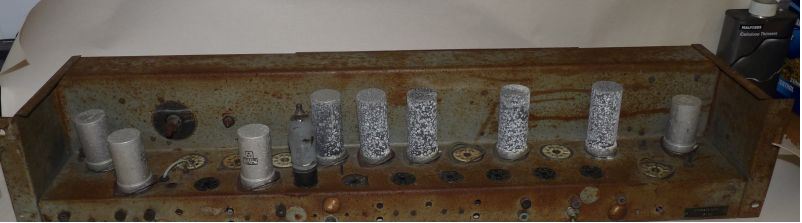
Chassis 1A, a Storage Regeneration Unit from one of the world’s first computers, was donated to the Museum by Robert Little. (Image: The National Museum of Computing)
When EDSAC was decommissioned in the 1950s, the recovered Chassis part is thought to have been sold off at some type of auction.
Leader of the EDSAC reconstruction project, Andrew Herbert, said:
“Details of the ‘auction’ are unclear, but there is a possibility that other parts of the original EDSAC still exist and could even be in the Cambridge area stored away in lofts, garden sheds and garages. We would very much like to hear from anyone who thinks they may have other parts.”
Mr. Little, a kind donor
Robert Little, from Allentown, Pennsylvania, USA, kindly donated the Chassis after reading about TNMOC’s reconstruction of EDSAC. He had obtained it from Dr. Robert E. Clark in 1969, who at the time lived in Cambridge, England.
Dr. Clark had previously bought three of four EDSAC racks and had planned to turn them into bookshelves. The other chassis were later discarded, but it is possible that some may have been given to colleagues.
Mr. Little said:
“I regret that the probability of finding any more of Dr. Clark’s EDSAC parts is vanishingly small. Dr Clark passed away in 1984. Sometime between 1969 and 1984 he relocated to a house on the outskirts of Cambridge and quite probably disposed of unneeded things then.”
“The bulk of the machine was most likely destroyed. I have a vague recollection of Dr. Clark describing how he was bidding against the local scrap metal dealer when he won the EDSAC parts at auction. Despite this, I am hopeful that those who built and worked with EDSAC kept other mementos that have been preserved intact until now.”
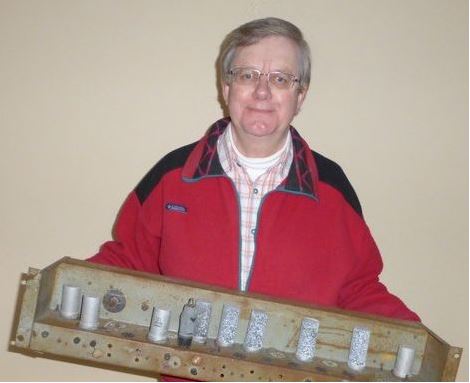
Andrew Herbert, EDSAC Project Leader, with the original rediscovered Chassis 1A. (Image: The National Museum of Computing)
Mr. Herbert said:
“Chassis 1A is quite distressed with corrosion and much of the wiring has broken away from tag strips. It would be a major task to return this particular chassis to operating condition. However, we hope to try to use some of the valves, if they are still functional, in our reconstructed EDSAC thus providing a very tangible connection with the original machine.”
“We would very much like to know if more of these chassis have survived. We think that as many as 42 of this type existed in the original machine. When EDSAC was decommissioned, only three chassis were thought to be in existence – one in the Cambridge University Computer Laboratory (since loaned to The National Museum of Computing), one in the London Science Museum and one in the Computer History Museum in Silicon Valley.”
“This is the first time any of our Project Team has heard of the auction and it’s tantalizing to think that more parts of the original EDSAC might be out there – somewhere! It is also exciting to think that we may have stumbled across the first computer auction!”
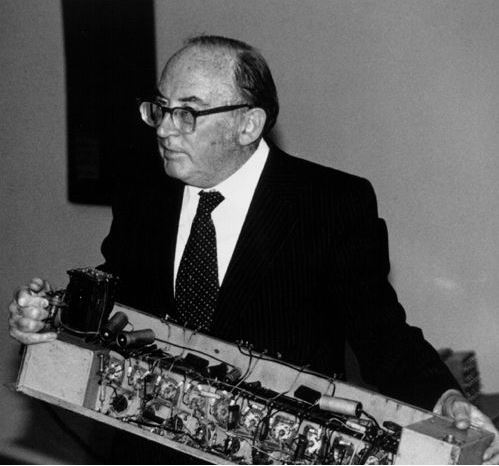
Sir Maurice Wilkes (1913-2010), head of the EDSAC team in the 1940s, holding an original chassis. Sir Maurice has been credited with several important developments in computing. (Image: The National Museum of Computing)
The chassis were key EDSAC components. EDSAC, which was built in modular fashion, had 12 vertical racks which held up to 14 individual horizontal chassis. Each chassis provided all or part of one of the computer’s logically distinct functional units.
At the time, there were around seventy different types of chassis. While some were replicated, others were represented only once. Chassis type 1A was a Storage Regeneration Unit that kept data recirculating through a short or long tank. There were a total of forty-two Store Regeneration Units.
According to the Museum “The chassis variants look quite similar: they all have two long rows of 14 holes each, for valve-holders, allowing each chassis to hold up to 28 valves. Given that it takes three pentode and two diode valves to build an ‘AND’ gate, each EDSAC chassis is therefore barely equivalent to even the simplest of modern integrated circuits.”
Chassis 1A is the latest welcome surprise find for the EDSAC Project Team. In 2014, some early computer diagrams that had been in storage for decades resurfaced.
