
Americans are not happy with their country’s current economy and fear that it is going to get worse. Pessimism about the economy has now spread to all socioeconomic groups, including the upper classes—that is, individuals and families with considerable financial reserves and investment portfolios.
In March 2026, consumer sentiment dropped six percent, declining to 53.3, its lowest level since December 2025, according to the University of Michigan.
The University of Michigan wrote the following regarding March’s consumer sentiment:
“Consumers with middle and higher incomes and stock wealth, buffeted by both escalating gas prices and volatile financial markets in the wake of the Iran conflict, exhibited particularly large drops in sentiment. Overall, the short-run economic outlook plunged 14%, and year-ahead expected personal finances sank 10%, while declines in long-run expectations were more subdued.”
“These patterns suggest that, at this time, consumers may not expect recent negative developments to persist far into the future. These views are subject to change, however, if the Iran conflict becomes protracted or if higher energy prices pass through to overall inflation.”
Oil has become more expensive
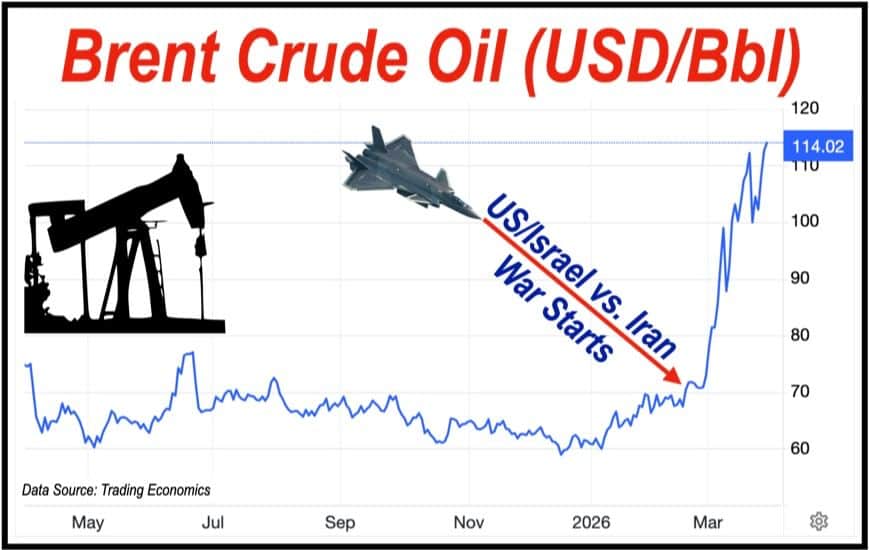
The military attack on Iran by the US and Israel, which started on 27 February and is in its fifth week, has pushed up the price of oil and gas, which means that gasoline, diesel, and butane gas have become much more expensive. Brent Crude, a global benchmark price for oil, has increased to over $115 per barrel, compared to about $75 five weeks ago.
The US President says that members of his Administration are engaged in talks with Iran. For several days, Iran has insisted that no such talks have taken place. Consumers in North America, Europe, Australia, Japan, China, and the rest of the world wonder who is telling the truth. Both Trump and the Iranian government are known to be unreliable sources of information. Who would have thought twenty years ago that in today’s advanced democracies, citizens would be unable to tell who was telling the truth, the US President or the Iranian government?
Oil prices and recession
Oil price rises can trigger much more than just frustrated moans and consumer tantrums. They can reach a point at which more and more companies are no longer profitable. If you have a business that is heavily reliant on the price of gasoline, diesel, or butane gas, your risk of going bankrupt increases if the prices of fossil fuels keep rising.
In the 1970s, there were two oil price increases—1973 and 1979—which were both followed by recessions. Unemployment rose and there was high inflation (stagflation). In 1973, the price of oil rose by 300% to 400%; history and economics books today refer to it as the “oil shock.” In 1979, oil prices doubled.
Since the end of February, when the Iran war started, the price of petroleum (Brent Crude) has increased by 55%. Over the same period, gasoline prices have risen by about 25% in the US, 40% in the UK, 35% in Germany, 30% in Japan, and 20% in China.
If the Iran war drags on for many months, economic forecasts will become more pessimistic. The value of company shares will decline, which will lead to lower spending, and eventually, a recession.
