
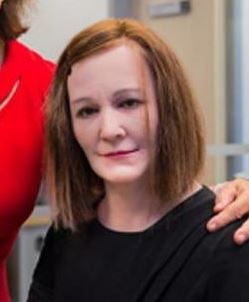
Nadine is a socially intelligent robot who is friendly, greets you back, makes eye contact, and remembers all the nice chats you had with her – she will never forget your name, say scientists at Nanyang Technological University (NTU) in Singapore.
Nadine is a ‘receptionist’, and looks nearly like a normal human female. Her skin is soft and her brunette hair flows like a human’s.
When this robot greets you she smiles and looks you in the eye when talking. Nadine is a humanoid that can also shake hands. A humanoid is something that looks just like a human being.
 Professor Nadia Thalmann (standing), next to the socially intelligent robot Nadine. (Image: http://news.ntu.edu.sg)
A socially intelligent robot with a personality
Nadine is not like other robots. She has her own personality, with its unique mood and emotions. Her mood reflects the tone or theme of the conversation. She may be happy or sad – it depends on what you are talking about.
Her memory is flawless – she can recognise anybody she has met, and remembers everything that was discussed.
She is named after Professor Nadia Thalmann, a Swiss Canadian computer graphics scientist, Director of the Institute for Media Innovation at Nanyang Technological University, and founder and head of the MIRALab Research Laboratory at the University of Geneva.
Nadine has many potential uses
Nadine is powered by intelligent software similar to Microsoft’s Cortana or Apple’s Siri. Researchers believe she may eventually become a personal assistant in work environments or in the home. She could also be used as a social companion for elderly or young individuals.
The technology that operates Nadine could also be used to appear as a virtual entity on a computer monitor or TV, i.e. your low-cost virtual social companion.
As silicon chips become more sophisticated, physical social robots like Nadine are expected to become more visible in homes and offices in future.
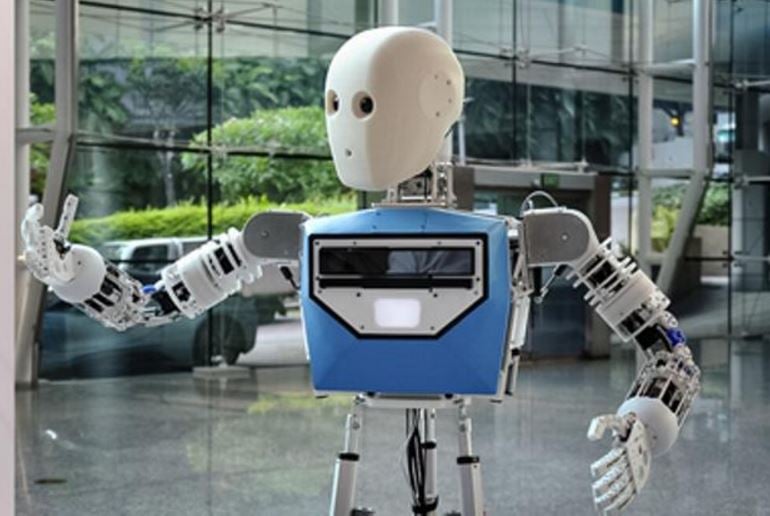 You can operate EDGAR from the other side of the world, if you want. He mimics your gestures and can even deliver speeches. (Image: news.ntu.edu.sg)
The emergence of social robots
Prof Thalmann, who led the development of Nadine, said:
“Robotics technologies have advanced significantly over the past few decades and are already being used in manufacturing and logistics. As countries worldwide face challenges of an aging population, social robots can be one solution to address the shrinking workforce, become personal companions for children and the elderly at home, and even serve as a platform for healthcare services in future.”
“Over the past four years, our team at NTU have been fostering cross-disciplinary research in social robotics technologies – involving engineering, computer science, linguistics, psychology and other fields – to transform a virtual human, from within a computer, into a physical being that is able to observe and interact with other humans.”
“This is somewhat like a real companion that is always with you and conscious of what is happening. So in future, these socially intelligent robots could be like C-3PO, the iconic golden droid from Star Wars, with knowledge of language and etiquette.”
EDGAR allows you to be in two places simultaneously
Nadine’s robot cousin EDGAR was also put through its paces at the new media showcase at NTU, complete with two highly-articulated arms and a rear-projection screen.
EDGAR is a telepresence robot – he allows you to be in two places at the same time. This robot is optimized to project the gestures of its human user. If you stand in front of a specialized webcam, you can control EDGAR remotely from the other side of the world.
Your face and expressions are displayed on EGDGAR’s face in real time. It also mimics your upper-arm movements.
EDGAR can even deliver a speech by autonomously acting out a script. With his integrated webcam, he automatically tracks the people he meets to engage with in conversation, replying to their questions with informative and sometimes witty answers.
This type of robot is ideal for using at public venues, such as shopping centres and tourist attractions, because it can offer practical information to visitors.
EDGAR was created in Singapore by a team led by Associated Professor Gerald Seet, from the School of Mechanical & Aerospace Engineering and the BeingThere Centre at NTU.
Prof. Seet said:
“EDGAR is a real demonstration of how telepresence and social robots can be used for business and education. Telepresence provides an additional dimension to mobility. The user may project his or her physical presence at one or more locations simultaneously, meaning that geography is no longer an obstacle.”
“In future, a renowned educator giving lectures or classes to large groups of people in different locations at the same time could become commonplace. Or you could attend classes or business meetings all over the world using robot proxies, saving time and travel costs.”
The researchers say they now plan to find partners in industry so that they can bring these robots to the market.

