
UK construction is officially in recession, figures show, as infrastructure and housebuilding output both declined in the second quarter of 2016. Economists fear this could be just the tip of the iceberg – the first of many sectors to show a downturn as the country enters a predicted recession later this year.
If an economic recession does occur this year, it will be self-inflicted – the result of a 23rd June referendum in which the Britons voted for Brexit – Britain Exiting the European Union.
The construction sector posted an overall decline of 0.7% in the three months ending on 30th June, following a 1.1% contraction in the first quarter. Compared to the same period last year, output was 1.4% down.
 UK construction, which already saw two declining quarters, is likely to have a worse second half because of a deterioration in consumer and business confidence following the Brexit vote. (Image: ons.gov.uk)
UK construction to deteriorate further?
Both quoted quarters occurred mainly before the Brexit referendum, which leads experts to conclude that the third quarter will be considerably worse. Most statistics and surveys reported since 23rd June show worsening economic conditions and deteriorating business & consumer confidence since we voted to leave the EU.
A private sector survey shows a decline in orders placed with construction companies. The Telegraph quoted Samuel Tombs from Pantheon Economics who said:
“The downturn looks set to deepen. Brexit negotiations will be protracted, so businesses will hold off committing to major capital expenditure for a long time to come. In addition, the public investment plans won’t be reviewed until the Autumn Statement at the end of the year and few construction projects are genuinely ‘shovel ready’.”
“Accordingly, we think that a slump in construction activity will play a key role in pushing the overall economy into recession over the coming quarters.”
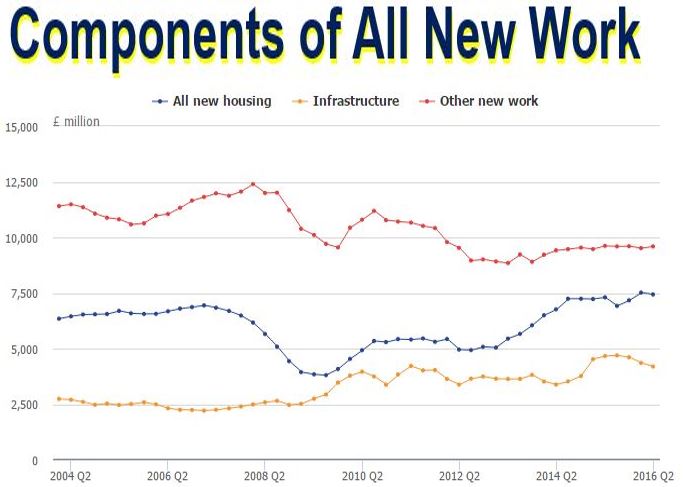 UK construction, including most other sectors of the economy, are unlikely to get back on a decent growth track until the Government has negotiated a trade deal with the European Union. This may take a long time. (Image: ons.gov.uk)
UK construction output figures for sectors during the second quarter were as follows:
– New houses: down -1.1%
– New infrastructure: down -3.7%
– Maintaining existing buildings: down -0.5%
– Government-back housing construction: down -6.5%
– Private housing: down -0.2%
– Industrial construction: up +7.3%
Infrastructure refers to roads, bridges, tunnels, and other structures we take for granted but without which our economy could not function.
The Office for National Statistics wrote:
“broadly flat output growth since the start of 2015, in contrast to the strength in output seen from the start of 2013 to the end of 2014.”
“The relatively modest fall in construction output this month conveys a somewhat less negative picture than that seen in the Markit/CIPS UK Construction Purchasing Managers’ Index, although this may be partly explained by us using a different measure of output and a different methodology to that used in the Markit/CIPS PMI.”
Housing
Despite a fall of 0.4% in June in UK construction of new housing, demand for housing increased, with government figures showing a 4.9% monthly increase in the total number of residential property transactions between May and June this year.
However, following the commencement of higher stamp duty rates for buy-to-let properties in April this year, this increase comes from a relatively low base.
The House Price Index for May this year showed an increase of 8.1% in house prices compared to May 2015, continuing the relatively strong growth that started three years ago.
The average house price in the UK was £2,400 higher than in the month before, which is in line with Halifax and Nationwide house price data, which reported annual house price growth in the 12-month period ending in May 2016 of 9.2% and 4.7% respectively.
