

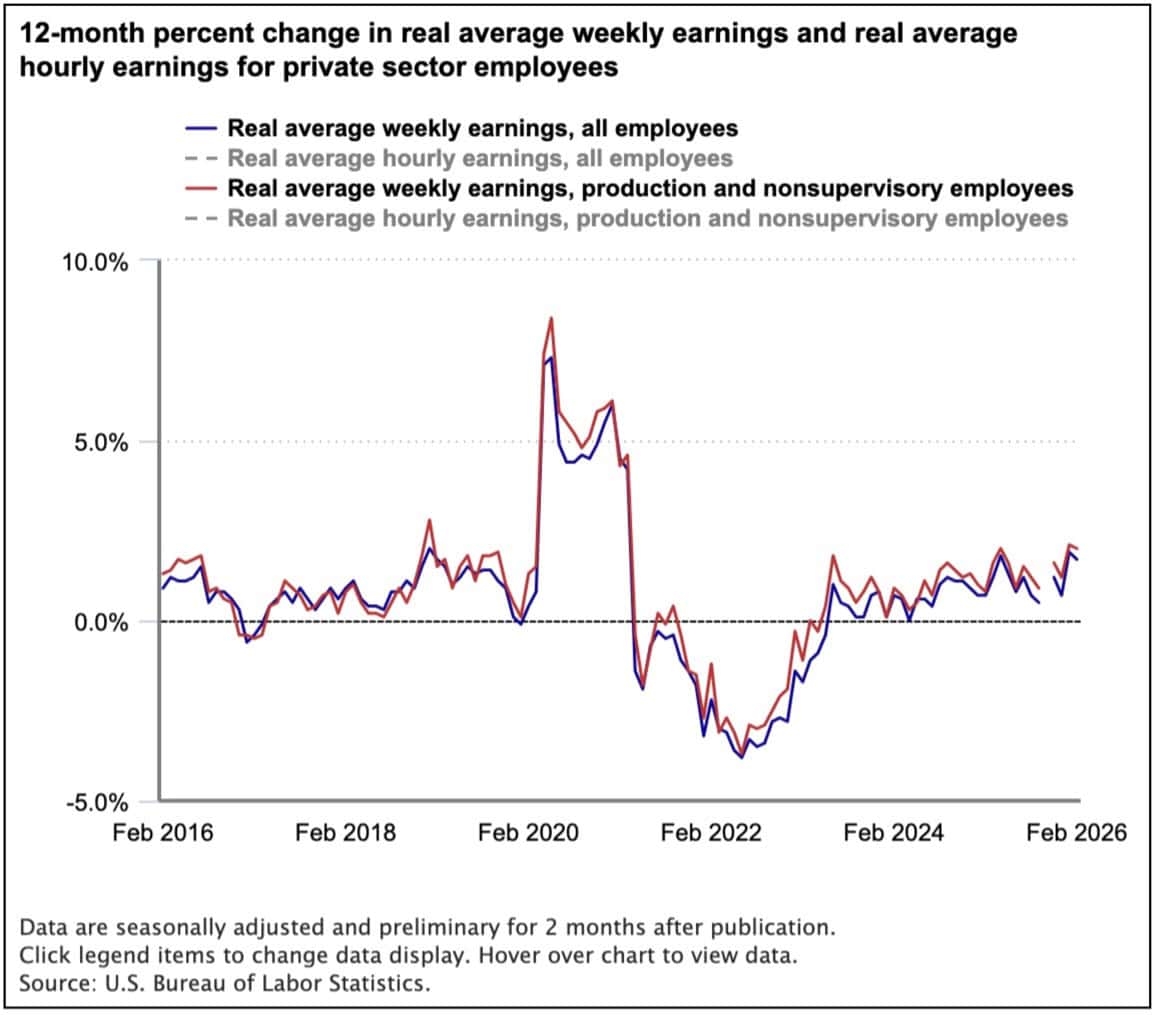
Non-farm payroll real average hourly earnings rose by 1.4% in the year to February 2026, according to the US Bureau of Labor Statistics. If this data is combined with an increase of 0.3% in the average workweek, real average weekly earnings rise by 1.7% over this twelve-month period, the Bureau added in a press release.
Production and nonsupervisory workers saw their real average hourly earnings grow by 1.4%, seasonally adjusted, over the same twelve months. If we combine this data with a 0.6% increase in the average hourse worked each week, real average weekly earnings over this period rose by 2%.
What does “real” mean?
In this article, the word “real” means “adjusted for inflation,” that is, after taking into account price rises (inflation).
Hourly, monthly, and yearly pay increases may be real or nominal:
1. As we have already seen, real average earnings are adjusted for inflation.
2. Nominal pay increases are not adjusted for inflation. Look at the example below:
Let’s imagine a group of workers earned $20 per hour in February 2025, and $22 per hour in February 2026. Prices over that twelve-month period increased by 4%. See the calculations below:
- Nominal earnings up 10%
Their nominal hourly earnings rose by 10%. When we talk about nominal pay, we are just focusing on the total increase, regardless of the inflation rate.
- Real earnings up 6%
Their real hourly earnings increased by 10%, minus 4% inflation, which equals 6%.
Inflation set to rise?
Economists worldwide are currently readjusting their inflation forecasts for the rest of this year after the United States and Israel launched a military attack on Iran three weeks ago.
Iran retaliated by firing missiles at nearby states, such as Kuwait, the United Arab Emirates, Bahrain, and Israel. It also fired at ships as they tried to navigate through the Strait of Hormuz. Consequently, all shipping through Hormuz has ground to a halt and oil prices have increased by over 60% since the beginning of the war.
Brent crude, a major global benchmark for crude oil prices, reached $119 per barrel last Friday, compared to $70 the day before the war began. Higher oil prices lead to more expensive gasoline (UK: petrol) and hundreds of other goods and services that individuals and businesses consume.
Inflation is expected to increase significantly over the next few months, and possibly until the end of this year and even into 2027. If Iran can stop ships from navigating through the Strait of Hormuz, through which 20% of the world’s oil passes, we will all suffer from higher prices.
Earlier this week, the US Federal Reserve (Fed) and the European Central Bank (ECB) decided to keep interest rates unchanged. Both central banks raised their inflation forecasts.
“The war in the Middle East has made the outlook significantly more uncertain, creating upside risks for inflation and downside risks for economic growth. It will have a material impact on near-term inflation through higher energy prices.”
Regarding the Fed, the BBC wrote:
“Fed board members now expect inflation to end the year at 2.7%, up from the 2.4% they were predicting in December.”
