
Vampire squid, which live very deep down in the ocean between 500 and 3,000 metres, live life at a slower place and have different reproductive patterns compared to their cousins that live in shallow waters, researchers in Germany, the US and UK discovered.
Vampire squid, known scientifically as Vampyroteuthis infernalis, which is Latin for ‘Vampire Squid in Hell’, do not feed on blood. They get their name from their dark colour, and Dracula’s cloak-like webbing and red eyes.
They survive with very little oxygen while consuming a low-calorie diet of detritus (dead particulate organic material) and zooplankton.
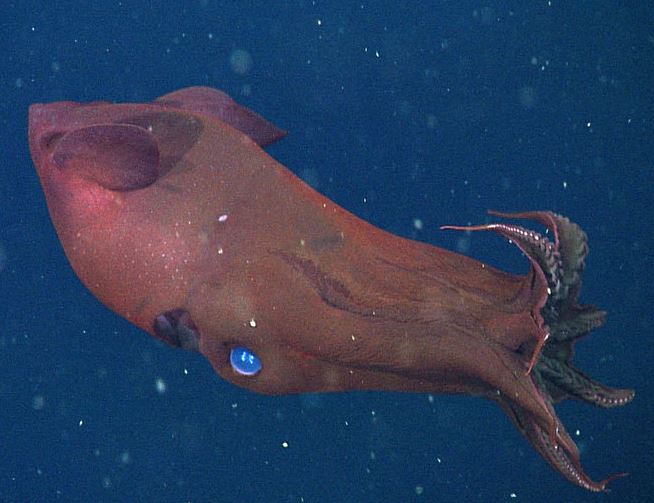
Vampire squid reproduce several times in a lifetime. (Image: geomar.de)
Henk-Jan T. Hoving, from GEOMAR, Helmholtz Centre for Ocean Research Kiel, Germany; Vladimir V. Laptikhovsky, from Cefas Laboratory, England; and Bruce H. Robison, from the Monterey Bay Aquarium Research Institute, USA, wrote in the academic journal Current Biology (citation below) that vampire squid differ from all other living coleoid cephalopods in their reproductive strategy too.
Vampire squid reproduce many times
Vampire squid oscillate between reproductive and resting phases, unlike other squid that reproduce all in one go in their lives. It is a pattern of multiple spawning more common among fish.
Hoving said:
“Their slow mode of life seems insufficient to support one big reproductive event, unlike other coleoid cephalopods.”
“Perhaps it is therefore that vampire squid return to a gonadal resting phase after spawning, and presumably start accumulating energy for a new reproductive cycle.”
The researchers made their discovery accidentally as they were looking though vampire squid collections dating back to the 1960s and 1970s at the Santa Barbara Museum of Natural History.
Along the way they noticed something surprising – several of the females had spawned but had no ripe or developing eggs and were in a reproductive resting phase.
Hoving and colleagues have now characterized the reproductive status of over 40 female vampire squid.
They noted that one female in the sample, in spite of being in a reproductive resting phase, had released more than 3,800 eggs yet still retained 6,500 viable oocytes (female germ cells involved in reproduction) for future spawning.
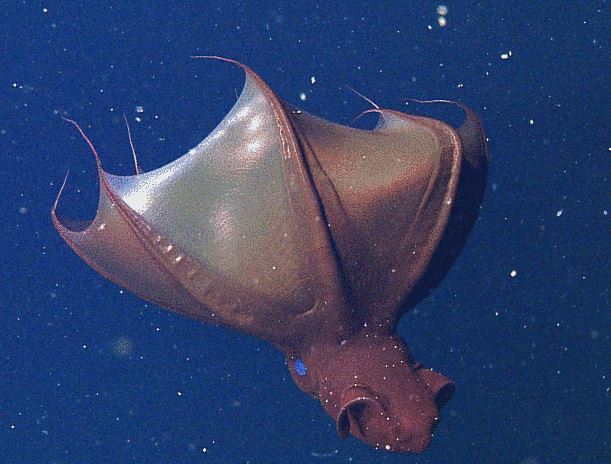
Vampire squid do not feed on blood. (Image: geomar.de)
More than 100 spawning episodes in a lifetime
Assuming that each batch contains 100 eggs, the authors believed that this one female had already spawned about 38 times, with eggs in reserve for a further 65 spawning episodes.
According to their findings, vampire squid live longer than their cousins that live in shallow water. The authors said that their discovery is also a reminder of just how much there is yet to learn about life in the deep sea.
Hoving said:
“We know very little about deep-sea organisms and their life-cycle patterns, in particular in the water column of the deep sea. The patterns we know from coastal and shallow-water organisms may not apply to deep-sea species.”
“We need to enhance our knowledge of deep-sea pelagic organisms and the system they are part [of], since the pelagic deep sea is the largest living space on the planet. A better understanding of this unique marine ecosystem will eventually allow for better development of management and conservation strategies.”
Citation: “Vampire squid reproductive strategy is unique among coleoid cephalopods,” Henk-Jan T. Hoving, Vladimir V. Laptikhovsky and Bruce H. Robison. Current Biology, Volume 25, Issue 8, pR322–R323. Published 20 April 2015. DOI: 10.1016/j.cub.2015.02.018.
