
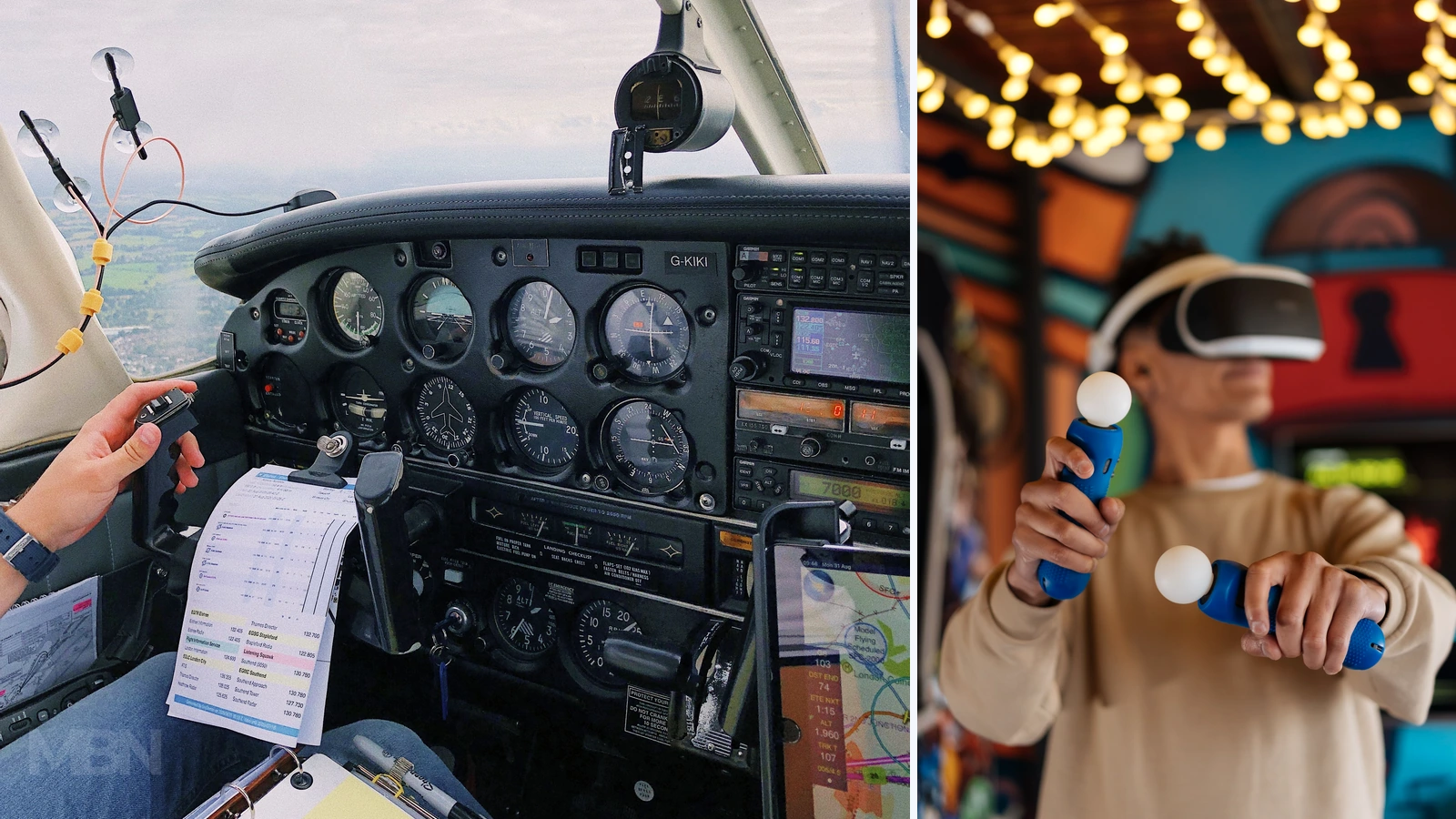
Student pilots who rehearsed in virtual reality received higher marks on their first real flight than a classroom comparison group in a small Spanish study, offering evidence that headset practice can transfer beyond the simulator.
The research, published in May in Frontiers in Virtual Reality, compared 45-minute sessions. All students had already received aircraft-specific theory instruction.
Researchers allocated students using their previous marks rather than fully random assignment. After withdrawals, 27 remained; two additional flight scores were excluded because lateness triggered a fixed grade. The flight comparison therefore covered 25 students, assessed by instructors unaware of their group.
The classroom group recorded a larger average gain on a theory test. However, finding a statistically significant improvement within one group and not the other does not, by itself, establish a significant difference between their gains.
The study’s VR setup was not certified for official flight training. Its small sample, short-term assessment and varying delay before the flight limit broader conclusions about effectiveness.
Practice can target a specific cockpit task
The commercial attraction is understandable: a student can rehearse before occupying an aircraft. The relevant outcome for a school is whether that rehearsal helps the student perform a particular task, and whether the benefit justifies the equipment, instructor time and support involved.
A cockpit contains instruments that must be read, controls that must be located and procedures that must be followed in sequence. Familiarity with the layout could leave a beginner with fewer unfamiliar things to process during a lesson. That is a plausible reason to test VR preparation, rather than a guarantee that every headset exercise improves flying.
CESDA, the aviation training institution associated with the researchers, describes a wider research program covering early pilot learning, emergency landings, workload and performance under stress. Those subjects require different assessments: feeling confident, remembering a procedure and handling a demanding maneuver are not interchangeable outcomes.
Regulators are looking at what a device can do
On July 15, the European Union Aviation Safety Agency announced a new framework for qualifying flight simulation training devices. Qualification means assessing a device against defined requirements for training use.
EASA says the framework replaces fixed simulator types and levels with a system based on technical capabilities. It includes provisions for extended reality, a term covering technologies such as virtual and augmented reality, alongside touchscreen flight decks.
An optional method matches training tasks to suitable devices. For training providers, the implication is that different equipment may serve different parts of a course. A device that supports one exercise does not automatically qualify for every other purpose.
The agency plans implementation workshops from late 2026 into 2027. The framework should not be read as blanket approval for consumer headsets or any particular research setup.
Commercial systems go beyond a headset
Manufacturers are also developing more specialized equipment. In July, Loft Dynamics announced an Airbus H145 multi-pilot VR simulator, designed for crews to practice together.
According to the company, it combines a full-motion platform with a virtual cockpit and aircraft data supplied by Airbus Helicopters. Babcock France signed a letter of intent for a planned deployment. That announcement establishes interest and intended use, not evidence that the installation has been completed or that training outcomes have improved.
For buyers, those details matter more than the VR label. A headset, physical controls, motion equipment, software and instructor supervision form a training system. Their suitability depends on the aircraft and lesson.
A school assessing such equipment needs to examine both learning and operations: how accurately the exercise represents the intended procedure, how instructors observe performance, how much setup is required and what happens when tracking or software fails. The useful purchase is one that improves a defined part of training at an acceptable total cost.
