
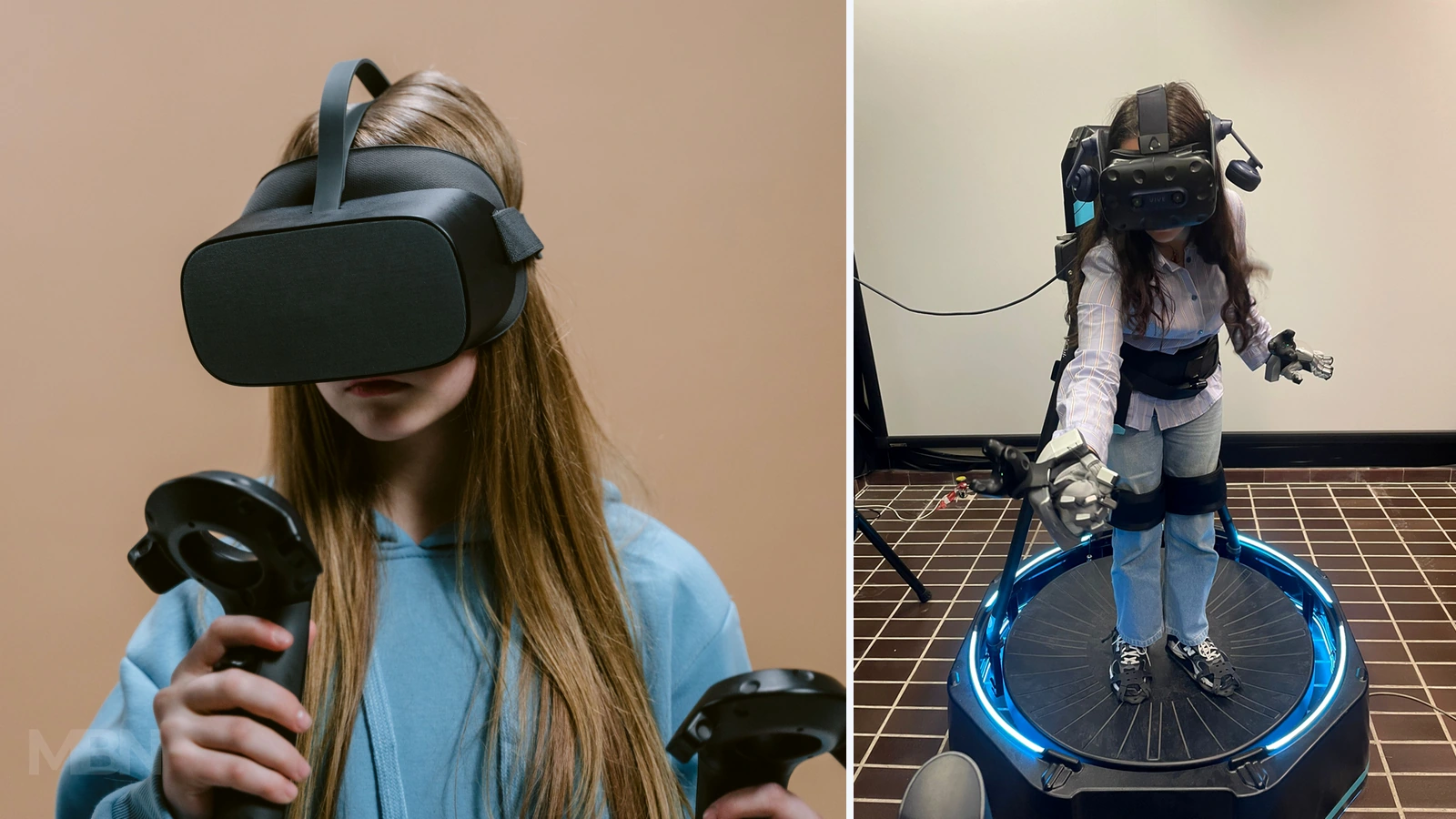
Adding haptic gloves, which provide physical feedback, and a walking platform can make a virtual world less convincing, a new museum study suggests. The result highlights a practical problem for VR developers: extra equipment can introduce difficulties as well as new sensations.
The study, published on September 12 in Multimedia Tools and Applications, involved 162 participants exploring a virtual jewelry museum under four combinations of controllers, gloves and treadmill-based movement.
Gloves reduced usability and increased mental workload. The treadmill reduced workload independently, but did not independently produce a statistically significant improvement in presence, the feeling of being inside the virtual environment.
Combining the gloves and treadmill was associated with lower presence than the other configurations. No statistically significant effect on motion-sickness scores remained after the study’s correction for multiple comparisons.
The findings concern particular devices, tasks and a predominantly young adult sample. They do not establish that gloves or treadmills are inherently unsuitable for VR, or that future versions will have the same limitations.
Seeing a hand is different from feeling an object
Several separate capabilities sit behind an apparently simple action such as picking something up. A system must detect the hand, identify what the user intends, move the virtual object and provide an understandable response.
Hand tracking estimates the position and movement of a user’s hands. Haptic equipment adds physical feedback, such as vibration or resistance. A virtual object can look detailed while still providing few of the sensations expected from a real one.
Meta’s hand-interaction guidance, updated in August, identifies missing weight, touch and material feedback as limitations of using bare hands in VR. It also describes tracking challenges when cameras cannot see a hand clearly or lighting conditions interfere.
The company advises developers to design around hand interaction from the outset. Replacing a controller button with a gesture can create an awkward action if the rest of the experience still assumes the speed and precision of a button press.
Its recommendations include teaching a simple core interaction, giving clear visual or audio confirmation when a gesture is recognized, and avoiding prolonged reaching that tires the user. These are software and interaction choices, not simply demands for sharper displays.
Brain interfaces solve a different part of the problem
Brain-computer interfaces, which translate recorded brain activity into commands, are sometimes discussed as a route to more complete virtual experiences. Existing demonstrations need to be understood on their own terms.
A 2025 Nature Medicine study enabled one person with paralysis to control a virtual quadcopter through signals decoded from implanted electrodes. The system interpreted attempted finger movements and used them to steer the computer simulation.
That was an advance in control and accessibility. It did not reproduce a whole body’s sensory experience, and the demonstration used a computer display rather than establishing an indistinguishable VR world.
Reading movement intentions and delivering realistic sensations back to a person are separate technical challenges. Progress on the first cannot be treated as proof that the second has been solved. Nor does a result in one research participant establish suitability for ordinary consumer use.
Developers have to make the whole experience work
Commercial demand also depends on more than technical spectacle. In its March update to developers, Meta said Quest reached a record number of unique users in 2025, while gross revenue generated through the Horizon Store rose only very slightly from 2024.
Those company-reported figures describe Meta’s ecosystem, not the entire VR market. They nevertheless show why reaching more users and generating more spending need to be considered separately.
For museums and other attractions, equipment also has to fit the visit. Staff need to explain its use, help people put it on and accommodate different abilities. MBN’s coverage of sensory effects in digital tourism examined a related design issue, although that research measured responses to descriptions and videos rather than this hands-on VR experiment.
There is no reliable date in these findings for VR becoming indistinguishable from everyday life. A more useful buying question is narrower: can the intended audience interact comfortably, understand what is happening and complete the activity without the equipment getting in the way?
