
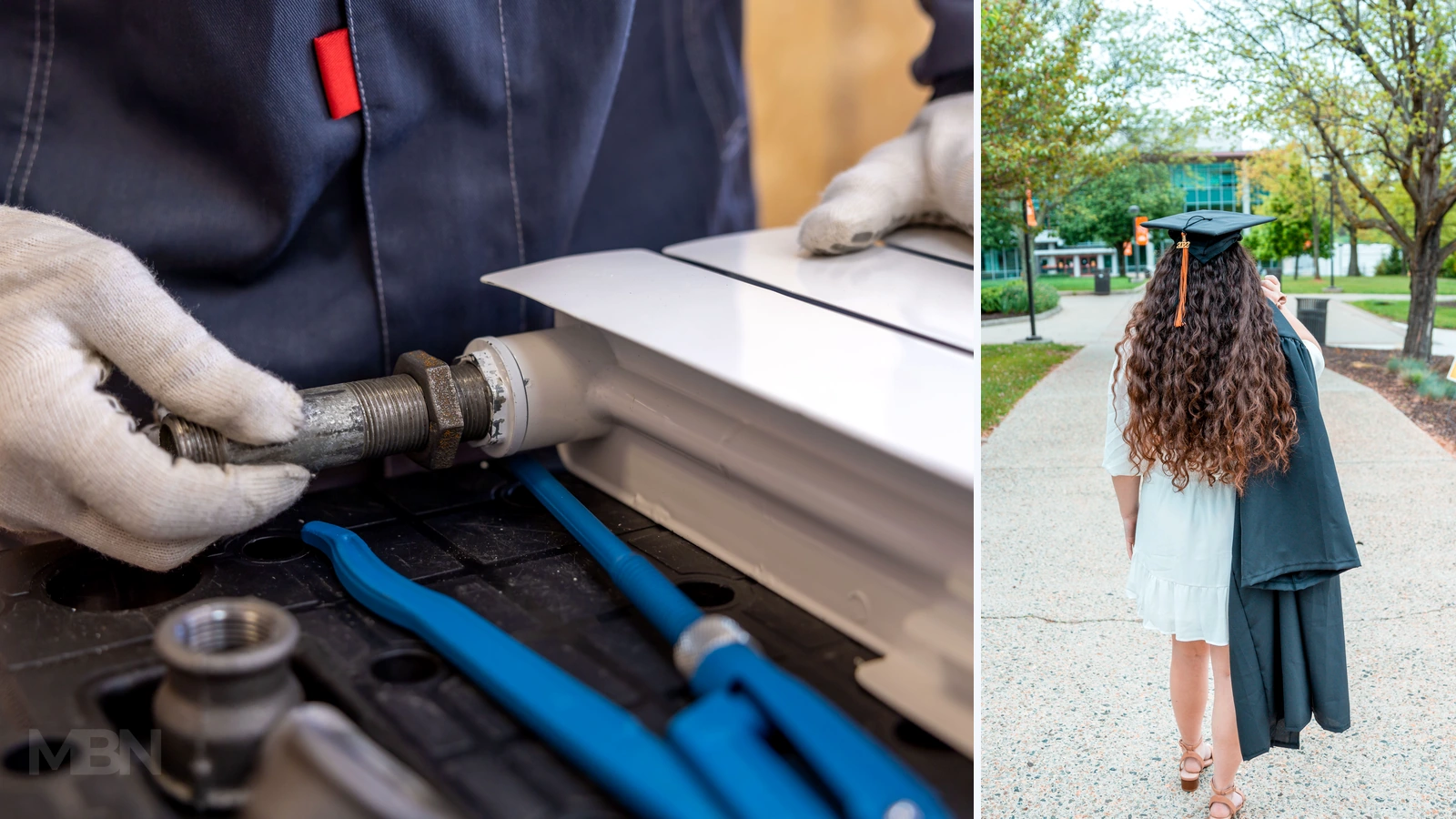
US employment of plumbers, pipefitters and steamfitters is projected to grow 7% between 2025 and 2035, compared with 3% across all occupations. That gives skilled trades a place in the debate about careers and artificial intelligence, although it does not settle which path offers a better future.
The Bureau of Labor Statistics puts the group’s median annual wage at $63,800 in May 2025. Median means half earned more and half less. It is not an apprentice’s starting salary, and the category includes industrial pipefitters and steamfitters as well as plumbers.
BLS projects about 42,000 openings annually, including replacements for workers who retire or change occupations. Those openings should not be confused with 42,000 additional jobs each year.
Graduate averages and first jobs tell different stories
College graduates still have an earnings advantage in broad national data. Among full-time wage and salary workers aged 25 and over, people whose highest qualification was a bachelor’s degree had median weekly earnings of $1,578 in 2025, compared with $966 for high school graduates.
Unemployment rates for the two education groups were 2.8% and 4.3%, respectively. BLS notes that these 2025 estimates exclude October because of the federal shutdown.
These figures cover many occupations and experience levels. They do not show what a new graduate will earn, or isolate the financial return caused by obtaining a degree. Comparing them directly with one occupation’s annual wage would combine different populations and measures.
For new entrants, the picture is tougher. The Federal Reserve Bank of New York reports unemployment of about 5.6% among recent college graduates in the second quarter of 2026. Underemployment reached 42%.
Recent graduates are aged 22 to 27. Underemployment here means working in an occupation that typically does not require a college degree. It does not mean that 42% had no job, and it says nothing by itself about AI causing their difficulties.
AI affects tasks before it determines entire careers
Generative AI produces material such as text, images and computer code. Its capabilities therefore overlap directly with parts of many office jobs. Physically locating a leak or fitting pipework presents a different problem from drafting an email about the repair.
Yet a plumbing business also has estimates, bookings and paperwork. Software could change those activities without removing the need for someone to do the installation. Equally, automating one activity in a graduate occupation does not demonstrate that the entire role can disappear.
The International Labour Organization’s 2025 assessment estimated that one in four workers worldwide had an occupation with some exposure to generative AI. Its central judgment was that transformation would be more likely than redundancy because human input remained necessary.
Exposure describes the potential for technology to affect tasks. It is not a forecast that the same proportion of workers will lose their jobs. Employers’ decisions, demand for their services and the way work is reorganized will influence what happens.
A paid apprenticeship still requires years of training
BLS says most workers in the plumbing group learn through a four- or five-year apprenticeship, typically combining 2,000 hours of paid workplace training annually with technical instruction. Most states require plumbers to be licensed.
The job can involve nights, weekends and emergency calls. It also carries physical risks, including cuts, burns and falls. These conditions belong in a career comparison alongside earnings and automation exposure.
Paid training can reduce the income forgone while learning. However, an applicant still needs an available place, suitable local employers and the ability to complete the program. College choices also vary considerably by course, tuition costs, financial support and prospects after graduation.
Compare a real opportunity with a real opportunity
The useful comparison is between a specific apprenticeship and a specific degree course, including their costs, completion prospects and likely work. National averages provide context; they cannot describe every local market or personal preference.
MBN’s earlier reporting on skills shortages alongside graduate unemployment explains why qualifications, practical experience and location can fail to match employers’ vacancies.
A strong apprenticeship may offer a clearer route into paid skilled work than a course with weak employment prospects. A degree tied to a suitable profession may open opportunities that a trade qualification does not. AI adds another factor to that assessment, but neither “plumber” nor “graduate” is a complete description of a working life.
