
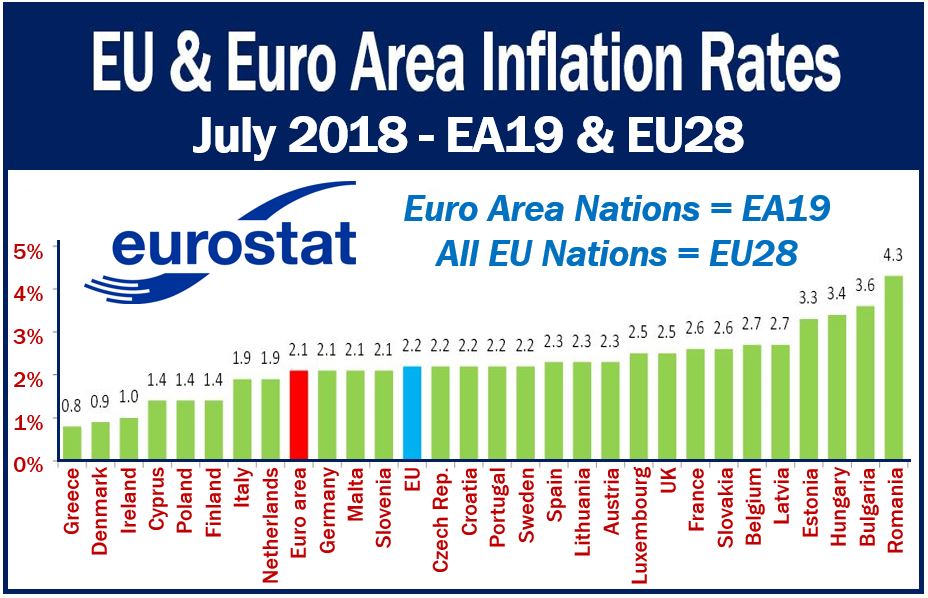
EU and Euro Area Inflation Rates

Euro Area inflation up to 2.1%

Published: 12:04, August 17, 2018

The euro area inflation rate rose to 2.1% in July 2018 compared to 2.0% in June 2018. In July 2017, the euro area inflation rate was 1.3%.

The EU28 inflation rate in June 2018 increased to 2.2%, from 2.1% a month earlier. In June 2017, the EU28 inflation rate was 1.5%, says Eurostat, the EU’s statistical office.

Euro area, EA19, and EU28

EU28 stands for the 28 European Member states, including those that do not use the euro as their national currency. The euro area, on the other hand, includes only those 19 European Union countries that adopted the euro as their national currency. We sometimes refer to the euro area as the EA19.

Therefore, Germany, which uses the euro as its national currency, is both an EA19 and EU28 country. The UK, which still uses the pound sterling, on the other hand, is an EU28 but not an EA19 nation.
EU and Euro Area Inflation Rates
The euro area inflation rate in July 2018 was 2.1%, while that of the EU28 was 2.2%.
Lowest inflation rates

The following countries registered the lowest annual inflation rates:

– Greece 0.8%.

– Denmark 0.9%.

– Ireland 1.0%.

Highest inflation rates

The following member states registered the highest annual inflation rates:

– Romania 4.3%.

– Bulgaria 3.6%.

– Hungary 3.4%.

– Estonia 3.3%.

Annual inflation declined in nine Member States in July 2018 compared to June 2018.
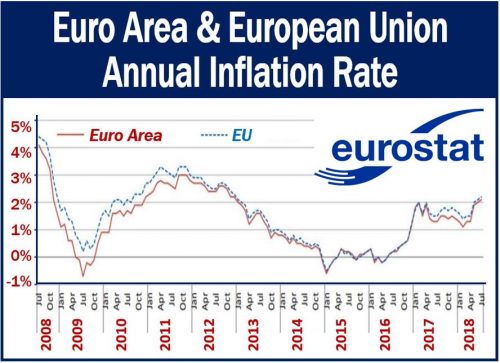
EU and Euro Area inflation rates over ten years
The EU and euro area inflation rates declined significantly during the Global Financial Crisis of 2008/9.

Euro area inflation – contributors

The biggest contributors to the euro area inflation rate for July 2018 were:

– Energy +0.89 percentage points.

– Services +0.64 percentage points, food.

– Alcohol and tobacco +0.49 percentage points.

– Non-energy industrial goods +0.12 percentage points.

European Union

The European Union or EU is a political and economic union of 28 Member States. With a population of 510 million, it is the world’s largest single consumer market.

The EU is a free trade area. This means there are no tariffs or quotas between member states. A tariff is a tax that a country levies on imports. A quota is a limit on imports.

Christian Nordqvist Avatar

Other News

Product recalls were linked to lower reported tax rates near year-end

Jul 27, 2026

Land degradation is linked to billions in lost farm output

Jul 26, 2026

Chile’s mining disruption exposes a hidden risk in the AI supply chain

Jul 26, 2026

Bad customer matching can make a profitable ad campaign look like a failure

Jul 26, 2026

1% of resumes contain hidden prompts to trick AI hiring tools

Jul 25, 2026

One fund transaction may have sent the wrong signal about bond investors

Jul 25, 2026

How Kuwait is raising $7.85 billion without selling its pipelines

Jul 25, 2026

Why Gruyère makers would rather make less cheese than cut prices

Jul 25, 2026

Consumer distrust grows twice as fast as trust, study finds

Jul 25, 2026

Autonomous vehicles may become mainstream in mines before they do on public roads

Jul 25, 2026

Allianz to buy HSBC Life Singapore for S$2.7 billion

Jul 24, 2026

Alphabet and Tesla AI spending worries shake tech stocks

Jul 24, 2026

What Google’s new AI study tells us about how we really use AI

Jul 24, 2026

Alphabet’s AI spending surge tests investor patience despite strong cloud growth

Jul 23, 2026

Is AI changing how students learn and think? New study investigates

Jul 20, 2026

Apple briefly overtook Nvidia as most valuable company

Jul 17, 2026

US consumer prices fall in June as energy costs drop

Jul 16, 2026

Robots boost productivity in small manufacturers but not exports, study finds

Jul 13, 2026

Why even unbiased AI can seem unfair in job interviews

Jul 12, 2026

Effects of foreign direct investment on rural employment and income

Jul 9, 2026