

Global house prices dropped by 0.6%, year-on-year, during the fourth quarter of 2025. The year 2025 saw the fourth consecutive year of decline in worldwide house prices.
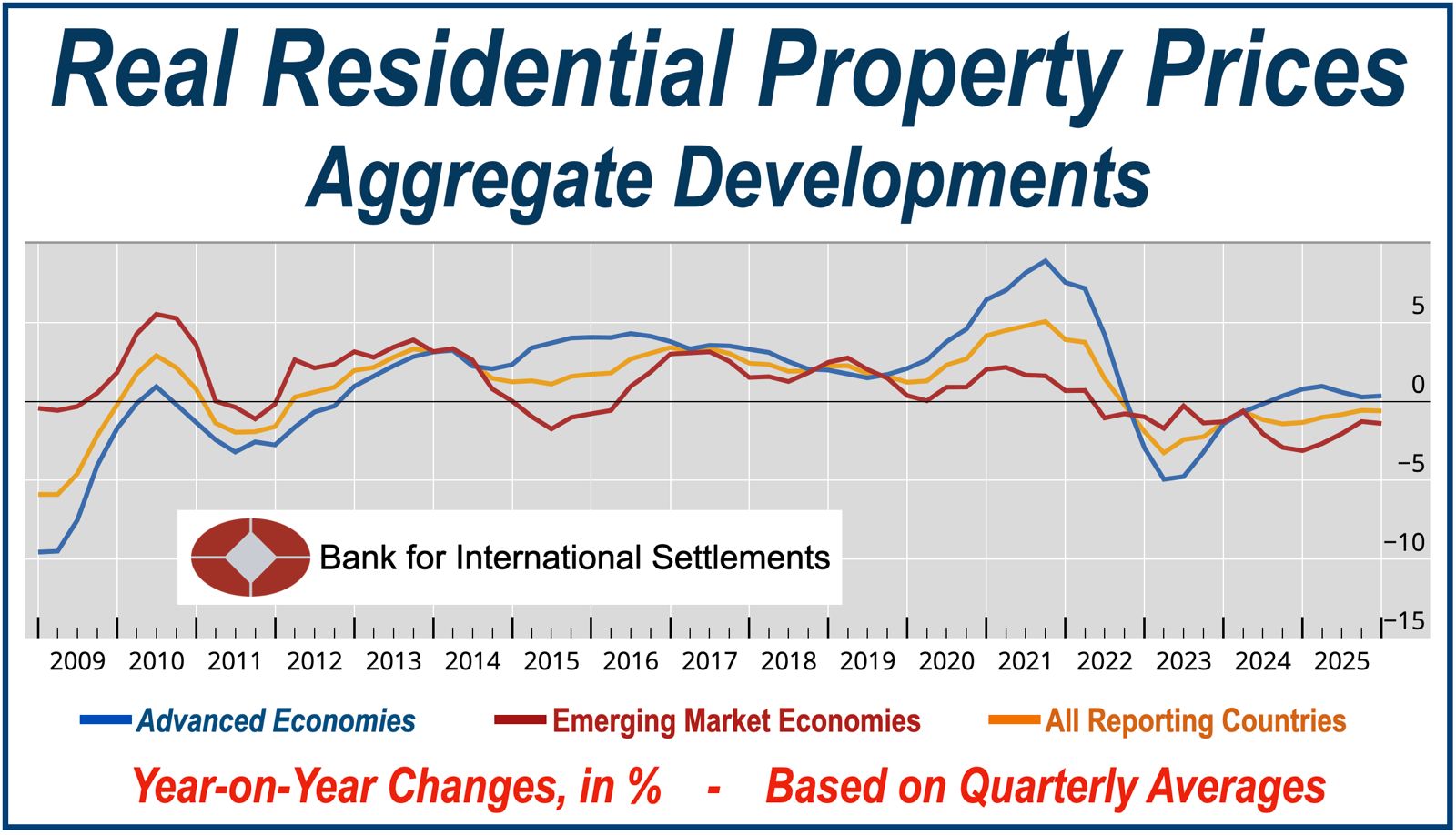
Between 2022 and the end of 2025, global house prices fell by an average of 4.8%, according to a report by the Bank for International Settlements (BIS). While this may look discouraging, the news is not that bad. There was a major price explosion during the pandemic, after which there has been a decline. However, globally we are still 3% higher than we were before the pandemic began—in other words, pre-pandemic prices were 3% lower than they are today.
The fall in global house prices over the past four years occurred as follows:
- Late 2022: Global real house prices fell by 2.1%. (Initial drop as inflation hit)
- Late 2023: Global real house prices fell by 1.2%. Steepest phase of the cooldown)
- Late 2024: Global real house prices fell by approx 1.0%. (The decline starts to bottom out)
- Late 2025: Global real house prices fell by 0.6% (Decline almost over)
Advanced economies vs. emerging markets
Since the 2008 global financial crash and the Great Recession that followed, global home prices have risen by 20%.
Some major economies with struggling property markets have skewed the global data over the last four years. They are actually hiding rising prices that have occurred elsewhere.
In fact, the majority of countries across the world have reported house price increases of between 0% and 10% during this period.
For example, severe downturns in China and Canada, two major economies where prices fell by 6%, have pulled down the global average. Their negative data masks the fact that other countries’ property markets have been thriving. India has rebounded by 3%, while Hungary and Portugal have reported double-digit price increases.
Home prices in Europe – 4th Quarter 2025
- The eurozone reported an increase of 3%. The eurozone refers to all EU countries that use the euro as their national currency.
- In North Macedonia, prices soared by an impressive 20%.
- Hungary’s home prices rose by 17%.
- In Portugal, property prices grew by 16%
- Spain’s growth, at 10%, was slightly lower, but still strong.
- France’s and Germany’s markets remained flat—they barely moved.
- In the UK, home prices dropped by 1%.
Home prices in the Americas – 4th Quarter 2025
- US prices fell by 2%; they are cooling down. However, they are 50% higher than in 2008.
- Canada reported a decline of 6%. Although not a crash, it is a significant fall.
- Mexico’s home prices increased by 5%. They have risen 22% since the pandemic and 50% since 2008.
- Brazil’s home market was flat; no change. In fact, house prices remain below 2008 levels (mainly due to high inflation).
- Latin America as a whole saw home prices grow by 2.6%.
Home prices in Asia/Australia – 4th Quarter 2025
- Asia’s home prices fell by 3.2%, dragging down global numbers.
- China reported a fall of 6%. The country has suffered a four-year property slump. Homes cost 20% less than before the pandemic.
- Japan reported a modest gain of 2%.
- India’s home property price grew by 3%. Prices have doubled since 2008.
- Indonesia saw a decline of 2%.
- South East Asia appears to be losing steam. Malaysia and the Philippines have experienced slowdowns.
- Australia reported 4% growth. Since the pandemic, prices have increased by 22%.
- New Zealand homes fell by 4%.
Other regions
- Turkish prices have fallen by 1% following recent growth. Home prices have doubled since the pandemic.
- Africa has experienced a modest gain of 1.4%.
Geopolitical tension and the global outlook
Many countries had been hoping to see an upturn this year and in the years to come. However, the Iran war and the closing of the Strait of Hormuz have clouded the outlook for the world economy.
When consumers and businesses are unsure about the future of their domestic economies or geopolitical stability elsewhere, they are less likely to spend on big-ticket items such as a new home, a new factory, or bigger offices. Whether the Iran war and its consequences will lead to a global recession remains to be seen. For now, we can only wait and watch.
