

Workers who were better able to make career decisions despite uncertainty were more likely to report meaningful work three months later, according to a study of 995 employed adults in the United States. That sense of meaning was subsequently associated with greater job satisfaction and work engagement.
The findings suggest that people do not necessarily have to identify a perfect profession or employer before they can find value in their working lives.
Instead, they may benefit from gathering the available information, accepting that some uncertainty will remain and making a thoughtful decision without knowing exactly how events will unfold.
The study, published in the Journal of Counseling Psychology, was conducted by Hui Xu of the University of Macau and Blake A. Allan of the University of Houston.
Career wisdom means accepting some uncertainty
The researchers describe the ability to make decisions under these conditions as career wisdom.
Career wisdom does not mean ignoring evidence, acting impulsively or relying entirely on instinct. It combines rational analysis with an acceptance that complete certainty is rarely possible when making important career decisions.
A person might investigate an occupation, compare salaries, assess employment prospects and consider whether the work matches their abilities. However, nobody can predict every future change in the economy, technology, an employer or their personal circumstances.
At some point, the individual has to decide whether enough information is available to move forward.
According to Xu: “Meaningful work may come not only from finding the ideal path, but also from learning how to live with uncertainty.”
The researchers regard career wisdom as a psychological resource that may be developed through career education and counselling. However, this study did not test whether a training programme can increase it.
Study followed 995 US workers
The researchers followed 995 employed US adults over six months. Participants completed assessments at three points, approximately three months apart.
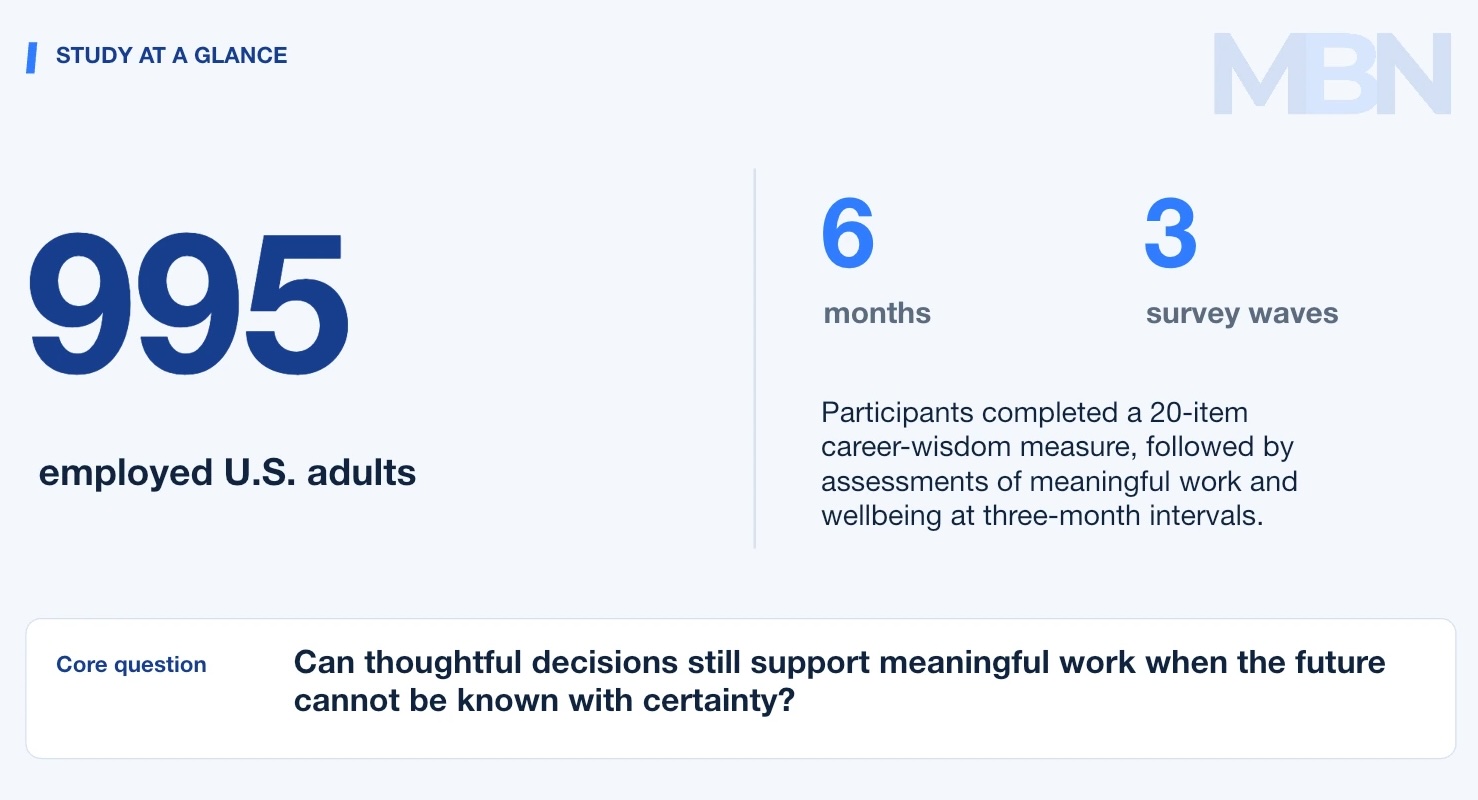
At the beginning of the study, the researchers measured career wisdom using a 20-item scale. Participants indicated how they generally approached difficult career decisions, including whether they could act with incomplete information, trust informed intuition and accept vulnerability.
Three months later, the participants reported how meaningful they considered their work.
After another three months, the researchers measured their job satisfaction, life satisfaction and work engagement. Work engagement refers to the extent to which people feel energetic, involved and absorbed in their jobs.
Using separate assessments allowed the researchers to examine whether career wisdom appeared before later differences in meaningful work and workplace wellbeing.
Meaningful work linked career wisdom to better outcomes
Participants with higher career-wisdom scores at the start of the study tended to report more meaningful work three months later.
Greater work meaningfulness then statistically predicted higher job satisfaction and work engagement at the final assessment.
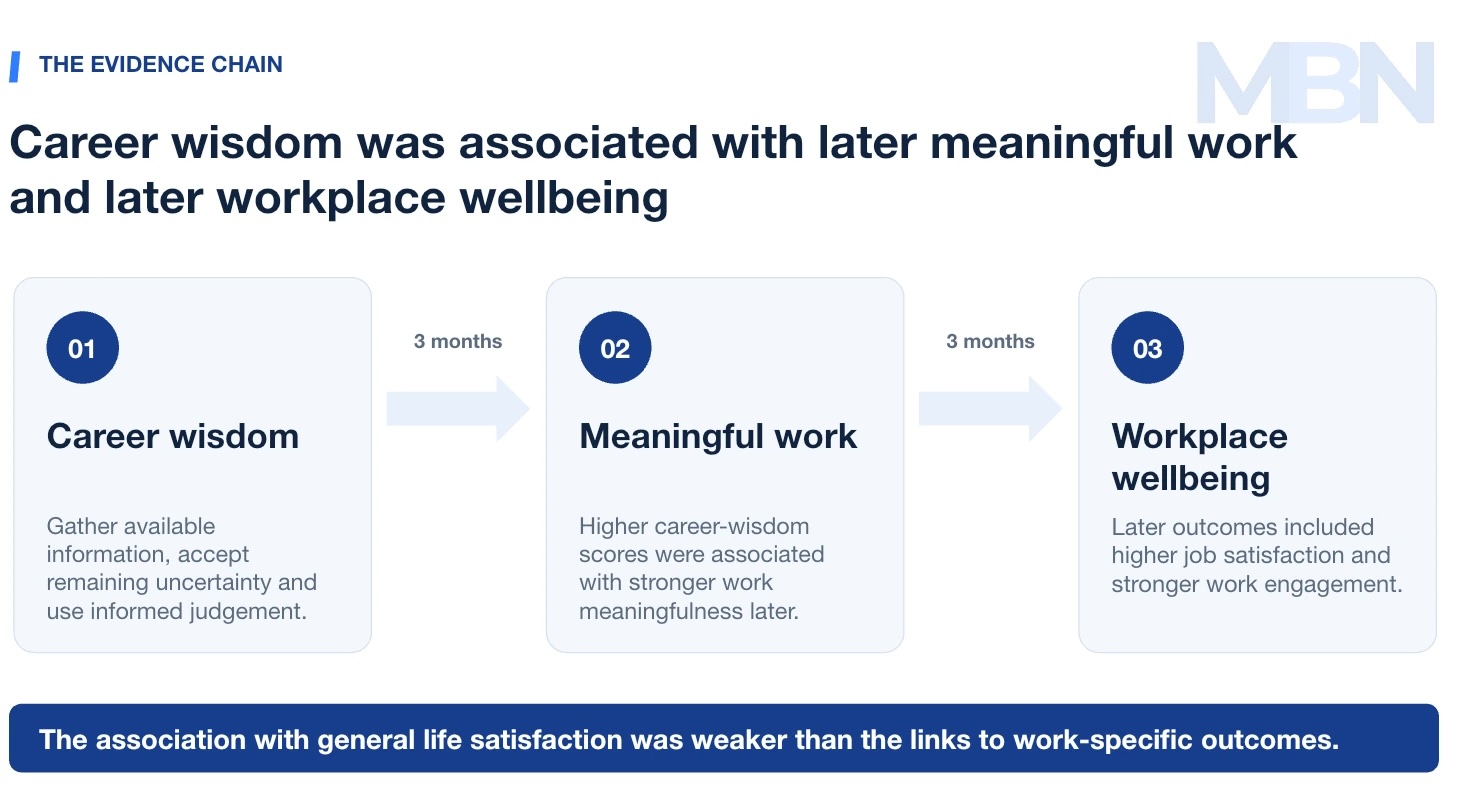
In other words, career wisdom did not simply coincide with happier workers at one moment in time. The statistical results suggested a pathway in which career wisdom preceded meaningful work, which in turn preceded greater satisfaction and engagement.
The relationship with overall life satisfaction was considerably weaker. Career wisdom may therefore be more closely related to how people experience their jobs than to how they evaluate their lives as a whole.
The pattern was also consistent across gender, race and socioeconomic status within the sample. This suggests that career wisdom could be useful to a range of workers, although studies in other countries and occupational groups are still needed.
Why does meaningful work matter?
Meaningful work generally refers to work that a person regards as significant, worthwhile or personally valuable.
Previous research has linked it with several favourable outcomes. A 2019 meta-analysis covering 44 articles and 23,144 participants found large correlations between meaningful work and job satisfaction, work engagement and organisational commitment.
However, a correlation does not establish cause and effect. Satisfied and engaged employees may be more likely to find meaning in their work, while meaningful work may also contribute to satisfaction and engagement.
The new study adds to this research by identifying career wisdom as one factor that may precede a stronger sense of meaning.
Does this mean career planning is pointless?
Not at all.
The researchers emphasise that gathering information and thinking rationally remain important. Career wisdom becomes relevant when further research cannot eliminate the uncertainty surrounding a decision.
Continually looking for a perfect answer may become counterproductive if it prevents somebody from making a reasonable choice or adapting when circumstances change.
This issue may become increasingly important as artificial intelligence, automation, remote working and changing business conditions make long-term career paths harder to predict.
A person entering an occupation today cannot know exactly how that job will change over the next decade. Even so, they can assess the available evidence, make a considered choice and revise their plans when new information appears.
Employers may also have a role
The findings could have implications for employers, career counsellors and educational institutions.
Career programmes often focus on identifying interests, comparing occupations and improving decision-making. These remain valuable activities, but the researchers suggest that people may also need help coping with the uncertainty that remains after the information has been gathered.
Employers could acknowledge uncertainty more openly when roles, technology or organisational priorities change. They may also be able to help workers understand how their responsibilities contribute to customers, colleagues or wider organisational goals.
Even so, the study did not examine a workplace intervention. Further research is required before anybody can say which training or management practices reliably increase career wisdom or meaningful work.
