
Georgia Tech researchers have developed an artificial intelligence system that allows robots to complete tasks learned from human demonstrations faster than the people who taught them.
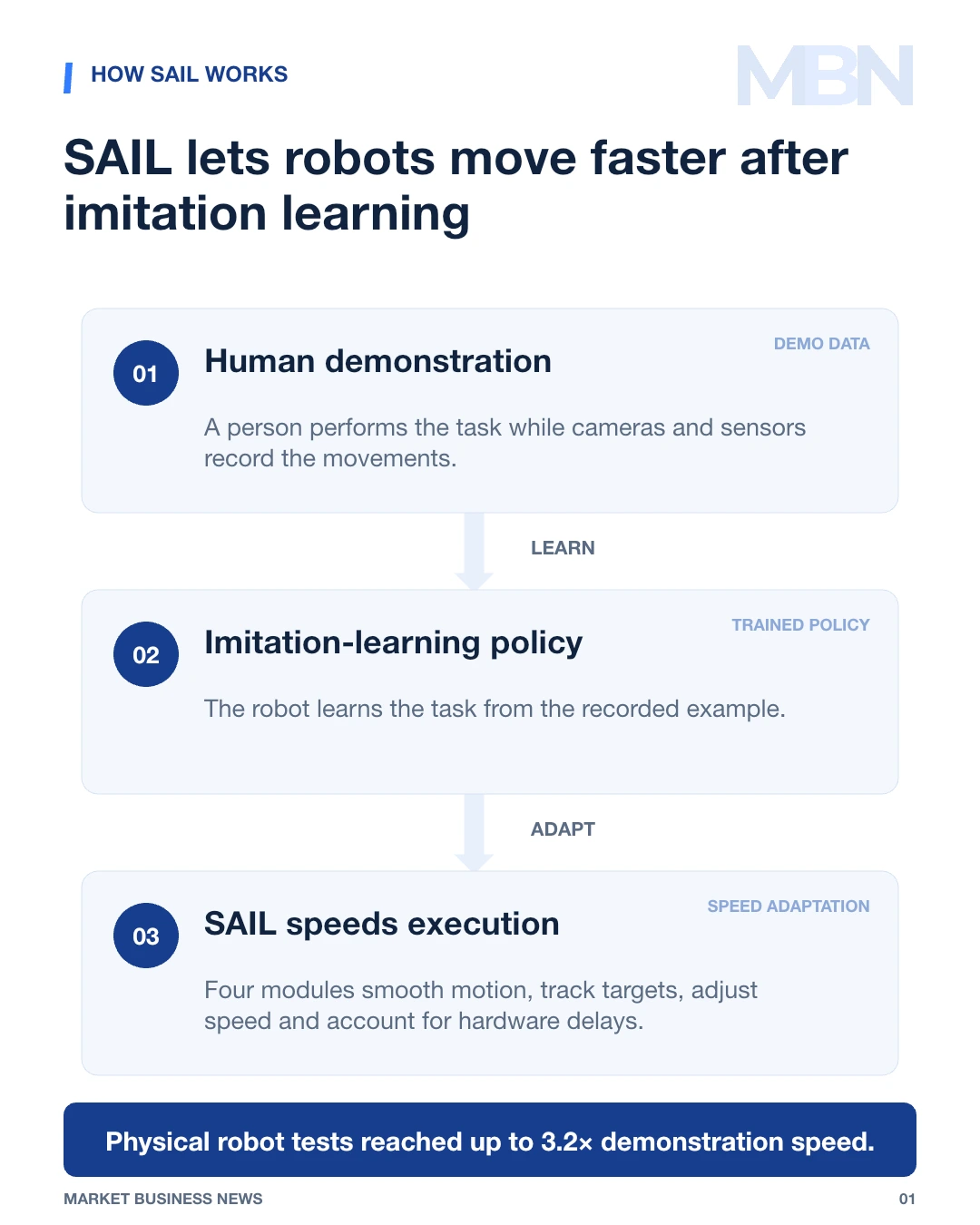
The system, called Speed Adaptation for Imitation Learning (SAIL), produced speed gains of up to 3.2 times on physical robots and four times in simulations, according to the research paper.
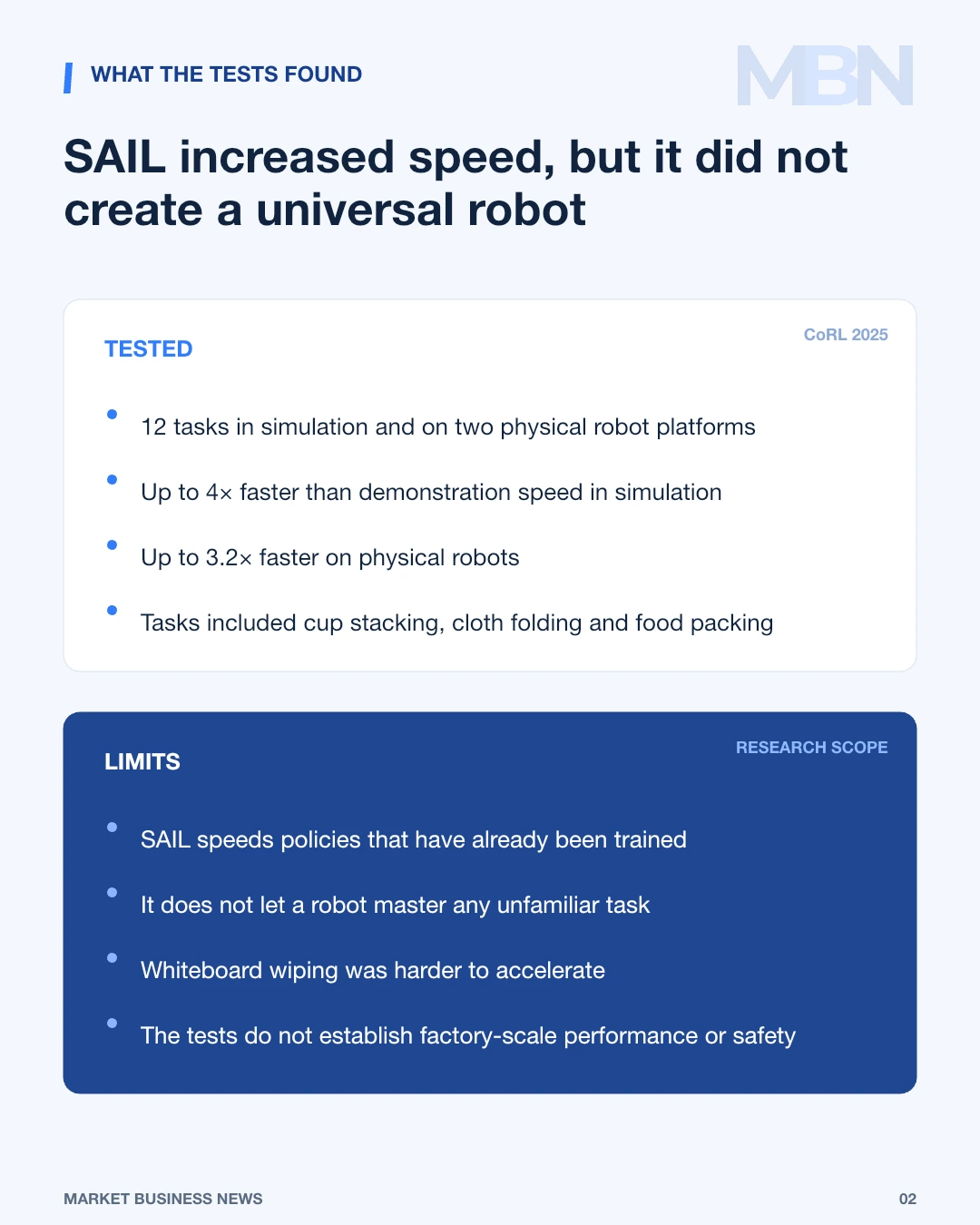
Imitation learning trains a robot using examples recorded through cameras and sensors. However, the resulting machine normally works at roughly the same speed as the demonstration data.
SAIL was designed to remove that restriction without requiring engineers to retrain the robot for each operating speed.
Robots tested on 12 tasks
The researchers tested SAIL on 12 tasks using simulations and two physical robot platforms. The tasks included stacking cups, folding cloth, plating fruit, packing food and wiping a whiteboard.
In most tests, the robots completed their work three to four times faster than standard imitation-learning systems without losing accuracy, Georgia Tech reported.
Whiteboard wiping was an exception. The robot needed to maintain contact with the surface, making faster movement less reliable.
SAIL adjusts its speed during a task
The system combines four functions. It produces smoother movements, tracks motion targets, adjusts speed according to the difficulty of each action and accounts for delays in the robot’s hardware.
This means the robot does not simply perform every movement at maximum speed. It can slow down when an action requires greater control.
“Sometimes slowing down is the right decision,” said Shreyas Kousik, an assistant professor at Georgia Tech and co-lead author of the study.
Research does not create a universal robot
SAIL does not allow a robot to master any unfamiliar task without training or human supervision. It accelerates tasks that the machine has already learned through imitation.
The researchers view the system as a step towards general-purpose robots that can learn different activities from people. However, the tests covered a limited number of tasks and two physical robot platforms.
For manufacturers and warehouse operators, faster execution could increase the amount of work completed by each robot. More testing will be needed to determine whether the system can maintain its speed, accuracy and safety under everyday industrial conditions.
