
A Higgs Boson type particle, perhaps an extremely heavy variation of it, may have been detected by the Large Hadron Collider, say CERN physicists, who spotted unexpected data spikes from two detectors. CERN is the European Organization for Nuclear Research, located in Switzerland.
The Large Hadron Collider is the largest particle accelerator on Earth, it is the biggest and most complex experimental facility ever built, and also the largest single machine in the world. According to CERN, it consists of a 27-kilometre ring of superconducting magnets with several accelerating structures to boost the energy of the particles along the way.
Both the ATLAS (A Toroidal LHC ApparatuS) and Compact Muon Solenoid (CMS) experiments at the Large Hadron Collider (LHC) detected the spikes. If confirmed, this finding could transform our understanding of the workings of the Universe.
 A 13 TeV collision recorded by ATLAS. The green and yellow bars indicate the presence of particle jets, which leave behind lots of energy in the calorimeters. (Image: home.cern. Credit: ATLAS)
At these energy levels, physicists have detected an excess of photon particles when protons and other heavier particles collide. This suggests the presence of a new particle – one never detected before – that is produced when protons collide.
Discovery could help revise the Standard Model
CERN scientists say it could help them revise the ‘Standard Model’ – which explains how the basic building blocks of matter in the Universe interact, governed by four fundamental forces.
CERN explained in a press release yesterday:
“The Standard Model is the theory that describes elementary particles and their interactions, but it leaves many questions unanswered. Physicists are therefore searching for signs of Beyond-Standard-Model physics that might help them to answer some of those questions.”
The breakthrough they believe they have made will not provide conclusive answers, but will give physicists a huge step forward, say researchers.
CERN scientists warned that the two spikes could just as easily have been the result of a statistical fluke. Even so, the finding has spawned more than ten new papers within a period of 24 hours, all propositioning a theoretical explanation for the particle, and has the physics departments of universities across the world buzzing with activity.
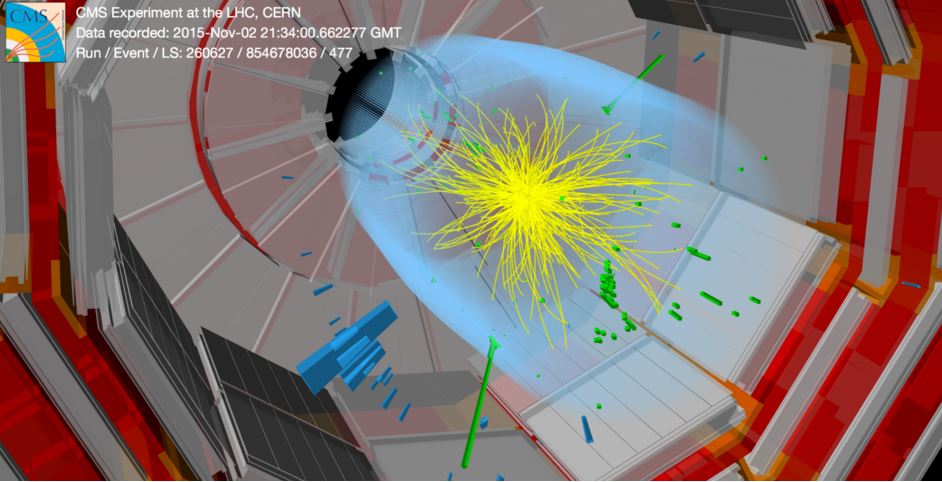 A 13 TeV proton collision recorded by CMS. The two green lines show two photons which were generated by the collision. (Image: cds.cern.ch/images)
CERN Theory Group member, Adam Falkowski, a physicist at the Institute of Theoretical Physics in Warsaw, wrote in resonaances.blogspot.co.uk:
“This is something that we’ve been waiting for for a long time. Of course we are aware this could be nothing. But for my generation, this is the first time there is a very large, quite reliable signal of physics beyond the Standard Model, so it’s definitely very exciting.”
Scientists looking for signs of gluinos
Scientists at the University of Bristol have been analyzing data from the LHC’s Compact Muon Solenoid experiment to see whether they can detect signs for the production of gluinos (the supersymmetric partners of the gluons which hold quarks together inside protons) that then deteriorate into quarks and neutralinos (the supersymmetric partners of photons and Z bosons).
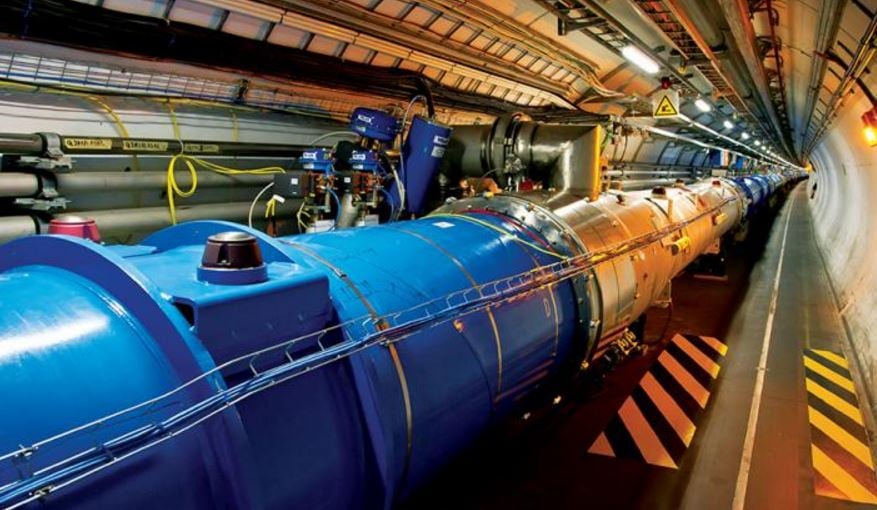 The Large Hadron Collider (LHC) is the world’s largest and most powerful particle accelerator (Image: CERN)
If neutralinos exist, they are potential candidates for the dark matter required to explain how galaxies behave as well as the evolution of the Universe.
Professor Joel Goldstein, leader of the Bristol Compact Muon Solenoid activities said:
“It has been very exciting to see the LHC switch on and deliver physics data so quickly, and the physicists working on these analyses here in Bristol and around the world have done a remarkable job of producing and cross-checking their results in such a short time. In a few months we will have even more data, and perhaps even the first signs of something truly new.”
Video – What is the Large Hadron Collider?
In this video, Fermilab’s Dr. Don Lincoln explains both some of the absolutely amazing scientific and engineering properties of this modern scientific wonder.
