
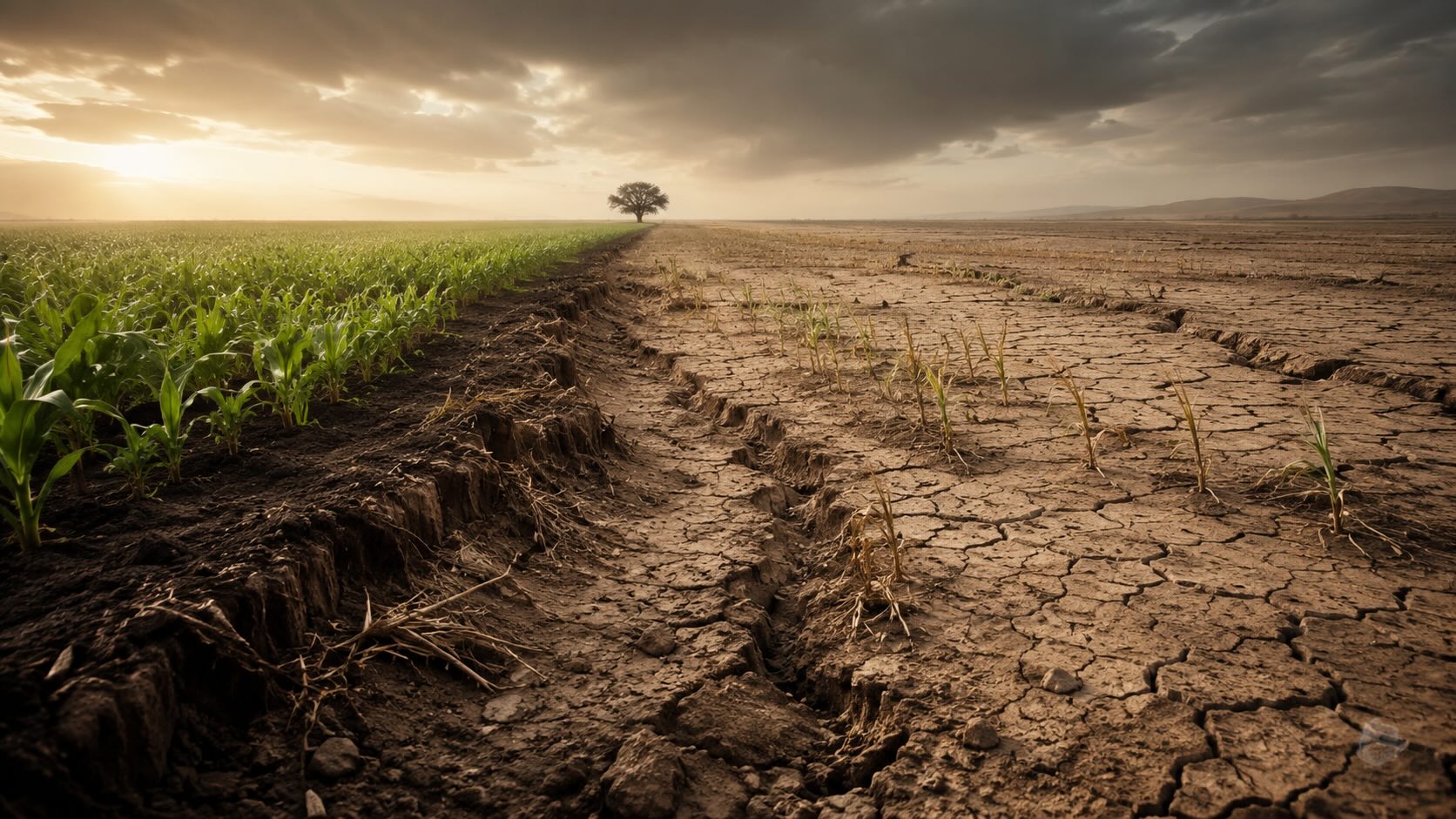
A global study found that farmland with more erosion, compaction, water loss and declining soil carbon tended to have a wider gap between the crops it produced and the amount it could realistically produce.
Soil rarely appears on a company balance sheet, but it is one of a farm’s main productive assets.
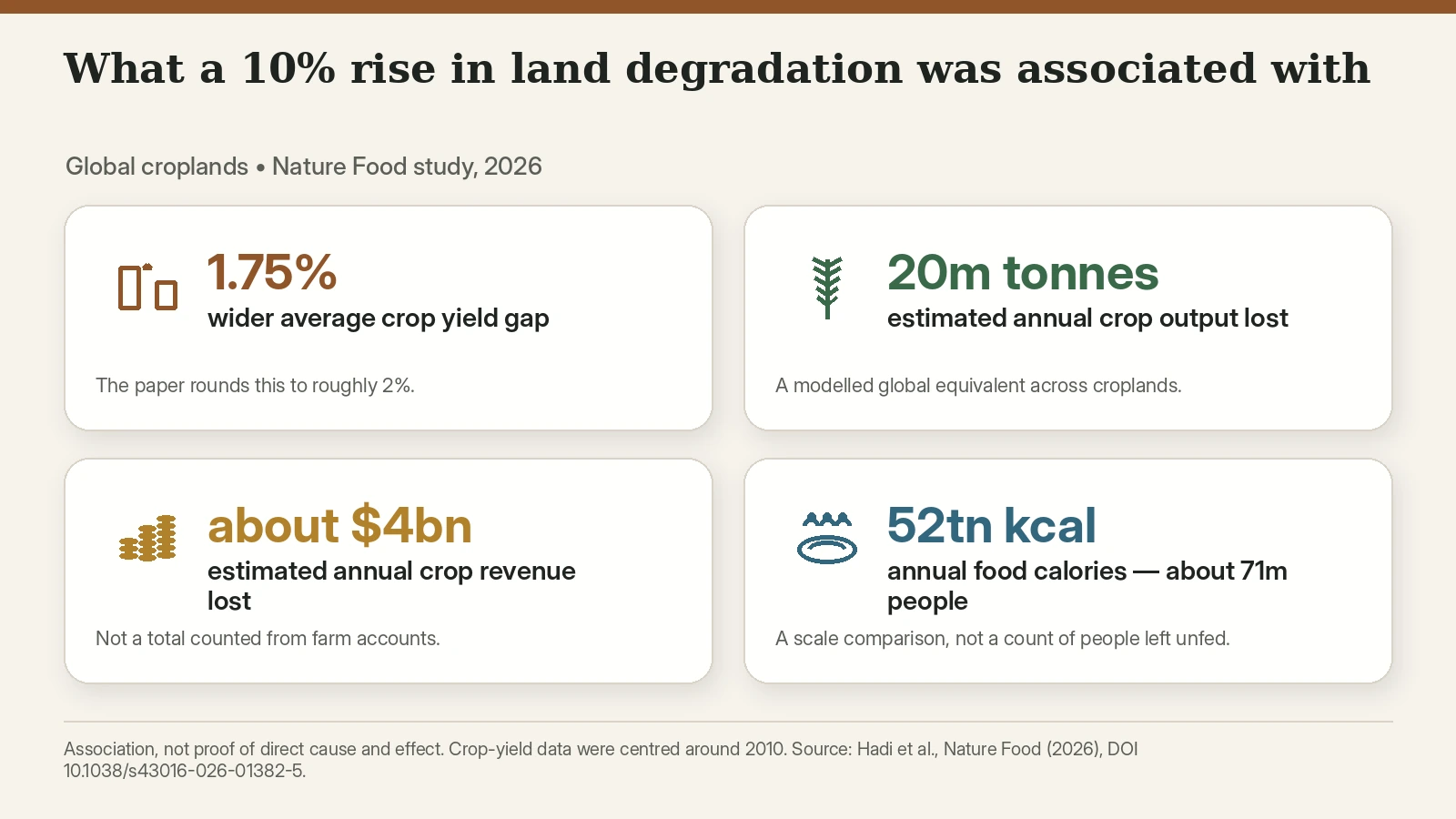
New research published in Nature Food found that a 10% increase in land degradation was associated with a 1.75% increase in the average crop yield gap. The researchers rounded this to roughly 2%.
A yield gap is the difference between what a farm currently produces and what similar farms could realistically produce under comparable local conditions.
For example, if farms in an area could reasonably produce 10 tonnes of a crop per hectare but currently produce eight tonnes, the yield gap would be 20%.
The researchers did not compare farms with an impossible laboratory maximum. They estimated attainable yields using the higher yields already being achieved by farmers working under similar climate and soil conditions.
The model pointed to large annual losses
The researchers converted the wider yield gap into estimates of lost crop production, revenue and food calories.
Across global cropland, a 10% increase in the study’s land-degradation measure was associated with annual losses of approximately:
- 20 million tonnes of crop production
- US$4.3 billion in crop revenue
- 52 trillion food calories
The calorie total is roughly equal to the annual food-energy needs of 71 million people, assuming 2,000 calories per person each day. The United Nations University also highlighted these estimates when the study was released.
This does not mean that exactly 71 million people are currently going without food because of land degradation. Crops may be exported, fed to animals, processed into other products or lost before they reach consumers. The comparison simply shows the size of the modelled calorie loss.
The US$4.3 billion figure is also a modelled estimate. It is not money counted directly from farm accounts, and it should not be treated as a measure of the full cost of land degradation in 2026.
How the study worked
The international research team divided the world’s cropland into squares measuring 10 kilometres by 10 kilometres. Its analysis covered more than 405,000 of these areas.
The crop data covered ten major crops, including wheat, maize, rice, barley, soybeans and sugar cane. Together, the ten crops account for approximately 83% of global crop calories.
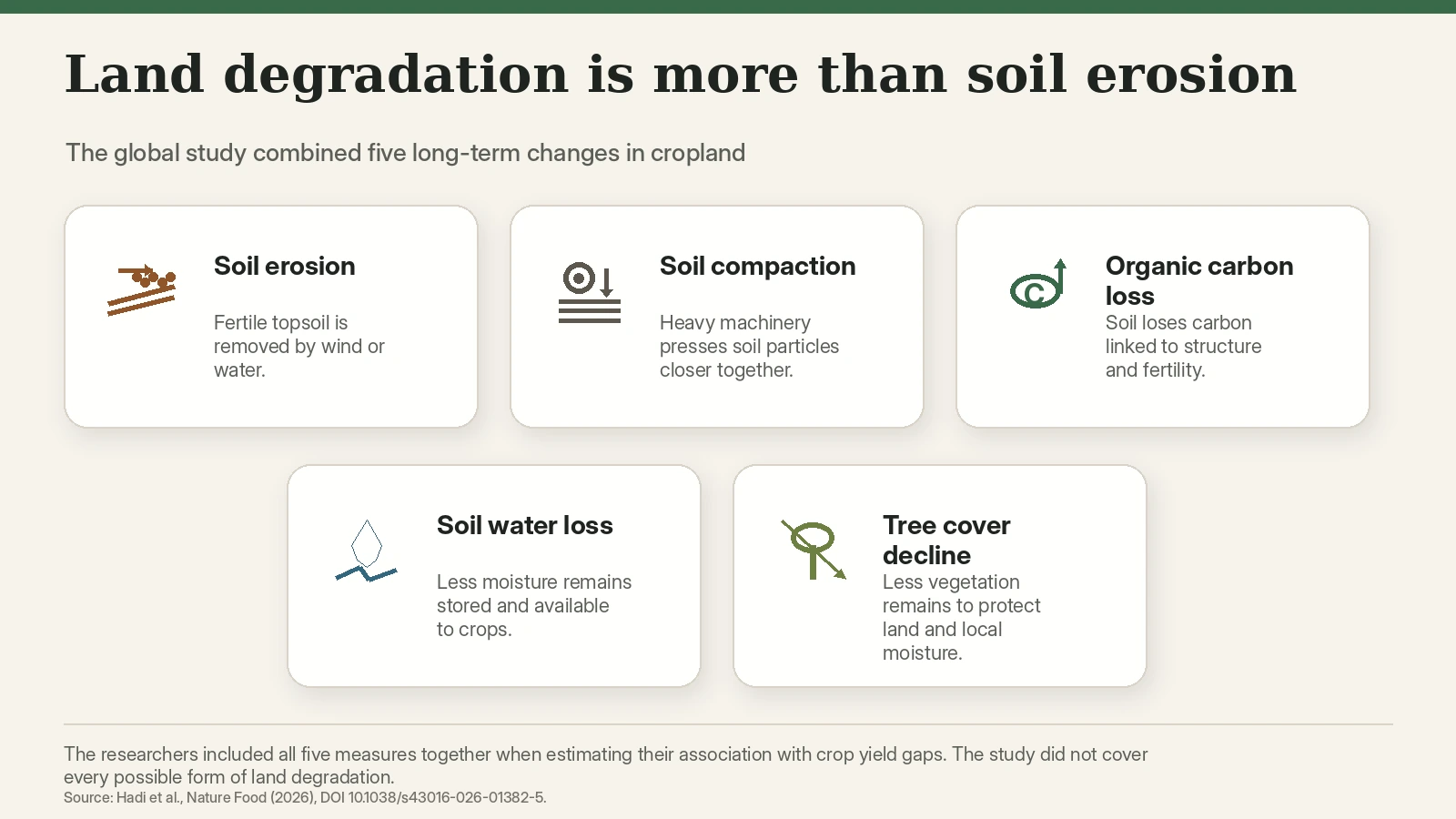
The researchers examined five forms of long-term land degradation:
- Soil erosion
- Soil compaction
- Loss of soil organic carbon
- Reduced soil moisture
- Loss of tree and vegetation cover
Soil compaction can occur when heavy agricultural machinery repeatedly travels across fields. Organic carbon helps support soil structure, fertility and water retention. Erosion removes fertile topsoil, while lower soil moisture leaves crops with less water during their growing period.
The model also accounted for other factors that can affect crop production, including climate, terrain, soil type, fertilizer, irrigation, pesticides, labour, machinery, income and institutional conditions.
A University of Bonn summary of the research explains that the team compared places with similar temperatures and rainfall before examining how land condition related to the difference in yields.
Highly productive regions were not protected
One of the more surprising findings was that land degradation was not limited to poor or low-output farming regions.
The strongest links between degradation and wider yield gaps appeared in parts of northern and southern India, northeastern China, the US Midwest, Central America and northern Argentina.
India, China and the United States were among the countries with the largest estimated production losses in absolute terms. Smaller countries, including Lesotho and Botswana, faced larger losses when measured as a percentage of their own crop production.
The researchers found that some intensive farming regions may be particularly sensitive to even small declines in soil quality.
These farms already use machinery, fertilizer, irrigation and other methods to remove many of the usual limits on production. Once those problems have been managed, soil condition can become one of the main factors preventing yields from rising further.
The study’s authors describe some highly productive systems as having been optimized for maximum output rather than resilience. A relatively small change in soil conditions may therefore have a noticeable effect.
Soil damage can affect profits before production collapses
Farmers can sometimes compensate for poorer soil by applying more fertilizer, using more water or carrying out additional work in the field.
The new study accounted for differences in agricultural inputs, but it did not calculate how much extra farmers may be spending to maintain their output.
That creates a possible hidden cost. A farm may continue producing a similar amount while using more water, fertilizer, fuel, machinery or labour. Revenue may appear stable even as its profit margin becomes smaller.
This part is a business implication of the research rather than a result directly measured by the study.
Why food companies, lenders and insurers should care
A food manufacturer that depends heavily on one farming region may face supply problems if the land in that region becomes less productive.
A bank lending money to farms depends on those farms earning enough income to repay their debts. Lower output or higher production costs can weaken that ability.
Agricultural insurers may also need to consider the condition of the land alongside weather risks. Degraded soil may hold less water, lose more topsoil during heavy rain or give crops less protection during dry periods.
For farmland investors, soil condition is part of the long-term productive value of the asset. Short-term crop prices can change quickly. Repairing erosion, compaction or lost soil carbon can take much longer.
Companies connected to agriculture may therefore benefit from monitoring soil condition in the same way they already monitor rainfall, water availability, energy costs and transport risks.
The research has important limits
The study found a strong association between land degradation and wider yield gaps. It did not prove that a particular amount of degradation directly caused a particular reduction in output.
The analysis compared conditions across different locations at one broad point in time. Even though the researchers controlled for many possible differences, unknown factors may still have influenced the results.
The crop-yield data were centred around 2010 and used an average covering 2008 to 2012. The researchers used this period because it offered a globally consistent set of ground-based crop data and reduced the effect of unusually good or bad individual years.
The findings describe long-term relationships. They are not an estimate of the amount of crops being lost during the current year.
The study also did not include every form of land degradation. Soil salinity and nutrient imbalances were excluded because suitable global data were not available at the required level of detail.
A 10% increase in degradation also does not mean that 10% more farmland became unusable. It refers to a 10% increase in the strength of the combined degradation measures used in the model.
Land degradation can be slowed
A separate Nature Food study published in May examined approximately 83 million measurements of cropland condition between 2001 and 2019.
It found that public agricultural and environmental policies improved cropland conditions globally by at least 2% and possibly as much as 5% on average.
Payments that rewarded farmers for more sustainable practices and regulations aimed directly at soil and land use produced the strongest estimated improvements. The results varied widely between countries and depended partly on government effectiveness, enforcement and policy funding.
The two studies suggest that soil decline is a measurable business risk, but it is not necessarily permanent or unavoidable.
For businesses that buy, finance or insure agricultural production, soil health is part of production capacity. Its condition can affect crop volumes, operating costs and the reliability of future supplies.
